
Low Water Activity Tablets: Why Effervescent and ODT Formulas Need Tighter Control
Effervescent tablets and orally disintegrating tablets (ODTs) are two of the least forgiving dosage forms when it comes to excipient moisture. Getting low water activity tablets right in these formats isn’t optional polish — it’s often the difference between a stable shelf life and a product that fails before it reaches the consumer.
Why effervescent formulas are especially exposed
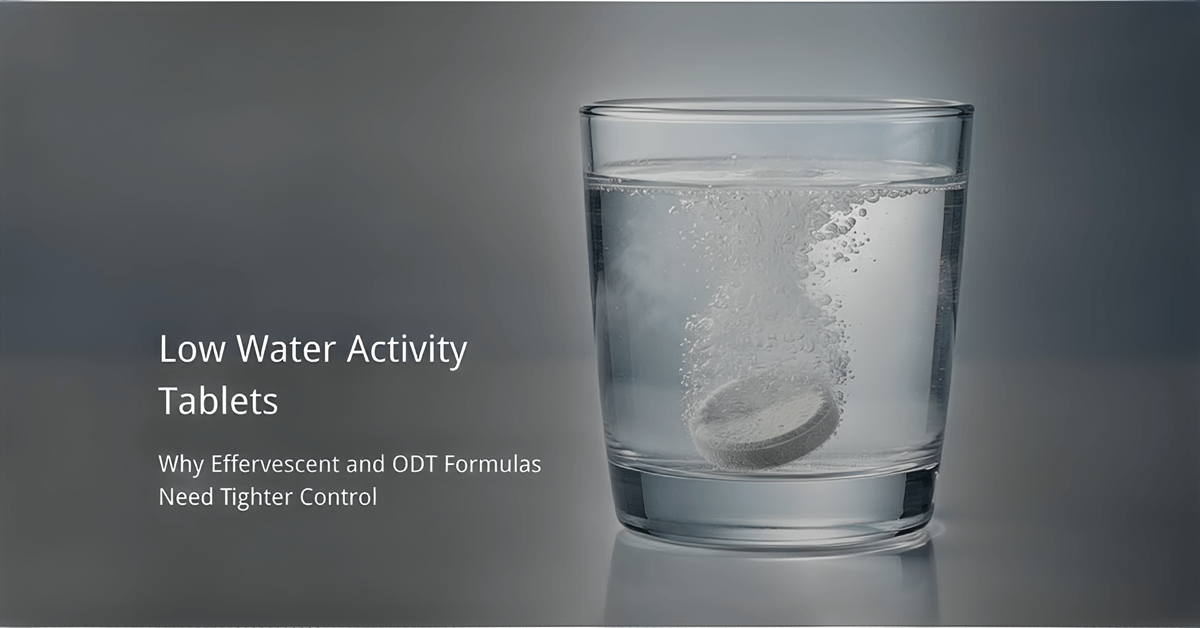
Effervescent systems rely on an acid-carbonate reaction that any premature moisture exposure can trigger during storage, long before the consumer ever opens the package. A single point of moisture ingress — during compression, packaging, or storage — can start that reaction early, degrading tablet integrity and reducing the dose delivered when the product is finally used. This makes low water activity tablets a baseline requirement for the category, not an optimization.
Why ODTs carry their own version of the same risk
ODTs are formulated for rapid disintegration, which generally means porous, low-density excipients — a structure that is inherently more exposed to ambient humidity during processing than a dense, standard-compression tablet. The same porosity that makes an ODT dissolve quickly in the mouth also makes it dissolve (or degrade) more readily in a humid production room if the excipients aren’t chosen carefully.
What formulators typically specify
Direct-compression mannitol or isomalt are the most common primary fillers for both formats, chosen specifically for high CRH and low intrinsic Aw. Processing-room relative humidity is generally controlled based on the CRH of the chosen filler rather than a generic humidity target — a facility running mannitol-based formulations can tolerate somewhat higher ambient humidity than one running a lower-CRH filler like isomalt. Packaging barrier selection — foil blister, desiccant sachets — is matched to the excipient’s CRH rather than applied as a one-size-fits-all default across every product in a portfolio.
The branded-excipient default, and why it persists
Many effervescent and ODT formulators default to internationally branded excipients for low water activity tablets — not necessarily because Chinese-sourced equivalents can’t meet the same Aw and CRH performance, but because comparable water activity data simply isn’t consistently published for most Chinese-origin material. That’s a data availability gap rather than a performance gap in most cases, and it’s the gap that keeps formulators from evaluating alternative suppliers on equal technical footing.
Comparing mannitol and isomalt for direct compression
If moisture resistance is the dominant requirement, mannitol is generally the more conservative choice, given its higher CRH. If mouthfeel and texture matter as much as moisture resistance — a common consideration for ODTs targeting pediatric or geriatric patients — isomalt is often preferred, with the tradeoff of a somewhat narrower humidity margin. Our detailed comparison in Low Aw Sugar Alcohols Compared: Mannitol vs Erythritol vs Isomalt breaks down the tradeoffs further.

Closing the data gap
Formulators evaluating alternative suppliers for low water activity tablets generally need three things upfront: Aw and CRH at a stated temperature and equilibrium method, particle size distribution suited to direct compression, and compendial compliance documentation (ChP, USP-NF, EP, JP as applicable). Suppliers who can provide all three on request are evaluable on the same terms as an established branded excipient, regardless of origin.
Esubio sources mannitol, erythritol, and isomalt from Chinese manufacturers with Aw and CRH data disclosed on the product page, so you can evaluate an alternative supplier on the same technical terms you’d use for any branded excipient. Browse our Low Water Activity Excipients range or request a side-by-side spec comparison for your current formulation.
References
- USP General Chapter <1112>, Application of Water Activity Determination to Nonsterile Pharmaceutical Products — https://doi.usp.org/USPNF/USPNF_M402_01_01.html
- Food Safety Magazine, “Water Activity: A New Food Safety Tool” — https://www.food-safety.com/articles/3960-water-activity-a-new-food-safety-tool
- Wikipedia, “Water activity” — https://en.wikipedia.org/wiki/Water_activity