
7 Essential Certification Requirements for Global Ingredient Sourcing
Certification requirements are often treated as something to check before a product launch.
That can be too late.
A formulation may already be finalized, samples may have been approved, packaging may be designed, and a launch date may already be planned. Then a customer asks for Halal certification. A retailer requires Kosher documentation. An organic product needs an acceptable organic certification route. A brand wants a Non-GMO claim supported by a recognized verification program.
The ingredient may work perfectly from a formulation perspective, but the existing supplier cannot provide the required documentation.
At that point, the problem is no longer simply certification.
It becomes a sourcing problem.
The key question is therefore not “Which certificates are popular?” It is:
Which certification requirements apply to this product, this market, this customer and this specific ingredient?
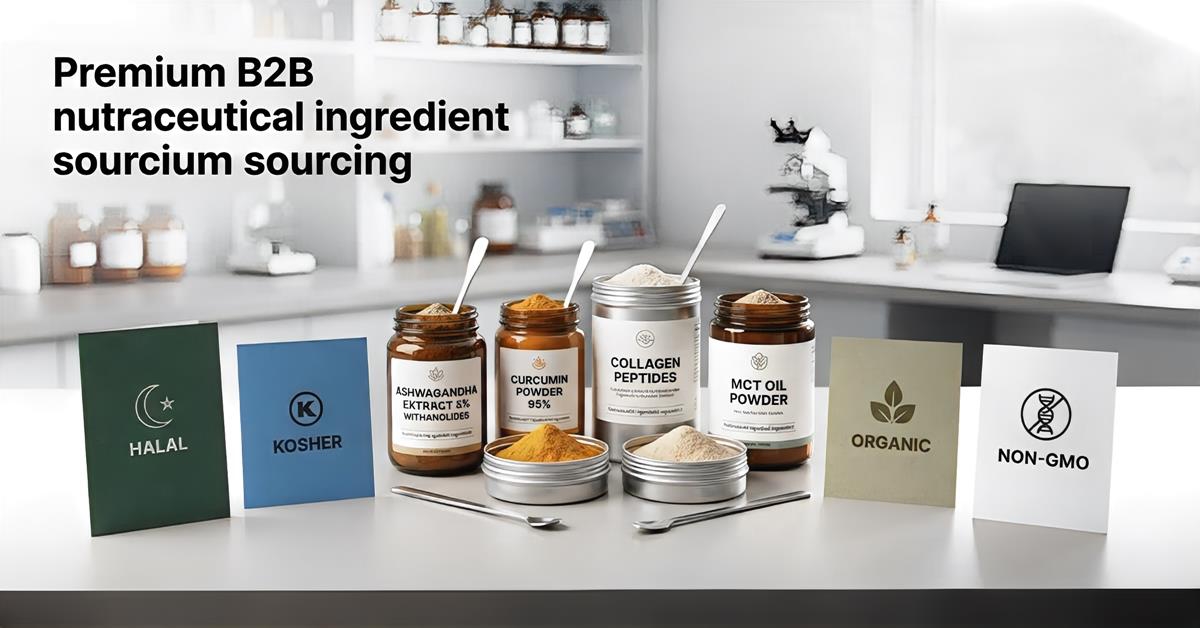
Why Certification Requirements Should Be Defined Before Sourcing
Certification is not always a characteristic of a finished product that can simply be added at the end.
For many ingredients, the relevant status is connected to the specific raw material, supplier, manufacturing site, production process and certification body.
Kosher certification provides a good example. OU Kosher explains that certification involves reviewing ingredients and their sources, production processes and facilities. Its ingredient approval system can identify the specific ingredient supplier and requirements associated with an approved material.
Halal certification can involve similar supply-chain considerations. JAKIM’s Malaysian Halal certification materials, for example, require information on ingredients and ingredient suppliers, and certain raw materials may require halal certificates or product specifications.
This means that changing the supplier after formulation approval may not be a simple purchasing decision.
The replacement material may need to be reviewed again.
That is why certification should be considered during ingredient selection, not only during final compliance review.
1. Halal: Check the Market and Certification Body, Not Just the Logo
Halal is particularly important for products intended for Muslim consumers, but the exact certification expectations can vary by market and customer.
A common sourcing mistake is to ask a supplier:
“Is this ingredient Halal?”
and accept a simple yes or no.
A more useful question is:
Which certification body issued the certificate, what product or facility does it cover, and is that certification accepted in the target market?
This distinction matters.
Malaysia, for example, operates a formal halal certification system through JAKIM and maintains a system for recognizing foreign halal certification bodies. JAKIM has also published procedures showing that the status of raw materials and ingredients is part of the certification process.
The status of a certification body can also change. JAKIM has published notices concerning the withdrawal of recognition of specific foreign halal certification bodies.
For an ingredient buyer, this creates several practical questions:
Is the certificate current?
Does it cover the exact ingredient?
Does it identify the relevant manufacturer or supplier?
Is the certifying body accepted by the target market or customer?
Are the certificate details consistent with the material being supplied?
The last point is especially important for ingredients sourced through distributors or traders.
A valid certificate does not automatically mean that every material with a similar product name is covered by that certificate.
2. Kosher: The Approved Ingredient and Supplier Both Matter
Kosher certification is another area where buyers can underestimate the importance of the specific source.
For a Kosher-certified finished product, it may not be enough for an ingredient to be generically described as “Kosher.”
The approved ingredient, supplier and certification status need to correspond to the requirements of the certification program.
OU Kosher’s certification process includes detailed review of ingredients and sources of supply. Its Schedule A system is used to identify approved ingredients and suppliers for a certified operation.
OK Kosher similarly provides a receiving system in which approved ingredients may have requirements related to the specified source, certification, packaging mark or lot-specific documentation.
This creates an important sourcing rule:
Do not assume that changing the supplier of a Kosher ingredient is technically neutral.
Even if the ingredient name, assay and appearance remain the same, the new supplier may not have the same Kosher approval.
This is one reason certification information should be included in supplier qualification and not treated as a document collected after the purchase order is issued.

3. Organic: “Organic” Is a Regulated Claim
Organic certification requires even more caution because “organic” is not simply a quality statement.
In the United States, USDA organic regulations establish specific categories and requirements for products making organic claims. The USDA explains that certified organic products must be produced and handled according to the applicable organic regulations or an accepted equivalence arrangement.
For example, USDA recognizes categories including 100% Organic, Organic, and Made with Organic ingredients, each with different composition and labeling requirements.
For international sourcing, the situation can become more complicated.
The United States and European Union have an organic equivalence arrangement, but it contains specific conditions regarding production, processing, labeling and trade documentation.
USDA also implemented the Strengthening Organic Enforcement rule, which introduced additional certification and import documentation requirements. Certified organic shipments entering the United States generally require an electronic NOP Import Certificate.
For buyers, the practical lesson is simple:
“Organic” should never be treated as a generic supplier claim.
Ask:
Which organic standard?
Which certification body?
Which operation is certified?
Does the certificate cover the specific ingredient?
Is the certificate current?
Does the intended market accept that certification route?
And, where applicable, what import or transaction documentation is required?
4. Non-GMO: Clarify What “Non-GMO” Actually Means
Non-GMO can be another source of confusion because a customer may use “Non-GMO” as a commercial requirement without specifying the verification standard.
A supplier may provide a Non-GMO statement.
Another may provide a manufacturer’s declaration.
Another may have certification or verification under a specific third-party program.
These are not necessarily equivalent.
The Non-GMO Project, for example, operates a formal Product Verification Program based on its own standard and verification requirements.
Therefore, before sourcing a Non-GMO ingredient, buyers should clarify:
Is a supplier declaration sufficient?
Is third-party verification required?
Does the customer require a specific program?
Does the requirement apply to the ingredient, the finished product, or both?
What supporting documentation is required?
This distinction can prevent a common problem: purchasing an ingredient that is described commercially as Non-GMO but does not satisfy the customer’s specific verification requirement.
5. Certification Is Often Ingredient-Specific
One of the most important principles in certification-based sourcing is that certification should be connected to the actual material.
Consider a botanical extract.
The supplier may have a Halal certificate for one product but not another. A manufacturer may have an organic certificate, but the certificate may cover only certain products, facilities or handling activities. A Kosher certificate may depend on the approved source and ingredient listing.
This is why a certificate should be reviewed together with the commercial and technical documents.
At minimum, buyers should compare:
Ingredient name
Manufacturer
Supplier
Product code where applicable
Certification body
Certificate number
Validity period
Scope of certification
Relevant site or facility
Batch or lot information where applicable
The purpose is not to create unnecessary administrative work.
It is to make sure the certificate actually describes the material being purchased.
6. Certification Requirements Can Affect Supplier Selection
Suppose R&D has already approved a botanical extract based on taste, assay, solubility and formulation performance.
Then procurement discovers that the customer requires Halal and the approved supplier does not have an acceptable certificate.
There are now several possible options:
Find another supplier with an equivalent specification and the required certification.
Ask the existing supplier whether a compliant certified source is available.
Re-evaluate the formulation using another raw material.
Change the target market or customer requirement, if commercially possible.
Each option has a cost.
The new supplier may have a higher MOQ.
The replacement material may have a different sensory profile.
The sample may need to be tested again.
The lead time may increase.
The formulation may require adjustment.
This is why certification is not simply a compliance issue. It can directly affect procurement strategy, cost and product development timelines.
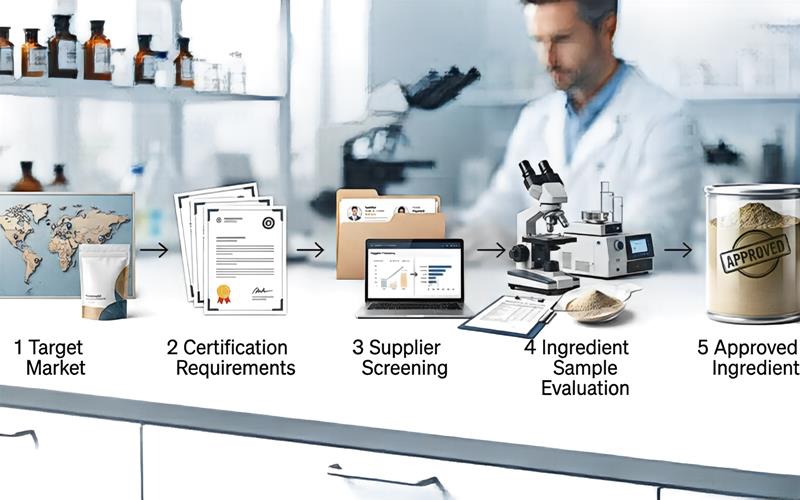
7. Build Certification Requirements Into the Initial Sourcing Brief
A more reliable approach is to include certification requirements when the ingredient is first sourced.
Instead of sending:
“Please quote Green Tea Extract.”
A better sourcing request might specify:
“Green Tea Extract for a European market application. Please provide available organic certification, Non-GMO documentation, COA, specification, MOQ and lead time.”
The same principle applies to other markets.
For a Middle Eastern project, the buyer may need to identify the required Halal certification route.
For a Kosher project, the customer may require a specific Kosher agency or documentation format.
For an organic product, the buyer needs to identify the relevant organic standard and intended labeling claim.
For a Non-GMO project, the buyer should clarify whether a supplier declaration or third-party verification is required.
The earlier these requirements are defined, the more suppliers can be screened before samples are approved.
What Buyers Should Ask Before Approving a Certified Ingredient
A simple checklist can prevent many late-stage problems.
Ask:
What market is the finished product intended for?
What customer or retailer requirements apply?
Which certification standard is required?
Does the certification cover the exact ingredient?
Does it cover the actual manufacturer and facility?
Is the certificate current?
Is the certifying body accepted by the target market or customer?
Can the supplier provide the certificate together with the COA and specification?
Can the same certification status be maintained if the supplier changes?
Are additional import or transaction documents required?
These questions are particularly important when sourcing through multiple suppliers or when working with small and flexible order quantities.
Certification Should Be Part of Ingredient Sourcing, Not a Last-Minute Check
A technically suitable ingredient is not necessarily a commercially suitable ingredient.
For an international nutrition product, the raw material may need to satisfy several requirements at the same time:
Technical fit + Quality requirements + Documentation + Certification + Market requirements + Commercial feasibility
Missing any one of these can create additional work later.
At Esubio, we support ingredient sourcing for projects serving the US, EU, Asia-Pacific, Australia & New Zealand, and Middle East markets. Depending on the ingredient, supplier and target market, available documentation and certification support may include Non-GMO documentation, organic certification, Halal certification and other relevant quality documents.
Availability is always verified on an ingredient- and supplier-specific basis rather than assumed from the ingredient name.
We also provide relevant documents such as COA, MSDS/SDS and product specifications for supplied materials.
The practical goal is simple:
Identify the market requirements first, then source the ingredient against those requirements.
This reduces the risk of reaching the final stage of product development only to discover that the approved raw material cannot support the intended market claim or customer requirement.
Certification is not always the first thing that determines whether an ingredient works in a formulation.
But when certification is required, it can determine whether that ingredient can move from the laboratory into the intended market.