
7 Powerful Signs You Need Custom Ingredient Specifications
Custom ingredient specifications become important when a standard ingredient almost works—but not quite.
In many formulation projects, the problem is not finding an ingredient. The problem is finding an ingredient that actually fits the application. The standard grade may have the right botanical source, active content, or basic quality parameters, but its particle size, solubility, carrier system, bulk density, flowability, or other physical characteristics may not work well in the final formulation.
This is where custom ingredient specifications can make a practical difference.
Most functional ingredients are supplied according to established commercial specifications. That makes sense for common applications because standard grades are designed to serve a broad range of customers. But a formulation is not a generic application. A powder intended for tablets has different requirements from one intended for a ready-to-drink beverage. An ingredient for a probiotic blend may need different moisture or water activity characteristics from the same ingredient used in a dry capsule.

The key question is not simply whether a supplier has the ingredient. It is whether the ingredient can be supplied in a specification that works for your actual application.
1. The Standard Grade Repeatedly Fails in Formulation Trials
One of the clearest signs is repeated failure during R&D trials.
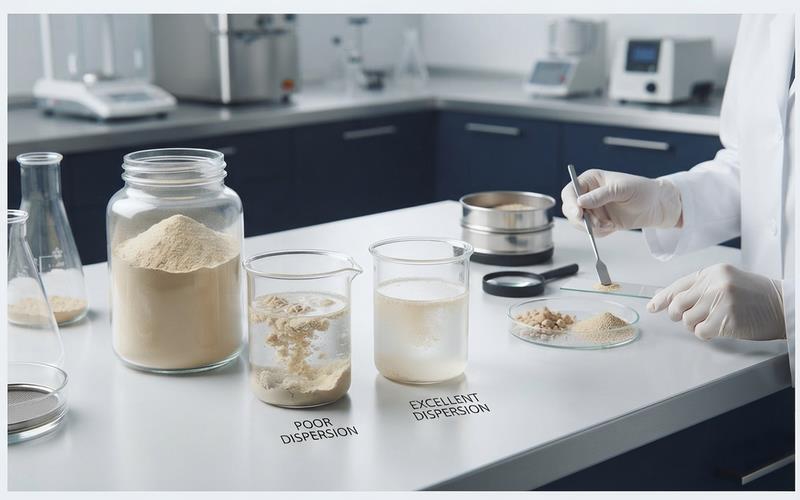
Suppose a development team is working with a botanical extract for an instant beverage. The active content meets the target, the microbiological results are acceptable, and the documentation looks complete. Yet the powder disperses poorly, produces excessive sediment, or creates unacceptable turbidity.
The team may try another supplier offering the same ingredient. The problem improves slightly but does not disappear.
At this point, continuing to compare standard grades may not solve the underlying problem.
The issue may be related to physical properties rather than the identity or potency of the ingredient. Depending on the material and application, particle size distribution, surface characteristics, carrier selection, processing method, or other material attributes may influence how the ingredient behaves in the finished formulation.
For certain pharmaceutical materials, FDA guidance specifically recognizes that particle size can affect dissolution, bioavailability, or stability, illustrating why physical characteristics can become meaningful quality attributes when they are relevant to product performance.
For dietary supplement development, the same principle should be approached from a formulation perspective: define the material characteristics that actually matter for the intended use rather than assuming that a standard commercial grade will automatically perform well.
2. Particle Size Is Creating Processing Problems
Particle size is one of the most common reasons a standard ingredient may need a different specification.
A powder that works well in one application may behave very differently in another. For example, a formulation may require a narrower particle size range to improve blending consistency, reduce segregation, improve dispersion, or support a particular manufacturing process.
Tablet and capsule applications can also be sensitive to powder flow, bulk density, compressibility, and particle-size distribution.
The important point is that asking for “fine powder” or “80 mesh” may not be enough.
A useful sourcing specification should define the requirement in a way that can be tested and reproduced. Depending on the project, this may include:
- Target particle size or mesh range
- Particle size distribution
- Bulk density
- Flowability
- Moisture or water activity
- Solubility or dispersibility
- Carrier or excipient system
- Appearance and color
- Assay or marker-compound requirements
Not every parameter needs to become a specification. The objective is to identify the attributes that are genuinely connected to formulation performance.
3. Solubility or Dispersibility Is Limiting the Final Product
Another strong signal is when an ingredient meets its standard specification but does not behave well in the final dosage form.
This is especially relevant for powdered ingredients used in beverages, stick packs, sachets, instant drinks, and other products where rapid dispersion is important.
A standard extract may have excellent assay results but still produce poor dispersibility. Simply increasing the dosage or trying another supplier may not solve the problem.
The formulation may require a different carrier, processing approach, particle-size profile, or physical form.
This distinction matters because “solubility” and “dispersibility” are not always interchangeable. Some botanical powders are not truly soluble but can still be formulated to disperse more effectively. The right target therefore depends on the product and the way the ingredient is expected to behave.
Instead of telling a supplier only that the ingredient “needs better solubility,” it is more useful to explain the actual application:
What is the dosage?
What is the final serving format?
What liquid is being used?
What temperature and mixing conditions apply?
How quickly does the ingredient need to disperse?
Is some sediment acceptable?
Is clarity required?
These details can turn a vague request into a workable custom ingredient specification.
4. The Carrier Is Affecting Your Formulation
Sometimes the active ingredient itself is not the main problem. The carrier is.
Many functional ingredients are supplied with carriers or processing aids to improve handling, stability, flow, dispersion, or manufacturing performance. However, the carrier used in a standard commercial grade may not be compatible with a particular formulation.
For example, a customer may have restrictions related to sugar, starch, allergen status, label declarations, dietary preferences, or a specific formulation system.
In this situation, asking for the same active ingredient with a different carrier may be more productive than searching for an entirely different ingredient.
The specification should therefore describe both the functional target and the formulation restrictions.
A useful sourcing brief might say:
“Botanical extract, standardized to X% marker compound, powder form, carrier-free preferred, or suitable alternative carrier acceptable, target particle size X–Y mesh, intended for beverage application.”
That gives a sourcing partner something concrete to work with.
5. The Ingredient Works in R&D but Not at Production Scale
A standard ingredient can sometimes perform acceptably in a laboratory trial but create problems during pilot or commercial production.
Small-scale processing does not always reproduce the mixing, conveying, feeding, compression, filling, or blending conditions of larger equipment.
For example, a powder may appear easy to handle during a bench-scale trial but show poor flow when fed through production equipment. Another ingredient may blend adequately in a small container but segregate during larger-scale handling.
This is why custom ingredient specifications should not be based only on laboratory convenience.
The development team and procurement team should identify which material attributes are likely to affect scale-up.
FDA’s quality framework for dietary supplements emphasizes scientifically valid specifications and testing for dietary ingredients and components, reinforcing the importance of defining appropriate specifications rather than relying only on a supplier’s generic commercial description.
The goal is not to create an unnecessarily complicated specification. It is to control the attributes that matter to consistent production.
6. Several Standard Suppliers Are “Close,” but None Actually Fits
This is one of the strongest signs that it is time to change the sourcing approach.
You may already have three or four suppliers. Supplier A has the right assay but poor dispersion. Supplier B has better particle size but the wrong carrier. Supplier C has an acceptable carrier but a higher moisture level. Supplier D looks promising but cannot meet the required MOQ.
At this stage, adding another standard supplier may simply produce another slightly different compromise.
Instead, consolidate the requirements into one technical sourcing brief.
For example:
Ingredient: Botanical extract
Application: Ready-to-drink beverage
Active content: X% minimum
Particle size: X–Y mesh
Solubility/dispersibility: defined application target
Carrier: specific or acceptable alternatives
Moisture: maximum X%
Water activity: maximum X, if relevant
MOQ: X kg
Required documents: COA, MSDS/SDS, specification
This allows a sourcing partner to search by specification rather than by ingredient name alone.
7. Your Specification Needs to Reflect the Final Application
The most important sign is also the simplest: the ingredient is being evaluated without enough consideration of its final use.
An ingredient specification should answer a practical question: what characteristics does this material need to have so that the finished product can be manufactured consistently?
That does not mean every formulation needs a custom ingredient.
Standard grades remain the most efficient choice when they already meet the application’s requirements. Custom specifications become worthwhile when one or more critical attributes repeatedly prevent successful formulation, processing, scale-up, or commercial production.
The decision should therefore be based on evidence from development trials, not simply on the assumption that a customized material must be better.

How to Define a Custom Ingredient Specification
Before asking a supplier to develop or source a custom grade, separate the requirements into three levels.
First, define the non-negotiable requirements. These may include active content, ingredient identity, allergen restrictions, regulatory requirements, prohibited carriers, or a specific particle-size range.
Second, identify preferred characteristics. These might include improved dispersion, a narrower particle-size distribution, lower moisture, better flowability, or a particular carrier.
Third, define acceptable alternatives.
For example, if the preferred carrier is one material but two other carriers are acceptable, tell the supplier. If the target particle size is preferred but a wider range can work during initial trials, make that clear.
This distinction gives suppliers more room to find a technically suitable and commercially realistic solution.
It also prevents a common procurement problem: creating a specification so narrow that only one supplier can theoretically meet it, making the project unnecessarily expensive or difficult to scale.
Custom Does Not Always Mean Manufacturing From Scratch
“Custom specification” does not necessarily mean developing a completely new ingredient from zero.
In many sourcing projects, the requirement can potentially be addressed by finding an existing grade from another supplier, adjusting a physical parameter, selecting a different carrier system, or identifying a supplier whose existing production specification is already closer to the application.
This is particularly relevant when working with a sourcing partner rather than approaching only one manufacturer.
A broader supplier network can make it possible to compare different production capabilities, standard grades, processing options, and MOQ structures before deciding whether true customization is necessary.
The key is to distinguish between a genuinely new development project and a sourcing problem that can be solved by finding the right existing specification.
What Should You Send a Supplier?
A good custom sourcing request should contain enough technical information to allow a supplier to evaluate feasibility.
At minimum, provide:
- Ingredient name and preferred source
- Intended application
- Active or marker-compound requirement
- Particle-size requirement
- Solubility or dispersibility target
- Carrier requirements
- Moisture or water-activity limits when relevant
- Packaging requirements
- Target sample quantity
- Expected commercial volume
- Required certifications or documentation
- Destination market
The more clearly the application is defined, the less time is wasted exchanging generic quotations for materials that were never technically suitable.
For quality and sourcing purposes, documentation also matters. Supplier records, specifications, testing results, and batch information should be traceable to the material being supplied. FDA guidance for regulated ingredient supply chains similarly emphasizes documented specifications, testing, supplier information, and material traceability.
When Standard Is Enough—and When Custom Is Worth Exploring
The purpose of custom ingredient specifications is not to make every ingredient more complicated.
If a standard grade works, use it.
If the standard grade repeatedly creates a formulation or manufacturing problem, identify the specific attribute causing the problem.
If that attribute can be changed without compromising the ingredient’s intended quality, regulatory suitability, or commercial feasibility, then a custom specification may be worth exploring.
The most efficient sourcing process is therefore not “find the most customized ingredient.” It is “find the simplest specification that reliably meets the application’s needs.”
For brands, manufacturers, and R&D teams, this can save considerable time. Instead of testing standard ingredients indefinitely, the project can move toward a clearly defined technical requirement and a targeted supplier search.
At Esubio, we work with functional ingredients and special sourcing requirements where a standard commercial grade may not fully match the application. Custom requirements can include particle size, solubility or dispersibility, carrier preferences, low water activity, and other application-related specifications, depending on ingredient and supplier capability.
We can evaluate the requirement, screen available supplier options, and coordinate samples and documentation such as COA, MSDS/SDS, and product specifications.
When a standard ingredient is always “almost right,” the next question should not simply be which supplier has another standard grade.
The better question is: which specification does the application actually need?
That is often where a more efficient sourcing solution begins.
References
- FDA — Q6A Specifications: Test Procedures and Acceptance Criteria for New Drug Substances and New Drug Products
FDA Q6A Specifications - FDA — Current Good Manufacturing Practices (CGMPs) for Food and Dietary Supplements
FDA CGMPs for Food and Dietary Supplements - FDA — Dietary Supplement Compliance Program
FDA Dietary Supplement Compliance Program - FDA — Q7A Good Manufacturing Practice Guidance for Active Pharmaceutical Ingredients
FDA Q7A GMP Guidance