
Choosing Low Aw Excipients for Probiotic Formulations
Selecting low Aw excipients for probiotics is an important part of developing stable powder and capsule formulations. A probiotic raw material may have a suitable specification on its own, but the finished blend can behave differently after the addition of carriers, prebiotic fibers, sweeteners, or other functional ingredients.
For R&D teams and supplement manufacturers, the challenge is not simply finding an excipient with a low water activity result. It is identifying a material that meets the formulation’s technical requirements while maintaining acceptable flowability, blending performance, process compatibility, and storage stability.
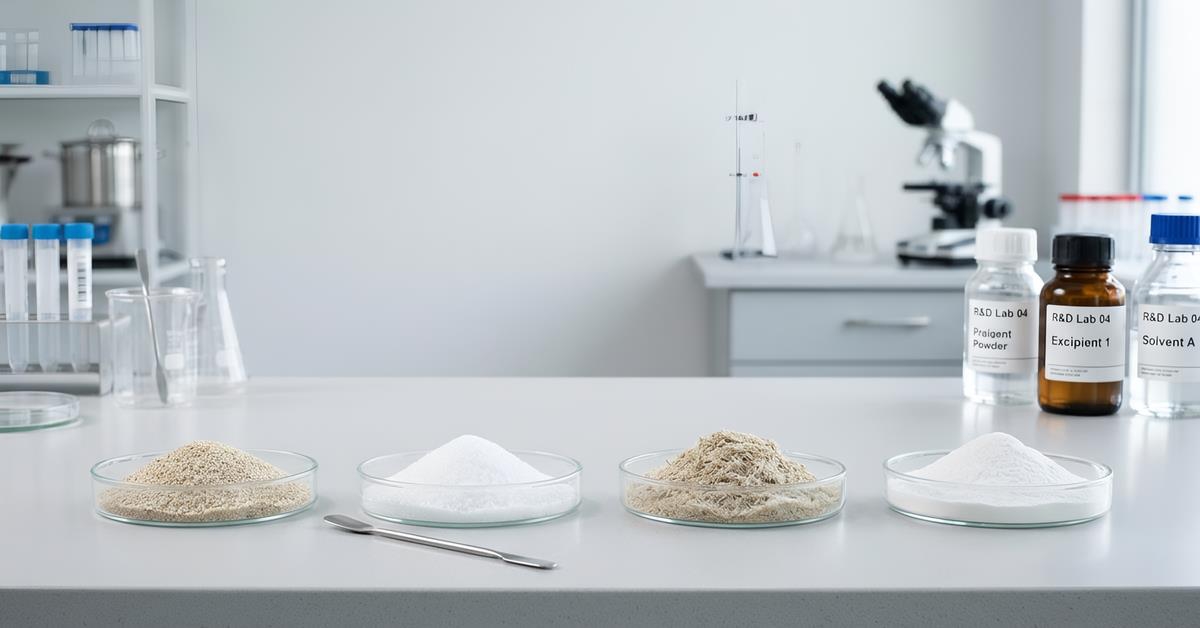
Why Excipient Selection Matters in Probiotic Formulations
Probiotic microorganisms are sensitive to their surrounding environment. Their viability can be affected by water activity, temperature, oxygen, processing conditions, and interactions with other formulation components.
Excipients are therefore more than inactive fillers. They can influence how a probiotic powder handles moisture, flows through manufacturing equipment, blends with other ingredients, and performs during storage.
A carrier may improve powder handling but introduce a moisture-related concern. A prebiotic fiber may support a synbiotic positioning but require additional evaluation for hygroscopicity and compatibility. A sweetener may help achieve the desired formulation weight or taste profile but may behave differently under humid conditions.
The correct choice depends on the complete formulation, not on one isolated specification.
Common Excipient Categories to Evaluate
Several ingredient categories may be considered when developing low water activity probiotic powders. Their suitability must be confirmed for the specific grade and application.
Xylitol and other polyols
Xylitol and erythritol may be considered in powder formulations where sweetness, bulk, and powder characteristics are relevant. They can be useful options in certain probiotic applications, but the actual Aw result, particle size, flowability, and moisture behavior should be verified for the selected grade.
Do not assume that every xylitol or erythritol product has the same Aw profile. Supplier specifications, manufacturing conditions, packaging, and storage can all influence the result.
FOS and inulin
Fructooligosaccharides (FOS) and inulin are commonly used prebiotic fibers. They may be included in synbiotic formulations that combine probiotics with prebiotic ingredients.
However, their moisture-related behavior can vary by source, processing, degree of polymerization, and product grade. Buyers should review Aw, moisture content, hygroscopicity, and physical handling data rather than relying on the ingredient name alone.
Resistant dextrin
Resistant dextrin can serve as a soluble fiber ingredient or formulation component. Different grades may vary in molecular distribution, solubility, particle characteristics, and moisture behavior.
For a probiotic powder, it is important to confirm whether the selected grade meets the intended Aw and moisture requirements and whether it remains compatible with the other components.
Microcrystalline cellulose (MCC)
MCC may be used as a carrier or functional excipient in certain capsule and powder applications. Its particle size, bulk density, flow behavior, and compatibility with the probiotic ingredient should be considered.
The grade should be selected according to the dosage form and manufacturing process. A material that performs well in a capsule blend may not necessarily be ideal for a drink powder.

Why a Low Aw Result Does Not Tell the Whole Story
A supplier’s Aw result is useful, but it should not be treated as the only selection criterion.
First, Aw and moisture content are different measurements. A complete specification review should consider both where the application requires them.
Second, hygroscopicity matters. A powder may have an acceptable initial Aw but absorb moisture during weighing, blending, transportation, or storage. This can change its handling properties and the behavior of the final formulation.
Third, particle characteristics influence manufacturing performance. Differences in particle size and bulk density can contribute to segregation, inconsistent filling, or poor blend uniformity.
Finally, the behavior of the finished blend may differ from the individual ingredients. A low-Aw excipient does not automatically guarantee that the combined formulation will meet the target Aw.
How to Screen Excipients Before Formulation
A practical screening process can reduce unnecessary sample testing and help R&D teams compare options more consistently.
Define the product format. Establish whether the target application is a capsule, sachet, powder blend, tablet, or another dosage form. The excipient’s role may differ depending on the manufacturing process.
Set measurable specifications. Identify the required Aw limit, moisture-content range, particle-size requirements, and any other critical parameters. Distinguish mandatory limits from preferred characteristics.
Request supporting documents. Obtain a current specification sheet and representative batch COA. Where Aw is critical, clarify whether the supplier can test it routinely for each shipment and provide the corresponding result.
Review physical properties. Depending on the application, assess particle size, bulk density, flowability, hygroscopicity, solubility, and dispersibility.
Conduct a laboratory trial. Evaluate the excipient with the actual probiotic ingredient and other formulation components. Measure the relevant parameters in the finished blend rather than assuming that individual COA values predict the final result.
Review storage and packaging. Consider humidity exposure, packaging barrier properties, sealing, storage temperature, and the conditions under which the product will be opened and handled.

How to Evaluate a Strict Aw Requirement
Some projects specify a maximum Aw such as 0.20 or 0.15. These values should be treated as customer-defined technical requirements, not universal limits for all probiotic formulations.
When a buyer requests a strict Aw specification, several questions should be clarified before confirming supply:
Is the requirement for the raw material or the finished blend?
Is the limit a target value or a mandatory batch acceptance criterion?
Does the customer require a test result for every batch?
Is third-party testing required?
Which test method and measurement conditions should be used?
How should the material be stored and handled after opening?
A supplier may have historical or typical results within a requested range, but that does not automatically establish a guaranteed specification for every future batch.
If the required limit is close to the material’s current measured result, a verification plan is particularly important. The supplier should clarify test capability, batch variation, and lead-time implications before making a commitment.
Questions to Ask Before Purchasing
| Evaluation area | Questions for the supplier |
|---|---|
| Product identity | What is the exact grade and composition? |
| Water activity | What are the specification limit and recent batch results? |
| Moisture | What method is used and what is the acceptance range? |
| Hygroscopicity | Is moisture uptake data available? |
| Physical properties | Can particle size, bulk density, or flow data be provided? |
| Documentation | Are specification sheets and batch COAs available? |
| Batch control | Can Aw be tested for each shipment if required? |
| Samples | Can a sample be provided for formulation screening? |
| Packaging | What packaging and storage conditions are recommended? |
These questions help buyers distinguish between a product that simply has a low Aw result and a material that can be consistently evaluated against a defined application requirement.
Building a More Reliable Probiotic Formulation
The best excipient is not necessarily the one with the lowest single Aw result. It is the one that meets the formulation’s critical requirements and performs consistently within the complete product system.
For probiotic manufacturers, this means balancing water activity, moisture content, powder handling, blend uniformity, strain viability, packaging, and storage conditions.
At Esubio, we support ingredient sourcing for probiotic and functional powder projects, including low water activity ingredients and formulation-related requirements. Our team can help review the target application, requested specifications, and documentation needs to identify suitable options for further evaluation.
Explore our Product Catalog or contact us with your target Aw, ingredient list, dosage form, and required batch documentation. We can then discuss available specifications and sample arrangements.
A low-Aw formulation starts with the right raw materials, but it must be validated as a complete blend.