
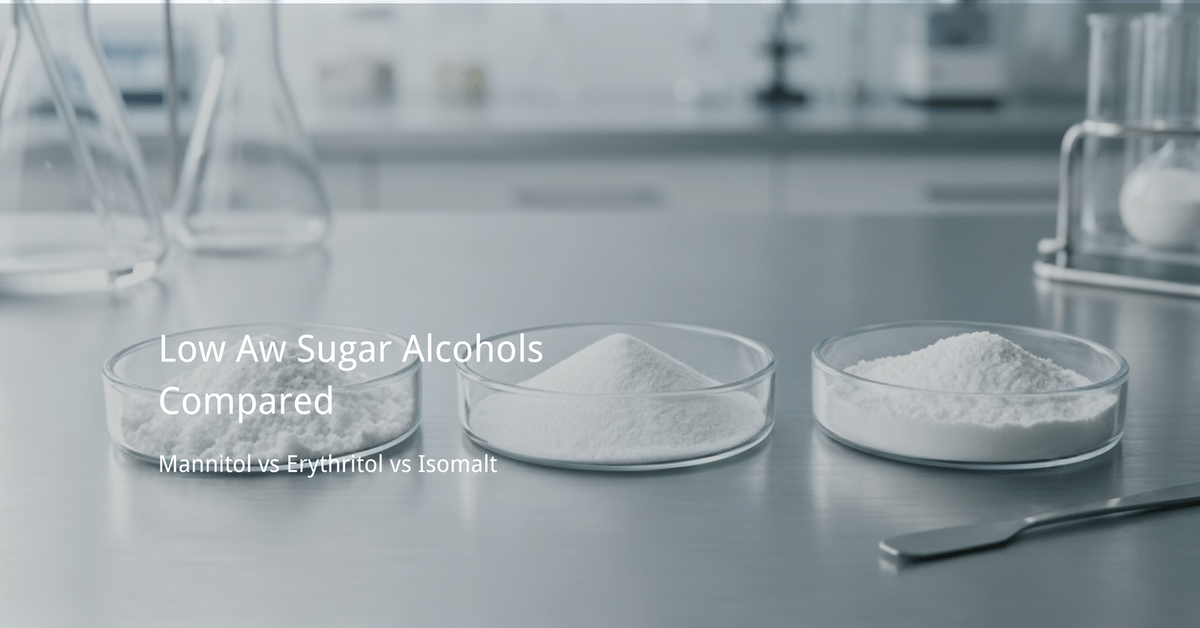
Low Aw Sugar Alcohols Compared: Mannitol vs Erythritol vs Isomalt
These three low Aw sugar alcohols show up repeatedly in low water activity formulation work — probiotic carriers, direct-compression tablets, functional gummies — but they aren’t interchangeable. Here’s how they typically compare, and what tends to drive the choice between them.
Mannitol
Among the most moisture-resistant common low Aw sugar alcohols, with critical relative humidity commonly reported in the range of approximately 98% — meaning it stays stable across a very wide range of ambient humidity. Widely used as the default choice for direct compression and ODT formulations where moisture resistance is the primary driver. It has a slightly cooling mouthfeel and is non-cariogenic, which makes it a common choice beyond just its moisture performance.
Erythritol
CRH commonly reported in the range of approximately 90%, still strongly non-hygroscopic and a common default specifically for probiotic carrier applications. Erythritol has a lower caloric value than mannitol and near-zero glycemic impact, and it’s increasingly preferred in “clean label” functional food and supplement formulations where sugar-alcohol aftertaste is a concern for the end consumer.
Isomalt
CRH commonly reported in the range of approximately 85% — still solidly in low-Aw territory among low Aw sugar alcohols, but the most borderline of the three covered here. Isomalt is valued for its mouthfeel, which is closer to sucrose than mannitol or erythritol, and it shows up frequently in functional gummies and chewable formats, where texture matters as much as moisture stability.
Side-by-side comparison
Sugar Alcohol | Approx. CRH | Typical Use Case | Notable Trait |
Mannitol | ~98% | Direct compression, ODT | Highest moisture resistance |
Erythritol | ~90% | Probiotic carriers, clean-label products | Low calorie, near-zero glycemic impact |
Isomalt | ~85% | Gummies, chewables | Sucrose-like mouthfeel |
How formulators typically choose between them
If moisture resistance is the dominant requirement — probiotic carriers, humid-climate export markets — mannitol or erythritol are the more conservative choices among low Aw sugar alcohols. If mouthfeel and texture in a gummy or chewable format matter as much as water activity, isomalt is often the better fit, with the tradeoff of a narrower humidity margin than the other two. All figures above are commonly cited literature ranges and should be confirmed against current batch data before formulation-critical decisions.
Where sourcing complicates the comparison
China holds significant production capacity across all three of these low Aw sugar alcohols, but Aw and CRH data is inconsistently published by manufacturer, which makes true apples-to-apples comparison harder than it should be. A mannitol from one supplier and an erythritol from another may not be tested under the same equilibrium conditions, which can make published figures harder to compare directly than the numbers alone suggest. This is one of the reasons formulators increasingly ask for testing method disclosure alongside the Aw or CRH figure itself — see Water Activity Excipients: 7 Facts Formulators Get Wrong About Moisture for more on why the method matters as much as the number.
A practical starting point
For most formulators new to this category, mannitol remains the lowest-risk starting point given its high CRH and broad familiarity across dosage forms. Erythritol is the natural next step for probiotic-specific applications, and isomalt enters the conversation once texture becomes a formulation priority alongside moisture control.
Esubio sources all three low Aw sugar alcohols from qualified Chinese manufacturers, with Aw and CRH data disclosed per product and per batch on request. Browse our Low Water Activity Excipients range or request samples to run your own side-by-side comparison.
References
- Food Safety Magazine, “Water Activity’s Role in Food Safety and Quality” — https://www.food-safety.com/articles/4420-water-activitye28099s-role-in-food-safety-and-quality
- USP General Chapter <1112>, Application of Water Activity Determination to Nonsterile Pharmaceutical Products — https://doi.usp.org/USPNF/USPNF_M402_01_01.html
- Wikipedia, “Water activity” — https://en.wikipedia.org/wiki/Water_activity