
Fast-Onset Satiety Ingredients: What Happens in the First 30 Minutes
Before any hormone signal reaches the brain, the stomach itself is already sending a message. Fast-onset satiety ingredients work on this first, purely mechanical mechanism — physical volume and stretch — which is why they act faster than anything that depends on digestion or absorption.
The mechanism: gastric distension, not digestion
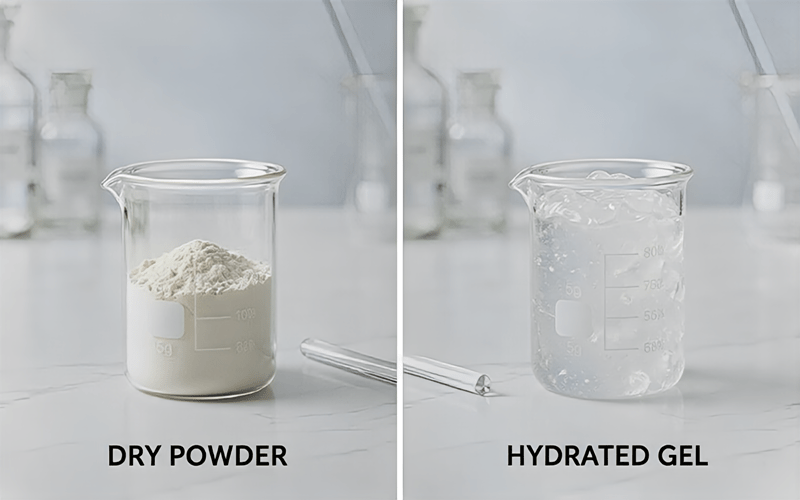
When the stomach wall stretches, mechanoreceptors activate and signal fullness via the vagus nerve, largely independent of what’s actually being digested. This is the fastest satiety pathway available, because it doesn’t wait for nutrients to be broken down or absorbed — it responds to physical volume. Fast-onset satiety ingredients are built around this mechanism specifically: they add bulk and, in many cases, absorb water and swell, amplifying the stretch signal beyond what the ingredient’s dry weight would suggest.
Glucomannan: the clearest example
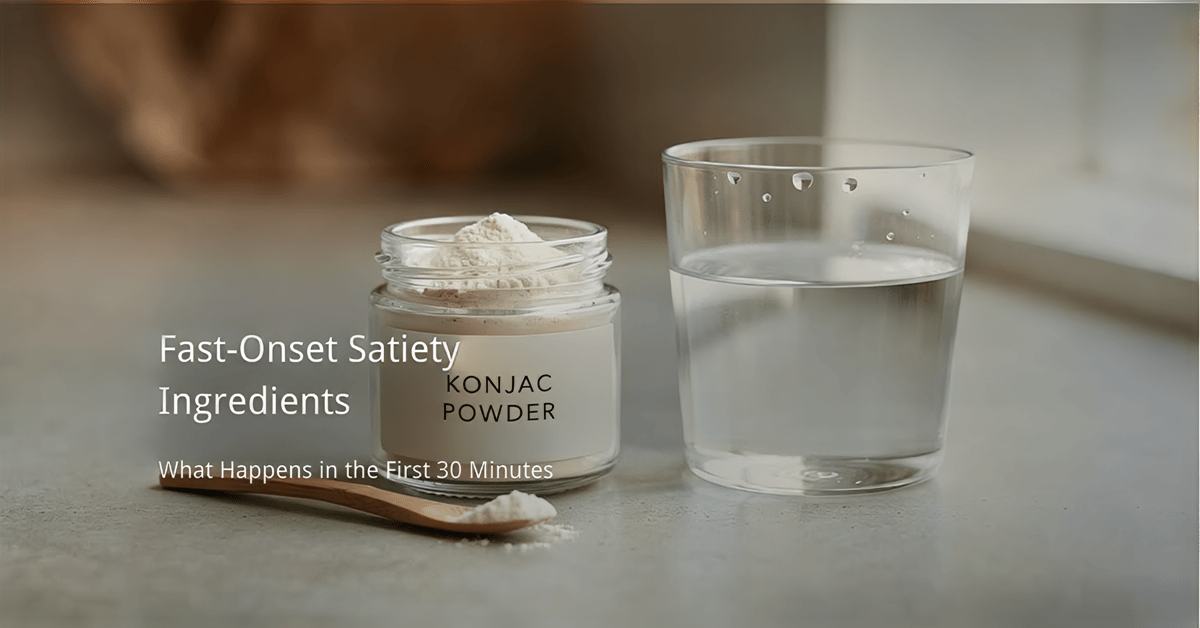
Konjac glucomannan is among the most studied fast-onset satiety ingredients for this mechanism. It’s a highly viscous soluble fiber that can absorb many times its weight in water, expanding substantially in the stomach after ingestion. Typical formulation doses cited in the literature sit in a modest range — often just one to two grams — reflecting how much expansion a small dry weight can produce once hydrated.
Psyllium husk: bulk with a longer tail
Psyllium husk works through a similar bulking mechanism but tends to have a somewhat longer functional window than glucomannan, partly due to differences in gel structure and fermentation rate further down the tract. It’s a common formulation partner for glucomannan for this reason — the two overlap in mechanism but not perfectly in timing, which can smooth the transition into the next digestive phase.
What limits this mechanism
Gastric distension satiety fades as the stomach empties — typically within the first hour or so for a liquid or semi-liquid meal, longer for solids. That’s the fundamental limitation of fast-onset satiety ingredients on their own: they’re genuinely fast, but they’re not built to last through a multi-hour gap between meals. This is why they’re generally formulated as the opening phase of a broader blend rather than as a standalone solution — see Multi-Stage Satiety Formulation: Why One Ingredient Isn’t Enough for how this phase fits into the larger timeline.
Formulation considerations
Viscosity and hydration behavior are the two properties that matter most when evaluating a fast-onset satiety ingredient for a specific format. A capsule-delivered glucomannan behaves differently than the same material in a beverage premix, because hydration timing and available water differ significantly between formats. Particle size and viscosity grade both affect how quickly and how much the material expands, which in turn affects both the perceived onset speed and mouthfeel in a finished product.

Sourcing considerations
Viscosity and molecular weight can vary meaningfully between suppliers even within the same nominal glucomannan grade, since these properties are sensitive to processing conditions. For a formulator, requesting viscosity data (typically measured in mPa·s at a stated concentration and temperature) alongside a standard CoA is worth doing before committing to a source, rather than assuming all glucomannan of a given mesh size will perform identically.
We source glucomannan, psyllium husk, and related fast-onset fiber ingredients with viscosity and particle size data disclosed per batch. Reach out with your target format and dose range, and we can walk through current specs and sample availability.
References
- Effects of GLP-1 and Incretin-Based Therapies on Gastrointestinal Motor Function — PMC — https://pmc.ncbi.nlm.nih.gov/articles/PMC3124003/
- Effects of glucagon-like peptide 1 on appetite and body weight: focus on the CNS — Journal of Endocrinology — https://joe.bioscientifica.com/view/journals/joe/221/1/T1.xml