
Multi-Stage Satiety Formulation: Why One Ingredient Isn’t Enough
The body doesn’t produce one signal that says “full.” It produces a sequence of them, released from different parts of the digestive tract over several hours, each triggered by a different physical or chemical event. Multi-stage satiety formulation starts from that fact — instead of asking “which single ingredient creates fullness,” it asks “which ingredient does the right job at the right point in digestion.” This is the first in a series looking at how that timeline works, phase by phase.
What “multi-stage” actually means
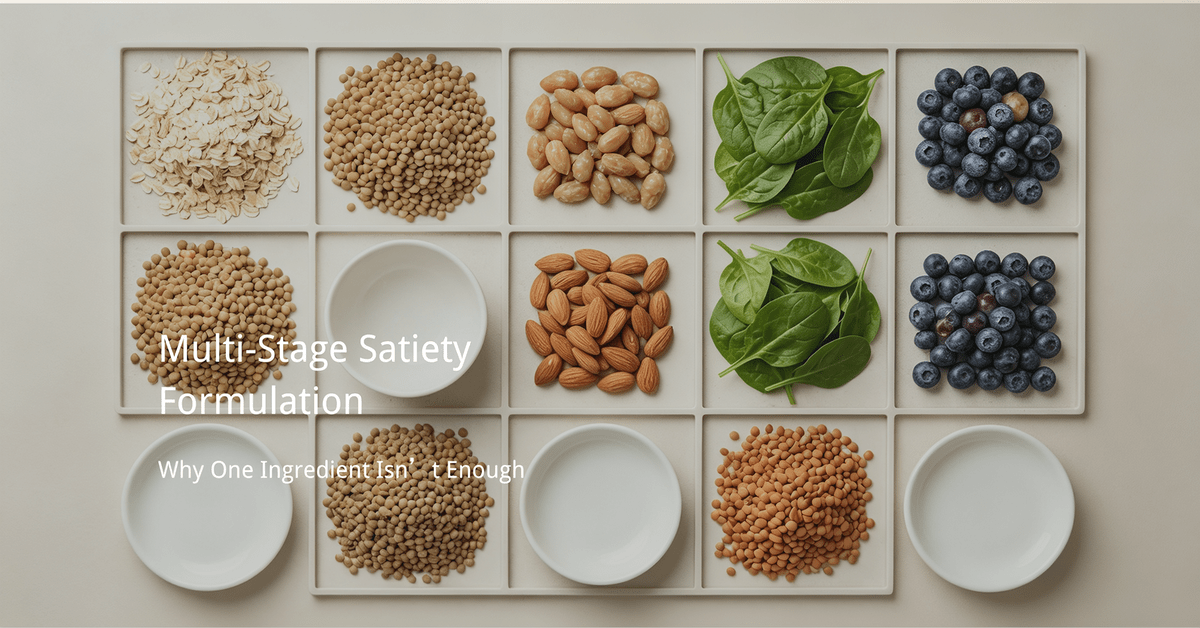
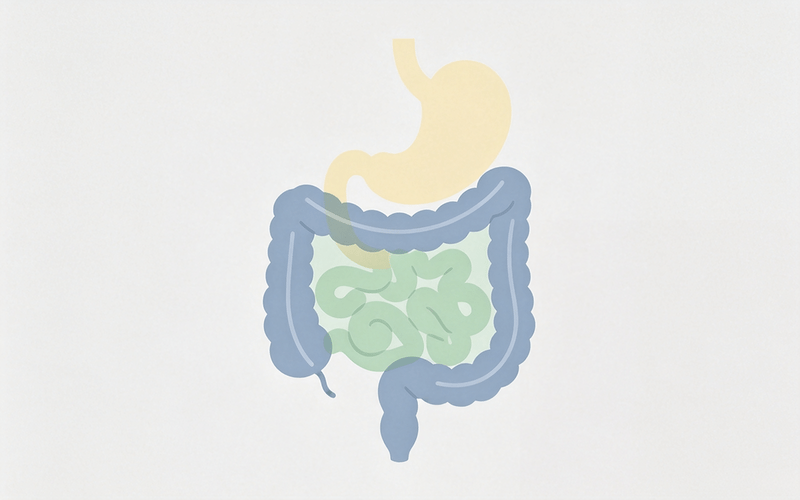
A meal doesn’t hit the gut all at once. It moves from the stomach into the duodenum, through the jejunum and ileum, and — hours later — into the colon, where whatever wasn’t digested becomes food for gut bacteria. Multi-stage satiety formulation maps ingredients onto this sequence: mechanical bulking agents for the first minutes, protein and fat for early hormone release, viscous fibers for the mid-digestion window, and fermentable fibers for the long tail. Each stage uses a different mechanism, and each one runs out at a different time.
The body’s own satiety timeline
Gut physiology research gives a reasonably clear picture of this sequence. Glucagon-like peptide-1 (GLP-1) — a hormone the body produces naturally in response to eating — is detectable in circulation within 10 to 15 minutes of a meal and can remain elevated for several hours, with the specific pattern depending on the meal’s composition. GLP-1-producing L-cells are distributed along the intestine but concentrated most densely in the distal ileum and colon, which is part of why fiber that survives digestion long enough to reach those regions plays a distinct role from fiber that acts earlier, in the stomach or duodenum.
Why a single ingredient falls short
A fast-acting bulking fiber taken alone creates an early sense of fullness that fades within an hour or two, well before a typical gap between meals. A slow-fermenting fiber taken alone does little in the first hour, when early hunger cues are strongest. Multi-stage satiety formulation exists because these mechanisms don’t substitute for each other — a formulation built around only one of them will have a real gap somewhere in its timeline, whether or not the label says otherwise.
Five phases, five ingredient roles
Phase | Approx. Timing | Primary Mechanism | Ingredient Examples |
Fast-onset | 0–30 min | Gastric distension | Glucomannan, psyllium husk |
Early hormone release | 30 min | Protein/fat-triggered secretion | Whey/casein protein, MCT oil |
Peak window | ~1 hour | Viscosity, slowed absorption | Beta-glucan, resistant starch |
Extended phase | ~2 hours | Slow-digesting carbohydrate | High-amylose starch, FOS |
Colonic phase | 4–6+ hours | Fermentation | Inulin, resistant starch, polyphenols |
We go deeper on each of these five phases in the rest of this series — starting with Fast-Onset Satiety Ingredients: What Happens in the First 30 Minutes.

What this means for product development
None of this is a shortcut to a finished-product claim. Ingredient-level mechanism research — how a fiber behaves in the stomach, how protein triggers hormone release — is not the same evidence as a clinical study on the finished formulation, and the two shouldn’t be presented as interchangeable on a label or in marketing copy. What multi-stage satiety formulation does offer is a more complete map of where a formulation’s ingredient choices actually intervene in digestion, which is a more useful starting point for R&D than searching for a single “satiety ingredient” to build around.
Explore the ingredient categories behind each phase of this timeline, or get in touch with specifics on your current formulation — we can walk through fiber, protein, and polyphenol options suited to a particular phase or product format.
References
- Nutrient detection by incretin hormone secreting cells — PMC — https://www.ncbi.nlm.nih.gov/pmc/articles/PMC3361765/
- Stimulation of incretin secreting cells — PMC — https://pmc.ncbi.nlm.nih.gov/articles/PMC4740941/
- Effects of GLP-1 and Incretin-Based Therapies on Gastrointestinal Motor Function — PMC — https://pmc.ncbi.nlm.nih.gov/articles/PMC3124003/