
Supplier Qualification: 7 Powerful Ways to Reduce Costly Sourcing Delays
For many dietary supplement and functional food projects, the formulation itself is not always what slows the project down.
Sometimes, the delay starts much earlier.
It starts when the team needs to find a new ingredient supplier.
A new ingredient may look simple on paper. The procurement team sends an RFQ, receives several quotations, requests samples, and compares prices.
But before a new supplier can actually become a reliable source, there is another layer of work.
Documents need to be reviewed. Certifications need to be checked. Specifications need to be compared. Manufacturing capabilities need to be assessed. Samples need to be tested. Questions need to be answered. Quality and procurement teams may need to review the supplier separately.
This is the hidden workload behind Supplier Qualification.
And when every new ingredient requires a completely new supplier search, the workload can become surprisingly large.
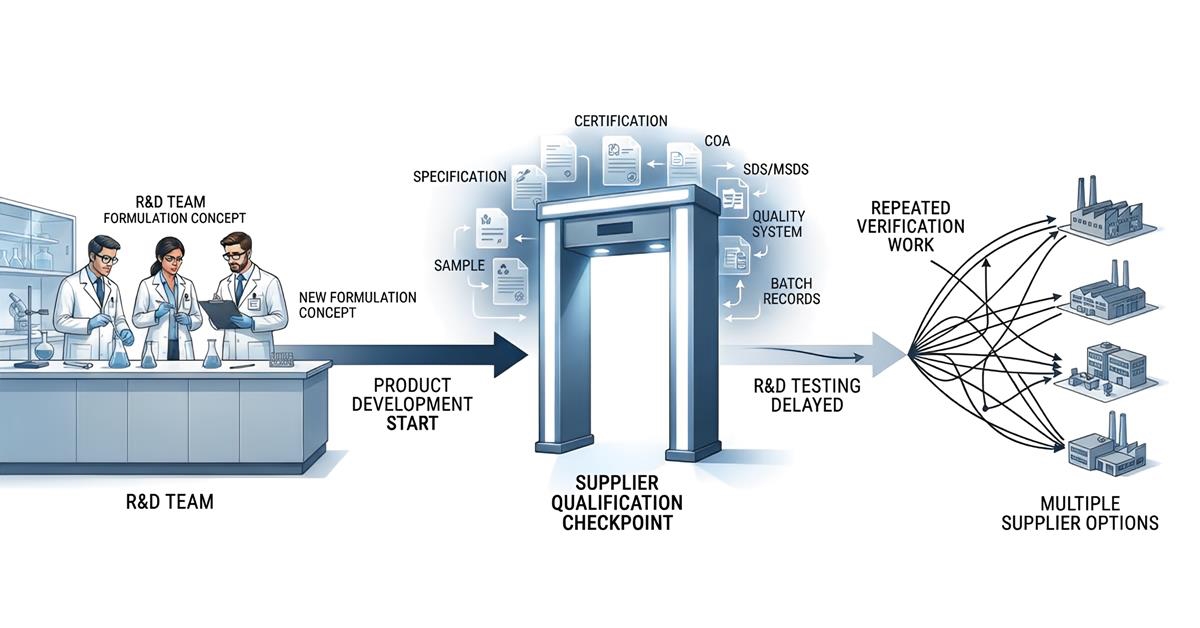
Why Supplier Qualification Can Slow Down Ingredient Sourcing
Supplier qualification is not simply checking whether a company can offer a lower price.
A proper supplier evaluation may involve reviewing technical capabilities, quality systems, certifications, capacity, documentation, product consistency, communication, and other factors relevant to the purchasing decision.
Professional procurement organizations also treat supplier evaluation as an ongoing activity rather than a one-time price comparison. CIPS, for example, describes supplier evaluation as a process for evaluating and approving potential suppliers, with methods ranging from desk appraisal to field research and third-party assessment.
For ingredient buyers, this means a new supplier can create a significant amount of work before the first commercial order is even placed.
Imagine a formulation team needs one new botanical extract.
Procurement finds four possible suppliers.
Four suppliers may mean four sets of specifications, four document packages, four sample discussions, four rounds of questions, four sets of certification checks, and potentially four separate quality evaluations.
The ingredient itself has not changed.
But the verification workload has multiplied.
1. Separate Supplier Discovery From Supplier Qualification
One reason sourcing projects become inefficient is that supplier discovery and supplier qualification are treated as the same task.
They are not.
Supplier discovery answers:
“Who can potentially supply this ingredient?”
Supplier qualification asks:
“Which of these suppliers can reliably meet our requirements?”
The first stage is about finding options.
The second stage is about reducing risk.
This distinction matters because procurement teams should not spend the same amount of time evaluating every company they find online.
A more efficient approach is to establish an initial screening process before detailed qualification begins.
Basic screening can include product availability, specification match, production capability, relevant certifications, documentation availability, MOQ, lead time, and target market experience.
Only suppliers that pass the initial screening need to move into deeper evaluation.
This creates a more efficient funnel:
Market Search → Initial Screening → Supplier Qualification → Sample → Approval → Commercial Supply
2. Standardize the Qualification Checklist
Another hidden source of wasted time is starting from zero every time a new supplier appears.
One person asks for a certificate.
Another asks for a specification.
Quality asks for testing information.
Procurement asks about MOQ.
Then someone realizes that the manufacturer information was never confirmed.
A standardized Supplier Qualification checklist can prevent this.
For functional ingredients, the checklist may cover areas such as:
- Company and manufacturing information
- Product specification
- CoA availability
- Relevant certifications
- Quality management system
- Manufacturing capacity
- MOQ and lead time
- Packaging options
- Batch traceability
- Testing capabilities
- Sample availability
- Export experience
- Destination-market requirements
The exact checklist should depend on the ingredient and risk level.
A low-risk commodity ingredient does not necessarily require the same depth of assessment as a highly specialized probiotic, botanical extract, or ingredient with strict customer specifications.
The principle is to make the evaluation structured and repeatable.
3. Don’t Treat Certifications as the Entire Qualification
A certificate can be useful evidence.
It is not the entire supplier evaluation.
A supplier may have ISO or HACCP-related certifications, but the buyer may still need to understand whether the actual product specification, manufacturing capability, testing process, traceability, and supply performance meet the project’s requirements.
CIPS similarly identifies technical capability, capacity, financial considerations, reliability, and certifications as relevant elements of supplier selection.
This is particularly important for ingredient sourcing.
A supplier may have the right certificate but not have the right grade.
Another may have the right product but an MOQ that is unsuitable for an early-stage project.
Another may provide an attractive sample but have limited commercial production capacity.
Supplier qualification therefore needs to connect documentation with actual supply capability.
4. Make Sample Evaluation Part of Qualification
A sample should not be treated as a completely separate step from supplier evaluation.
It is one of the most useful ways to connect supplier claims with actual product performance.
For example, procurement may receive a specification showing the correct assay and appearance.
But the R&D team still needs to determine whether the ingredient works in the formulation.
The quality team may also need to check whether the sample meets internal specifications.
This is why an efficient qualification process should connect:
Supplier → Documentation → Sample → Testing → Approval
Rather than:
Supplier Search → Supplier Review → Start Again → Sample Search → More Review
The second process creates repeated work.
The first creates a more connected sourcing workflow.
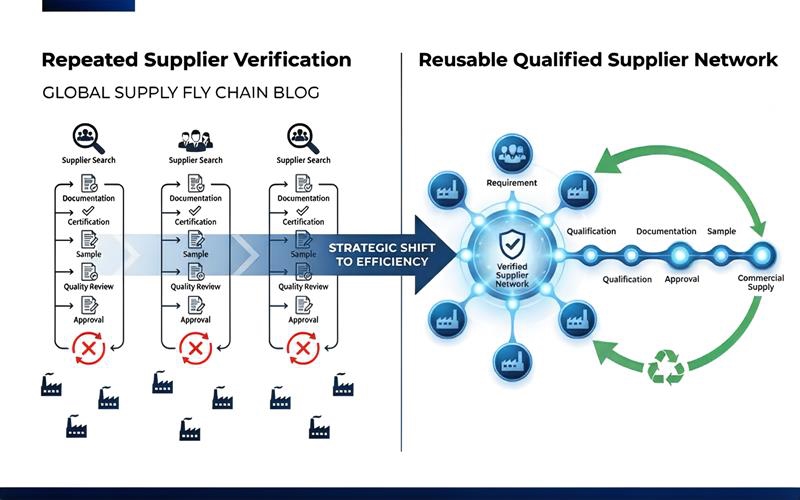
5. Build a Reusable Qualified Supplier Network
This is where the biggest efficiency gain can come from.
If every new project starts with a blank page, procurement has to repeat the same supplier qualification work again and again.
But a qualified supplier network creates institutional knowledge.
Once a supplier has been reviewed, the information does not have to disappear when the project ends.
The supplier’s product categories, specifications, certifications, documentation, MOQ, lead times, sample history, and previous performance can become part of a reusable sourcing database.
This does not mean a supplier should be permanently approved for every future ingredient.
Product-specific qualification may still be necessary.
It means the next sourcing project starts with a better information base.
Instead of asking:
“Who can supply this?”
the team can begin with:
“Which qualified sources already exist in our network?”
That is a much faster starting point.
6. Use Supplier Performance to Update Qualification
Supplier qualification should not end when the first order is approved.
Actual supply performance provides information that documents and samples cannot fully show.
Procurement teams can monitor areas such as:
- Batch consistency
- Delivery performance
- Documentation accuracy
- Response time
- Complaint handling
- Specification compliance
- Packaging condition
- Commercial reliability
CIPS notes that supplier performance can be assessed through indicators such as product quality, delivery accuracy, lead times, customer service, and commercial performance.
This creates an important feedback loop:
Qualification → Purchase → Performance → Re-evaluation
A supplier that performs well becomes a stronger source.
A supplier with repeated quality or delivery problems may need corrective action, closer monitoring, or replacement.
This makes supplier qualification a living process rather than a one-time approval form.
7. Let Procurement Focus on Decisions, Not Repeated Verification
The real problem is not that supplier qualification takes work.
It should take work.
The problem is when highly skilled procurement, quality, and R&D teams repeatedly spend their time collecting the same basic information from completely new suppliers.
Their time is more valuable when it is spent on decisions.
Which specification is appropriate?
Which supplier provides the best risk-to-cost balance?
Does the sample work in the formulation?
Can the supplier support scale-up?
Is there a suitable backup source?
What commercial terms make sense?
These are higher-value questions.
A sourcing partner can help reduce the lower-value repetition by maintaining access to screened suppliers, collecting standard documentation, coordinating samples, and organizing the initial supplier information.
The final qualification decision should still remain with the buyer’s procurement and quality teams.
The goal is not to remove control.
It is to reduce unnecessary friction before that decision is made.
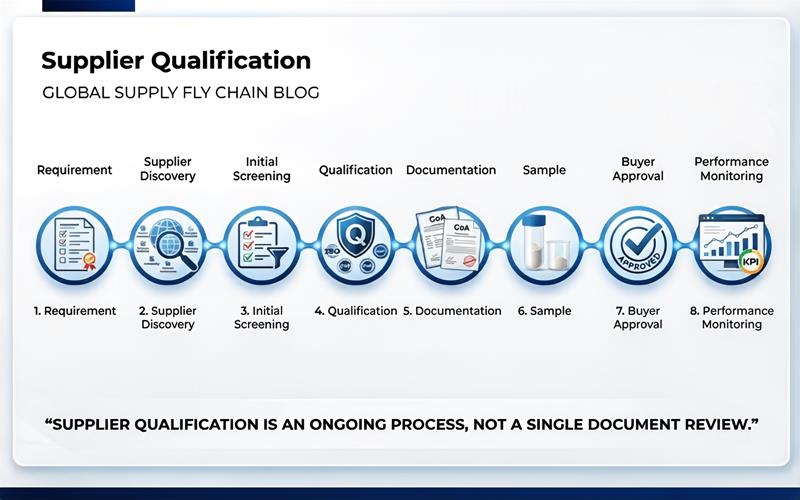
Supplier Qualification Is a Process, Not a Document
A common mistake is to think of supplier qualification as a folder containing certificates and questionnaires.
In reality, it is a process.
A more effective model looks like this:
Requirement → Supplier Discovery → Initial Screening → Qualification → Documentation → Sample → Testing → Approval → Performance Monitoring
Each stage reduces a different type of uncertainty.
Supplier discovery reduces search uncertainty.
Qualification reduces supplier risk.
Documentation reduces information gaps.
Sampling reduces product-performance uncertainty.
Performance monitoring reduces long-term supply risk.
When these stages are connected, supplier qualification becomes much more efficient.
From Supplier Search to Supplier Network
This is also why a sourcing partner can create value beyond simply providing another quotation.
The real value is not:
“Here are three suppliers.”
It is:
“Here are suitable sources, the relevant product information, available documentation, samples, and the information needed for your team to make a qualification decision.”
At Esubio, we work with a verified supplier network for functional ingredients, including botanical extracts, amino acids, probiotics, postbiotics, and other specialty ingredients.
Depending on the product, supplier documentation may include specifications, CoA, SDS/MSDS, certifications, testing reports, and other available supporting information.
Where applicable, suppliers in our network may operate under ISO- or HACCP-based quality systems. Specific certifications and documents are confirmed according to the actual supplier and product rather than assumed across the entire portfolio.
The objective is straightforward:
Reduce the repeated work required to find, screen, document, sample, and communicate with new ingredient sources.
What a More Efficient Supplier Qualification Model Looks Like
A traditional sourcing process often looks like:
New Ingredient → Search → Contact Supplier → Collect Documents → Verify → Request Sample → Review → Start Again
A more efficient model can look like:
Ingredient Requirement → Screened Supplier Network → Qualification → Documentation → Sample → Buyer Approval → Commercial Supply
The second model does not eliminate due diligence.
It makes due diligence more reusable.
That distinction matters.
The purpose of a sourcing partner is not to tell a buyer which supplier to approve.
It is to help reduce the time and effort required to reach an informed decision.
For fast-moving supplement and functional food projects, that can make a meaningful difference.
Because sometimes the biggest delay in R&D is not the formulation.
It is everything that has to happen before the formulation can properly begin.
And when Supplier Qualification becomes a reusable capability rather than a repeated project-by-project task, procurement and quality teams can spend more of their time on the decisions that actually move the project forward.
References
- Chartered Institute of Procurement & Supply. (n.d.). Supplier evaluation: How to evaluate suppliers. CIPS.
- Chartered Institute of Procurement & Supply. (n.d.). Supplier selection: What is the supplier selection process?. CIPS.
- Chartered Institute of Procurement & Supply. (n.d.). Supplier performance: How to manage supplier performance. CIPS.
- Chartered Institute of Procurement & Supply. (n.d.). The procurement process. CIPS.
- Chartered Institute of Procurement & Supply. (n.d.). Managing suppliers. CIPS.
- Chartered Institute of Procurement & Supply. (n.d.). What is procurement?. CIPS.
- Association for Supply Chain Management. (2024). Supplier relationship management certificate: Module 5—Supplier risk management. ASCM.
- Association for Supply Chain Management. (n.d.). Supplier relationship management certificate. ASCM.