
7 Powerful Ways to Reduce Single-Source Supply Risk in Ingredient Procurement
Single-source supply risk is easy to overlook when everything is running smoothly. One supplier provides the raw material, the documentation is already approved, the quality is familiar, and the purchasing process is predictable. From an operational perspective, staying with one source often feels efficient.
The problem appears when that source suddenly becomes unavailable.
For ingredient manufacturers, supplement brands, contract manufacturers, and other businesses that depend on imported raw materials, a supplier disruption can quickly become a production problem. Capacity constraints, unexpected price increases, quality deviations, transportation delays, export restrictions, or regional disruptions can all affect supply continuity.
The real question is not whether a single supplier can perform well today. It is whether the business can continue operating if that supplier cannot deliver tomorrow.

Why Single-Source Supply Risk Is Often Hidden
A single-source strategy does not necessarily mean that a supplier is unreliable. In many cases, the supplier may have an excellent quality record, competitive pricing, and a long-standing relationship with the buyer.
The risk comes from concentration.
If one supplier represents 100% of the available supply for a critical ingredient, the buyer has very limited flexibility when conditions change. Even a reliable supplier can experience an unexpected production issue, raw material shortage, equipment failure, labor disruption, logistics problem, or temporary capacity constraint.
This creates a single point of failure.
The same principle applies geographically. A company may have several suppliers on paper, but if those suppliers depend on the same production region or upstream raw material source, the apparent diversification may provide less protection than expected.
Supply chain resilience therefore requires looking beyond the number of supplier names in a purchasing system. It requires understanding where critical materials come from and how quickly an alternative source could actually be activated.
1. Identify Critical Ingredients Before Adding Suppliers
Not every ingredient needs a second source.
The first step is to identify which raw materials could create the greatest operational or financial impact if supply stopped.
A practical assessment can consider:
- Importance of the ingredient to the finished product
- Monthly or annual purchasing volume
- Available inventory coverage
- Supplier lead time
- Availability of qualified alternatives
- Product-specific specifications
- Regulatory or customer approval requirements
- Geographic concentration
- Impact of a supply interruption on production
A low-cost ingredient with many qualified suppliers may present little risk. A specialized botanical extract, probiotic strain, functional active, or customized blend with a long qualification cycle may represent a much greater exposure.
The goal is not to diversify everything. It is to prioritize the materials where a second source creates meaningful resilience.
2. Build a Qualified Backup Supplier, Not Just a Supplier List
Finding another company that can quote the same ingredient is not the same as having a backup supplier.
A genuine backup source should be capable of passing the same qualification process as the primary source.
That may include specifications, CoA review, analytical testing, manufacturing information, certifications, allergen information, regulatory documentation, packaging requirements, and other customer-specific requirements.
This is particularly important for food ingredients, dietary supplement ingredients, botanicals, probiotics, amino acids, and specialty functional ingredients.
If a backup supplier has never been evaluated, its value during an emergency may be limited. The organization may still need several weeks or months to complete qualification before placing a production order.
Supplier diversification therefore works best when qualification happens before the disruption.
3. Standardize Specifications and Documentation
One hidden barrier to supplier diversification is inconsistent documentation.
A primary supplier may already understand the buyer’s required specification, packaging format, labeling requirements, testing methods, and documentation package. A new supplier may provide the same ingredient under a different specification or with incomplete supporting documents.
This creates additional work for purchasing, quality, regulatory, and R&D teams.
Standardizing the information required from suppliers can make switching much easier.
For example, a qualification package may include:
- Product specification
- Certificate of Analysis
- Safety Data Sheet where applicable
- Country of origin
- Manufacturing information
- Allergen statement
- GMO status
- Microbiological requirements
- Heavy metal and contaminant limits
- Stability or storage information where relevant
- Packaging and shelf-life information
The exact requirements depend on the ingredient and market, but the principle is straightforward: the more standardized the qualification process, the easier it becomes to activate another source.
4. Test Supply Continuity Before You Need It
A supplier can look qualified on paper and still be difficult to use in practice.
This is why an occasional trial order can be more valuable than simply keeping a supplier’s contact information in a database.
For critical materials, buyers can consider small validation orders or sample-to-batch comparisons before an emergency occurs.
This helps answer practical questions:
Can the supplier meet the required specification?
Can the material be supplied within the required lead time?
Is the batch-to-batch quality consistent?
Can the supplier provide the required documentation?
Can the packaging withstand international transportation and storage conditions?
Can the supplier respond quickly when an RFQ becomes urgent?
These questions turn a theoretical backup supplier into a potentially usable supply option.

5. Consider Dual Sourcing Where the Risk Justifies the Cost
Dual sourcing does not necessarily mean splitting purchases 50/50.
Depending on the material, a company may maintain one primary supplier for most of its volume while keeping a qualified secondary supplier available for a smaller allocation.
For example, a procurement strategy could use one supplier for the majority of annual demand while periodically purchasing from a second source to maintain qualification and commercial familiarity.
This approach may cost more than pure single sourcing. There may be lower volume discounts, additional qualification work, separate logistics arrangements, or more supplier management.
However, the relevant comparison is not simply supplier price.
The better question is:
What is the cost of maintaining a backup source compared with the cost of production downtime caused by a supply interruption?
The answer will differ by ingredient and business model, but the risk should be evaluated against the potential cost of disruption.
6. Look Beyond Price When Evaluating Ingredient Suppliers
A lower quotation does not automatically create a lower procurement cost.
For critical ingredients, supplier evaluation should consider total supply performance, including quality, lead time, documentation, responsiveness, MOQ, payment terms, logistics flexibility, and consistency.
A supplier offering a slightly higher price may create greater value if it provides shorter lead times, lower MOQs, reliable documentation, or a more flexible response during shortages.
This is especially relevant for international ingredient sourcing, where transportation, customs procedures, documentation, and regional supply conditions can affect the final landed cost and delivery timeline.
Price remains important. It simply should not be the only variable.
7. Maintain an Active Supply Option Before a Disruption Happens
The biggest mistake in supplier diversification is waiting until the primary supplier fails.
Once a shortage occurs, every buyer is competing for alternative capacity. Lead times become longer, prices may rise, and qualification teams have less time to evaluate new suppliers properly.
A better approach is to build supply flexibility while the existing supplier is still performing normally.
This does not require maintaining large inventories or continuously purchasing from multiple sources.
It means knowing:
- Who the potential alternative suppliers are
- Which suppliers have already been qualified
- Which documents have been reviewed
- Which specifications have been confirmed
- Whether samples have been tested
- What MOQ and lead time they can support
- How quickly they could respond to an urgent requirement
That information turns supplier diversification from a theoretical strategy into an operational capability.
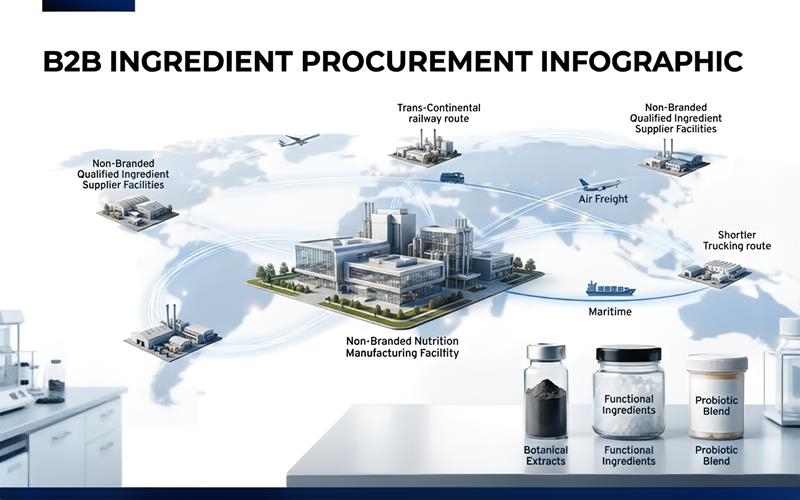
From Single Sourcing to Supply Flexibility
Single sourcing can be efficient. It can simplify communication, consolidate purchasing volume, and reduce supplier-management workload.
The problem begins when efficiency becomes dependency.
A resilient ingredient procurement strategy does not necessarily require dozens of suppliers. It requires enough qualified alternatives for the materials where supply interruption would have a meaningful business impact.
Research from McKinsey has highlighted dual sourcing, supplier diversification, and supply network redesign as important measures for improving supply chain resilience. The OECD has similarly emphasized diversification and proactive risk management as part of strengthening global supply chains.
For ingredient buyers, the practical lesson is simple: do not wait for a supply disruption to discover that your second source is not ready.
Esubio supports international ingredient sourcing across botanical extracts, amino acids, probiotics, functional blends, and other functional ingredients. Through a verified-supplier approach, we help buyers evaluate additional sourcing options, review product documentation, and maintain greater flexibility beyond an existing supply structure.
The objective is not to replace a supplier that is already performing well.
It is to make sure that when circumstances change, there is another qualified path available.
In global ingredient procurement, the strongest supply chain is not necessarily the one with the lowest number of suppliers.
It is the one that can keep moving when one supplier cannot.