
Water Activity vs Moisture Content: What Powder Ingredient Buyers Need to Know
When evaluating powder ingredients, water activity vs moisture content is an important distinction that R&D, quality assurance, and procurement teams should understand. These two measurements are related, but they do not describe the same property. A powder may meet its moisture specification and still present water activity concerns that affect storage stability, flowability, or compatibility with other ingredients.
This distinction becomes particularly important when developing probiotic powders, dietary supplements, functional blends, and other moisture-sensitive formulations. Relying on only one measurement may leave important product risks unidentified.
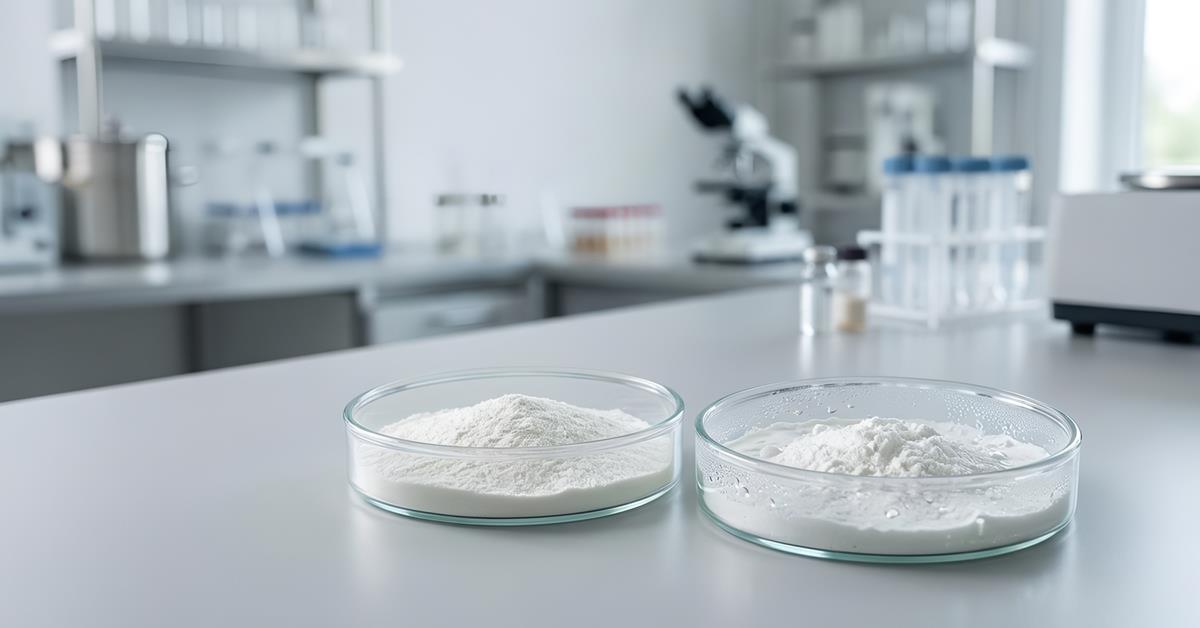
What Is the Difference Between Water Activity and Moisture Content?
Moisture content measures the total amount of water present in a material. It is commonly expressed as a percentage and determined using methods such as loss on drying or other validated analytical techniques.
Water activity (Aw), on the other hand, describes the availability of water for physical, chemical, and biological processes. It is expressed on a scale from 0 to 1. A higher Aw generally indicates that water is more available within the product system.
In practical terms, moisture content tells you how much water is present, while Aw provides information about how that water behaves in the material.
The two measurements are related, but their relationship depends on the ingredient’s chemical composition, structure, temperature, and moisture-binding characteristics.
For example, two powder ingredients may have similar moisture percentages but different Aw values because their components interact with water differently. Sugars, fibers, proteins, minerals, and other solids do not bind or retain water in the same way.
This is why moisture content alone cannot fully describe the stability of a powder ingredient.
Why Moisture Content Alone Is Not Enough
Moisture content remains an important quality parameter. It can help verify drying performance, identify changes between batches, and support raw material specifications.
However, it does not directly indicate how much water is available for reactions or microbial activity.
For ingredients used in sensitive formulations, this difference can matter in several ways.
First, microbial and chemical stability. Water activity is commonly used to assess the potential for microbial growth and to understand conditions that may influence degradation reactions. A low Aw can help reduce certain risks, but it does not guarantee that a probiotic ingredient will retain its viable count throughout its shelf life.
Second, powder handling. Moisture-related changes may contribute to caking, agglomeration, poor flow, and changes in dispersibility. These effects depend on the ingredient’s physical properties and storage environment.
Third, formulation compatibility. When several ingredients are blended together, the final system may behave differently from each individual raw material. A carrier, botanical extract, prebiotic fiber, or flavor component may influence moisture distribution and the physical stability of the blend.
For this reason, the specifications of individual ingredients should not automatically be treated as proof of finished-product performance.
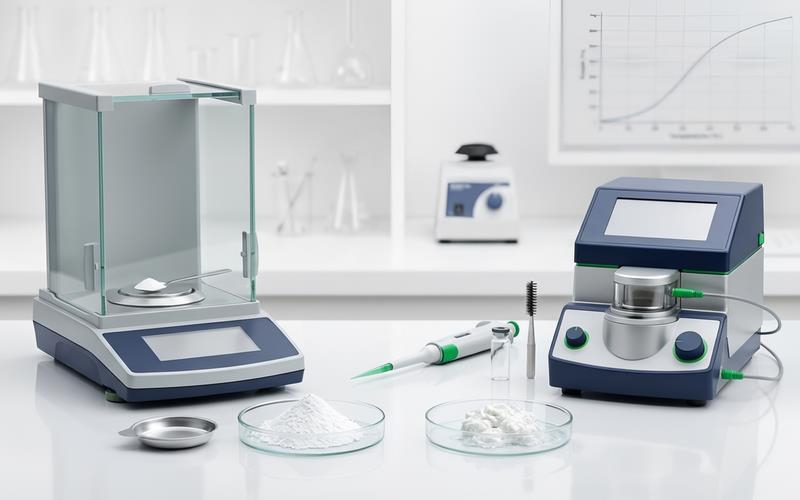
Why Water Activity Matters in Probiotic Formulations
Probiotic powders require particular attention because they contain live microorganisms. Their viability can be affected by water activity, storage temperature, oxygen exposure, processing conditions, and the surrounding formulation matrix.
Research on Lactobacillus rhamnosus GG in dry food matrices has shown that storage water activity can have a substantial influence on long-term viability. In the reported study, samples stored at Aw 0.11 showed much better viability retention than samples stored at Aw 0.43 over the study period.
This does not establish one universal Aw specification for every probiotic strain or finished product. It demonstrates why Aw should be considered alongside strain characteristics, formulation composition, packaging, and storage conditions.
A practical evaluation should consider:
The target probiotic strain and its documented stability characteristics
The Aw and moisture content of the probiotic raw material
The Aw and moisture-related behavior of other formulation ingredients
Processing and blending conditions
Packaging moisture-barrier properties
Expected storage temperature and shelf life
The finished blend should be evaluated rather than relying exclusively on the COA of each individual ingredient.
Factors That Can Change Water Activity in Powder Ingredients
Several factors may influence the Aw of a powder or finished blend.
Ingredient composition: Different carbohydrates, fibers, proteins, and mineral salts interact with water differently. The same moisture percentage can therefore correspond to different Aw values in different materials.
Hygroscopicity: Some powders readily absorb moisture from surrounding air. This can cause changes during weighing, blending, filling, and storage, particularly in environments with high relative humidity.
Particle characteristics: Particle size, surface area, and powder structure can influence moisture exchange and handling behavior. These factors should be evaluated when they are relevant to the intended application.
Environmental conditions: Temperature and relative humidity can affect moisture transfer between the product and its surroundings. A powder that meets its specification when tested may change after exposure to humid air.
Packaging: Packaging is part of the stability system. Moisture-barrier performance, seal integrity, headspace, and handling after opening can all influence the product’s condition over time.

How Buyers Should Evaluate Aw and Moisture Specifications
A useful supplier evaluation should go beyond asking whether an ingredient has a low moisture percentage.
Start by defining the intended application. A probiotic capsule, a dry beverage powder, and a botanical premix may have different performance requirements.
Next, identify which parameters are mandatory and which are supporting indicators. For example, a project may require both an Aw limit and a moisture-content limit, while also requesting particle size or flowability data.
When reviewing a supplier’s COA or specification sheet, check the following:
| Parameter | What to verify |
|---|---|
| Water activity | Test result, method, and specified limit |
| Moisture content | Test method and acceptance range |
| Hygroscopicity | Whether moisture uptake is relevant to the application |
| Particle size | Whether it affects blending or filling |
| Flowability | Whether the powder can be handled consistently |
| Packaging | Moisture protection and storage recommendations |
| Batch consistency | Whether results are available across representative lots |
If the customer has a strict Aw requirement, clarify whether the supplier can provide a routine test result for each batch, a third-party report, or only a typical value. These are different levels of evidence and should not be confused.
It is also important to understand the measurement conditions. Sample handling, temperature equilibration, instrument calibration, and testing procedures can influence the reliability and comparability of results.
Why One Aw Result Does Not Guarantee Shelf-Life Stability
A single Aw result describes the sample under the conditions at the time of testing. It does not automatically predict how the product will behave throughout storage.
For example, an ingredient may meet its initial Aw specification but absorb moisture during transportation, manufacturing, or repeated opening. The finished product may therefore require additional protection.
For moisture-sensitive products, a more complete stability approach may include:
Initial Aw and moisture testing
Evaluation of the finished blend
Packaging compatibility assessment
Storage studies under relevant temperature and humidity conditions
Periodic monitoring of Aw, moisture, and product-specific quality attributes
For probiotics, viability testing should also be included where appropriate. Aw is an important stability parameter, but it should not be used as a substitute for CFU testing.
Working with Suppliers on Low Water Activity Requirements
A clear technical request helps suppliers assess whether an ingredient is suitable for a specific formulation.
Instead of asking only for a low-moisture powder, provide the intended application, target Aw, moisture limit, required testing frequency, and any documentation requirements.
For example, a request for a probiotic-compatible excipient may specify:
Intended application: probiotic powder or capsule formulation
Required Aw: customer-defined maximum
Moisture content: customer-defined maximum
Required documentation: specification sheet and batch COA
Additional evaluation: hygroscopicity, flowability, and sample testing where relevant
The exact limits should be established according to the formulation and validated product requirements. They should not be copied from another ingredient or application without technical justification.
Supporting Moisture-Sensitive Ingredient Projects
At Esubio, we support ingredient sourcing for supplement manufacturers, R&D teams, and product developers working with probiotics, low water activity ingredients, botanical extracts, and functional powders.
For projects with specific Aw or moisture requirements, the most useful starting point is to share the ingredient name, intended application, target specification, and documentation requirements. This allows the available options to be assessed against the actual project needs rather than relying on a general product description.
Explore our Product Catalog or contact our team to discuss low water activity ingredient requirements, request specifications, and evaluate suitable samples.
The key takeaway: moisture content and water activity should be evaluated as separate but complementary parameters. For sensitive powder formulations, both the raw materials and the finished blend need to be considered, together with packaging and storage conditions.