
How to Write an Effective Amino Acid RFQ: A Guide for Buyers and R&D Teams
An effective amino acid RFQ helps suppliers understand exactly what a buyer needs before preparing a quotation. However, many inquiries contain only a product name and a requested quantity.
For example:
“I need L-Citrulline. Please send your best price.”
This is enough to start a conversation, but it may not provide sufficient information for an accurate quotation. The supplier may need to clarify the required grade, purity, application, source preference, quality documents, sample quantity, and delivery destination.
For sports nutrition brands, supplement manufacturers, procurement teams, and product developers, a well-prepared request for quotation (RFQ) can reduce unnecessary communication and make supplier comparisons more meaningful.
The goal is not to create a complicated purchasing document. It is to provide enough technical and commercial information for the supplier to identify a suitable ingredient and respond with relevant options.
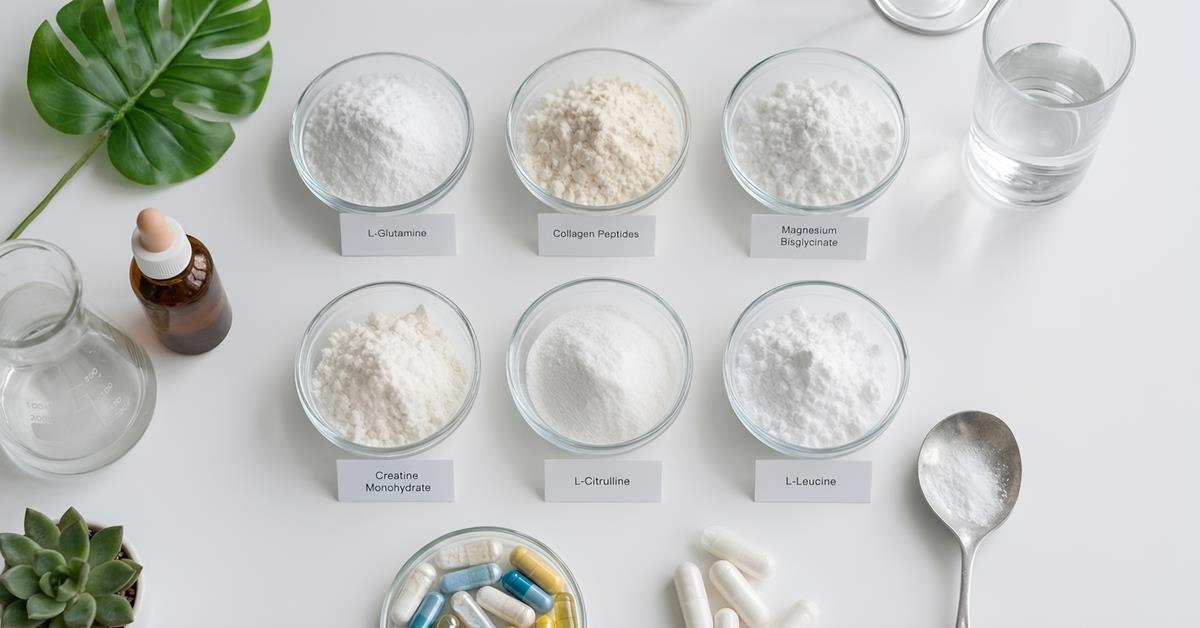
Amino Acid RFQ: Why a Product Name Alone Is Not Enough
The name of an amino acid identifies the general ingredient, but it does not always define the complete purchasing requirement.
Take L-Citrulline as an example. A buyer may require a particular assay specification, analytical method, physical form, or quality documentation. A supplier who receives only the product name cannot know whether the buyer has additional requirements.
The same applies to L-Arginine, Taurine, L-Leucine, L-Isoleucine, and L-Valine. Although these ingredients may be familiar to sports nutrition manufacturers, the exact specification and intended application still need to be established.
Purity or assay is important, but it is not the only consideration. Depending on the project, buyers may also need to review identity, related substances or impurities, moisture, particle size, bulk density, microbiological requirements, and other quality attributes.
Source preference can also affect the sourcing process. Some projects may require fermentation-derived ingredients, while others may accept alternative sources if the material meets the agreed specification. This requirement should be stated clearly rather than assumed.
A quotation based on incomplete information may be commercially attractive but technically unsuitable. The first step is therefore to define the requirement before asking suppliers to compete on price.
Six Key Details to Include in an Amino Acid RFQ
A practical amino acid RFQ should cover the following information.
| RFQ information | Example or details to provide | Why it matters |
|---|---|---|
| Ingredient name | L-Citrulline, L-Arginine, Taurine, L-Leucine | Identifies the requested material. |
| Required specification | Assay, purity, identity, relevant impurity limits | Defines the quality requirements. |
| Intended application | Sports nutrition, recovery products, energy formulations, capsules, powders | Helps assess suitability for the intended product. |
| Source preference | Fermentation-derived or another specified source | Clarifies sourcing expectations. |
| Quantity | Sample, pilot order, or estimated commercial volume | Supports pricing and MOQ assessment. |
| Documentation | COA, specification, SDS/MSDS, and other required declarations | Establishes the information needed for technical review. |
Not every project requires every possible specification. Buyers should distinguish between mandatory requirements and preferences that can be discussed.
For example, a sports nutrition brand developing a powdered product may place greater emphasis on solubility, particle size, flavor, and powder handling. A capsule manufacturer may have different priorities, including bulk density, flowability, and filling performance.
A clear RFQ allows the supplier to understand these differences before recommending an ingredient.
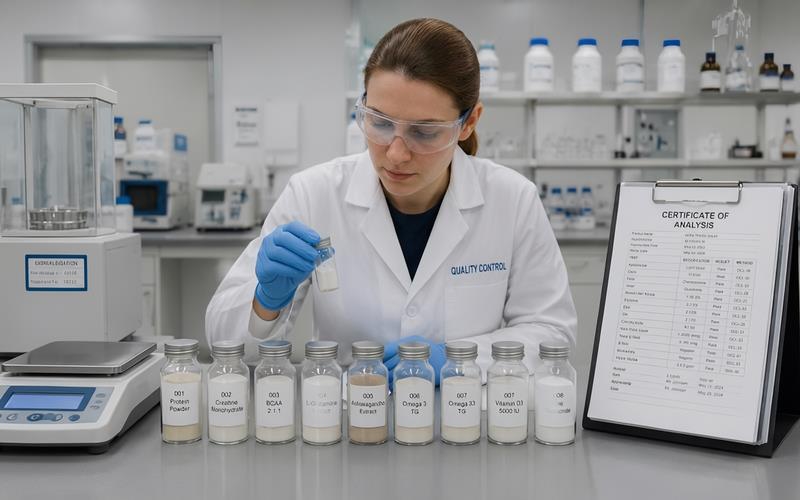
Beyond Assay: Physical Properties That Affect Formulation
An amino acid that meets the required assay specification may still create challenges during production.
This is why formulation teams often need to consider physical properties in addition to chemical quality.
Particle size can affect blending behavior, segregation risk, dissolution rate, and the uniformity of a powder mixture. If an amino acid is combined with several other ingredients, substantial differences in particle size may need to be assessed during development.
Bulk density is relevant when the product has a fixed serving size or limited capsule volume. Two materials with similar chemical specifications can occupy different volumes, which may influence formulation calculations and filling operations.
Flowability affects how a powder moves through processing and packaging equipment. Poor flow can make weighing, conveying, and filling less consistent. The appropriate evaluation depends on the equipment and the formulation.
Solubility and dispersibility may be important for powdered sports nutrition products, especially when consumers are expected to mix the product with water. These properties should be evaluated under relevant conditions rather than inferred from the ingredient name.
Flavor profile is another practical consideration. Some amino acids have distinct taste characteristics that may influence the finished product’s sensory profile. Formulators may need to assess flavor masking, sweetener selection, or the balance of multiple ingredients.
These properties should not automatically become mandatory specifications for every amino acid. Instead, the buyer and supplier should identify which characteristics are critical for the intended application.
Individual Amino Acids vs. Custom Blends
Another important point in amino acid sourcing is the distinction between individual ingredients and custom blends.
Individual amino acids give formulators direct control over ingredient ratios and allow them to develop their own formulations. This can be useful for brands with established blending capabilities or specific nutritional targets.
Custom blends may help simplify sourcing and reduce the number of separate materials a buyer needs to manage. However, they require more detailed agreement on composition, ratios, tolerances, and quality requirements.
For BCAA products, buyers should specify the intended proportions of L-Leucine, L-Isoleucine, and L-Valine. A request for “BCAA powder” alone does not establish the required ratio.
For EAA products, the buyer should provide the intended amino acid composition, individual ingredient proportions, and any requirements for additional components. Different EAA formulations may use different compositions, so suppliers should not assume that every buyer wants the same blend.
For either type of project, clarify whether the quotation is for individual amino acids, a standard blend, or a custom formulation. If the source of each component is important, state that requirement as well.
The more precisely the blend is defined, the easier it becomes to evaluate whether a proposed formulation matches the project.
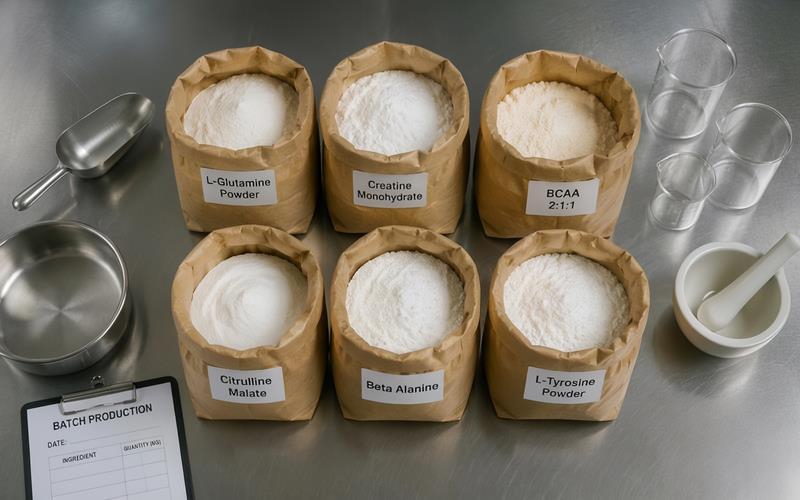
Sample Evaluation Before Commercial Purchasing
Samples can help R&D teams assess whether a proposed ingredient is suitable before moving to a larger order.
However, sample evaluation should be linked to the original RFQ. A sample is useful only when its identity, specification, and intended application are clear.
For an individual amino acid, the evaluation may include reviewing the sample’s documentation and testing relevant properties such as appearance, dissolution, flowability, and suitability for the intended process.
For a custom blend, the assessment may also include checking the ingredient ratios, mixing uniformity, sensory profile, and compatibility with the other formulation components.
Before accepting a sample, buyers should confirm whether it represents a standard commercial grade or a specially prepared development sample. They should also clarify whether the sample specification is expected to match the material proposed for commercial supply.
Once the sample has been evaluated, the buyer can confirm the required product, quantity, and commercial terms. Any changes to the specification should be agreed before placing the purchase order.
Sample approval should not be treated as automatic proof that all future commercial batches will be identical. The relevant specifications, batch documentation, and quality requirements should still be agreed.
A Practical Amino Acid RFQ Template
The following template can be copied and used when contacting an amino acid supplier.
Amino Acid RFQ
Ingredient Name:
Required Specification / Assay:
Intended Application:
Source Preference:
Physical or Processing Requirements:
Estimated Quantity:
Sample Requirement:
Required Documents:
Destination Country:
Additional Quality or Regulatory Requirements:
For example, a buyer developing a sports nutrition powder could provide:
Ingredient Name: L-Citrulline
Required Specification: Please provide your available assay specification and relevant quality parameters.
Intended Application: Sports nutrition powder
Source Preference: Fermentation-derived preferred; please confirm available sourcing options.
Physical Requirements: Suitable for powder blending; solubility information requested.
Estimated Quantity: Sample for R&D evaluation, followed by a potential commercial order.
Required Documents: COA, product specification, and SDS.
Destination Country: [Country]
This example does not replace a detailed technical specification, but it gives the supplier a clearer starting point.
Conclusion: Better Specifications Lead to Better Sourcing Decisions
A well-prepared amino acid RFQ helps buyers move beyond a simple price request. By specifying ingredient identity, quality requirements, intended application, source preference, quantity, and documentation, procurement and R&D teams can receive more relevant quotations and evaluate suppliers more efficiently.
The most effective RFQ is not necessarily the longest one. It is the one that clearly distinguishes mandatory requirements from preferences and gives the supplier enough information to assess the project.
If you are sourcing individual amino acids, BCAA, EAA, or ingredients for a sports nutrition formulation, start with the product name, target specification, application, and estimated quantity.
Explore our amino acid ingredient range, request available product specifications and COAs, or contact Esubio with your ingredient list and project requirements. Our team can help you review available sourcing options and discuss sample arrangements for your evaluation.
References
U.S. Food and Drug Administration. 21 CFR Part 111 — Current Good Manufacturing Practice in Manufacturing, Packaging, Labeling, or Holding Operations for Dietary Supplements. https://www.ecfr.gov/current/title-21/chapter-I/subchapter-B/part-111
U.S. Food and Drug Administration. Small Entity Compliance Guide: Current Good Manufacturing Practice in Manufacturing, Packaging, Labeling, or Holding Operations for Dietary Supplements. https://www.fda.gov/regulatory-information/search-fda-guidance-documents/small-entity-compliance-guide-current-good-manufacturing-practice-manufacturing-packaging-labeling
Analytical Chemistry of Impurities in Amino Acids Used as Nutrients: Recommendations for Regulatory Risk Management. https://pmc.ncbi.nlm.nih.gov/articles/PMC9319416/
U.S. Food and Drug Administration. 21 CFR § 111.70 — What specifications must you establish? https://www.ecfr.gov/current/title-21/section-111.70
U.S. Food and Drug Administration. 21 CFR § 111.75 — What must you do to determine whether specifications are met? https://www.ecfr.gov/current/title-21/section-111.75