
Probiotic Packaging: What Really Protects Viability During Storage?
A probiotic ingredient may meet its initial CFU specification, but that does not automatically mean the finished product will maintain the required viable count throughout its shelf life. Between manufacturing and consumption, probiotics may be exposed to moisture, oxygen, temperature fluctuations, and other environmental stresses.
This is why probiotic packaging should be considered part of the formulation and stability strategy, not simply the final step in production.
For supplement brands, contract manufacturers, and R&D teams, selecting an appropriate packaging system requires more than choosing between a bottle, sachet, or blister pack. The material, barrier performance, sealing process, headspace, storage conditions, and product characteristics all need to be considered together.
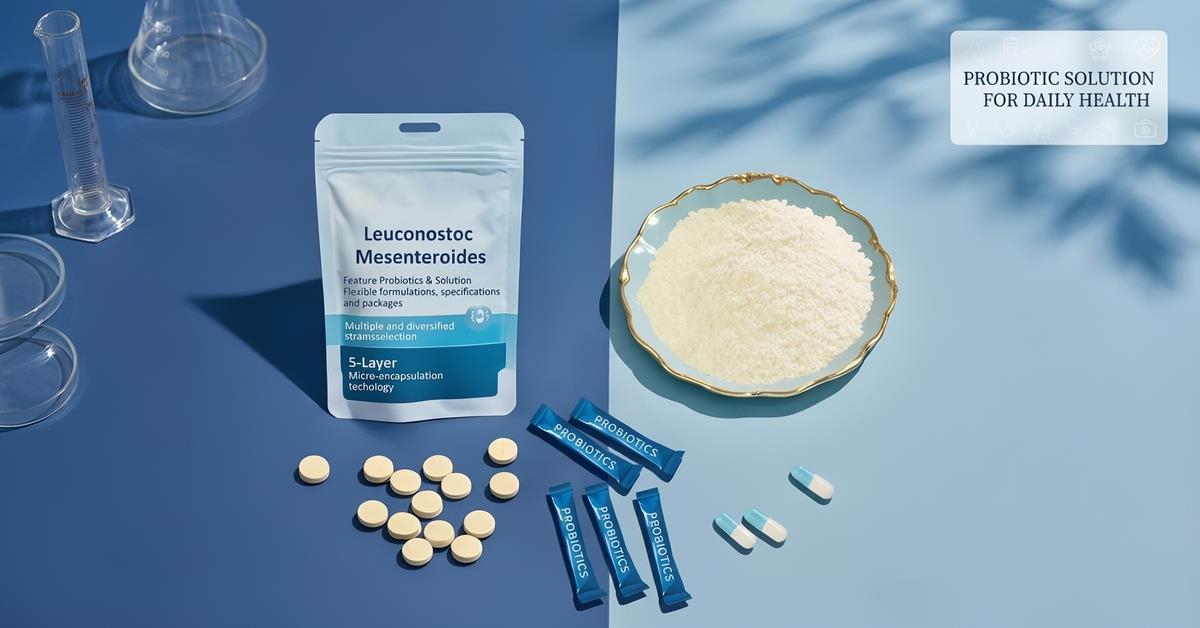
Why Packaging Matters for Probiotic Viability
Probiotics are living microorganisms. Their viability can decline during processing and storage, and the rate of change depends on the strain, formulation, moisture conditions, oxygen exposure, and temperature.
Packaging helps control the environment surrounding the finished product. In particular, it can slow the movement of water vapor and oxygen into the package.
Moisture ingress may change the water activity of a dry probiotic formulation and contribute to a less favorable storage environment. Oxygen exposure can also be a concern for oxygen-sensitive strains, including certain Bifidobacterium species.
However, packaging does not compensate for an unsuitable formulation or poor manufacturing controls. A product with inadequate initial stability may still experience significant viability loss even when placed in a high-barrier package.
The objective is to create a compatible system in which the probiotic ingredient, excipients, manufacturing process, packaging, and storage conditions work together.
Moisture Barrier: A Critical Packaging Consideration
For dry probiotic powders, moisture protection is often a major packaging consideration.
Water vapor can gradually pass through packaging materials or enter through imperfect seals. The rate of moisture transfer depends on the packaging material, thickness, surface area, temperature, relative humidity, and seal quality.
One useful parameter is the water vapor transmission rate (WVTR), which describes the rate at which water vapor passes through a material under specified test conditions.
When comparing packaging options, buyers should avoid treating a WVTR value as a universal measure of package performance. The test conditions, material thickness, and actual package construction matter.
A laboratory film result may not fully represent the performance of a finished bottle, pouch, or sealed sachet.
For probiotic projects, the packaging evaluation should consider:
Water vapor barrier performance
Package and closure compatibility
Seal integrity
Desiccant requirements, where appropriate
Storage temperature and humidity
Expected shelf life and distribution conditions
A desiccant can help control moisture within a package, but it should be selected according to the product and package design. It is not a substitute for adequate barrier protection or validated packaging performance.

Oxygen Barrier and Sensitive Strains
Moisture is not the only environmental factor that matters. Oxygen sensitivity varies among probiotic strains, and certain microorganisms may be more vulnerable to oxidative stress than others.
Oxygen transmission rate (OTR) describes the amount of oxygen that passes through a packaging material under defined conditions.
For formulations containing oxygen-sensitive strains, a packaging material with suitable oxygen barrier properties may be beneficial. Nitrogen flushing or oxygen scavenging systems may also be considered, depending on the product design.
These technologies should not be selected automatically. Nitrogen flushing, for example, needs to be assessed in relation to the package structure, filling process, product characteristics, and residual oxygen target.
The important point is that oxygen management should be based on the strain and formulation rather than a general assumption that every probiotic product requires the same packaging solution.
Comparing Common Probiotic Packaging Formats
Different packaging formats offer different practical advantages.
| Packaging format | Potential advantages | Points to evaluate |
|---|---|---|
| HDPE or other suitable bottles | Convenient for capsules and tablets; can accommodate desiccants | Closure seal, moisture barrier, repeated opening |
| Aluminum foil sachets | Individual portions; can offer strong moisture and oxygen protection | Laminate structure, seal integrity, filling compatibility |
| Blister packs | Individual unit protection and controlled dispensing | Barrier properties of the forming and lidding materials |
| High-barrier pouches | Flexible format for powder products | Film structure, zipper performance, seal quality |
| Glass containers | Strong barrier properties when properly closed | Weight, breakage risk, closure system, handling |
No format is automatically best for every probiotic application. A single-dose sachet may be appropriate for a powder intended to be consumed once, while a multi-use bottle may be more convenient for capsules but needs to account for repeated exposure after opening.
The selection should reflect the intended dosage form, distribution route, consumer use pattern, and stability data.
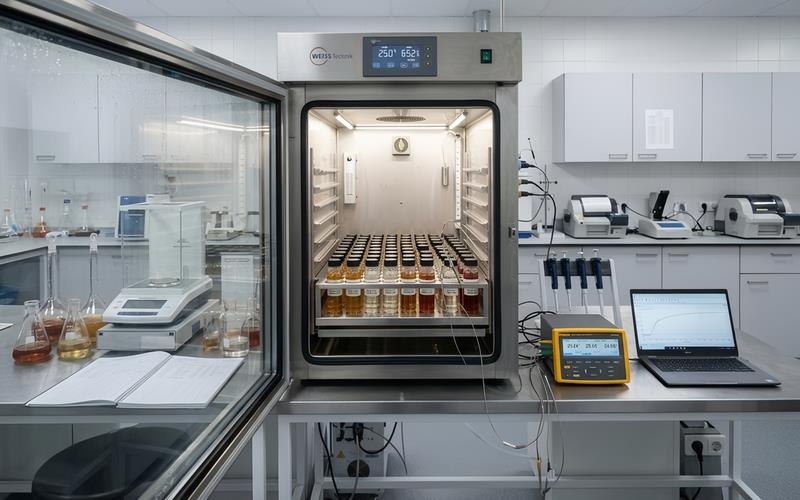
Why the Finished Product Must Be Tested
A packaging material specification alone cannot prove that the finished probiotic product will meet its shelf-life target.
The formulation may contain multiple strains, carriers, prebiotic fibers, flavors, or other ingredients. These components can influence moisture behavior and stability.
A practical evaluation should begin with a defined target product profile.
R&D teams should identify the target CFU at manufacture and at the end of shelf life, the dosage form, storage conditions, and expected distribution environment.
The team can then compare candidate packaging systems using the actual formulation.
A stability program may include:
Initial viable count testing
Water activity and moisture measurements
Residual oxygen evaluation where relevant
Packaging seal and integrity checks
Real-time stability testing
Accelerated stability testing as a supporting tool
Monitoring of relevant physical and microbiological quality attributes
Accelerated studies can help identify potential risks, but they should not automatically be treated as a direct replacement for real-time shelf-life data. The relationship between accelerated conditions and actual product behavior must be scientifically justified.
Questions to Ask Packaging and Ingredient Suppliers
Packaging and ingredient suppliers should be evaluated together when a project involves sensitive probiotic strains.
Useful questions include:
What are the material’s WVTR and OTR values, and under which test conditions?
Are the values measured on the film or the finished package?
Is the closure or seal system compatible with the intended product?
Is a desiccant or oxygen control system recommended?
What storage conditions are specified for the probiotic ingredient?
Are strain-specific stability data available?
Can samples be provided for packaging compatibility trials?
These questions help identify whether the proposed packaging system is supported by relevant technical information.
Building a More Reliable Probiotic Product
Probiotic shelf-life performance is a system-level result. It depends on the microorganism, formulation, manufacturing conditions, packaging, and storage environment.
At Esubio, we support sourcing requirements for probiotic ingredients and functional materials used in powder and capsule development. For projects involving moisture-sensitive ingredients, it is useful to define the target strain, dosage form, CFU requirements, packaging concept, and storage conditions at the beginning of the discussion.
Explore our Product Catalog or contact our team to discuss probiotic ingredient specifications and sample requirements.
The key takeaway: packaging should be selected and evaluated as part of the probiotic stability system. A suitable package helps protect product quality, but only finished-product testing can demonstrate whether the complete system meets its shelf-life requirements.