
How to Read a Raw Material COA: What Buyers Should Check
A supplier sends a Certificate of Analysis (COA), and the results appear to meet the specification. Is the ingredient ready for approval?
Not necessarily.
A COA is an important quality document, but it should not be treated as a complete substitute for supplier qualification, material verification, or a review of the customer’s own requirements.
For procurement, quality assurance, and R&D teams, knowing how to read a raw material COA helps identify missing information, compare suppliers more accurately, and reduce avoidable quality risks before an ingredient enters production.

What Is a Certificate of Analysis?
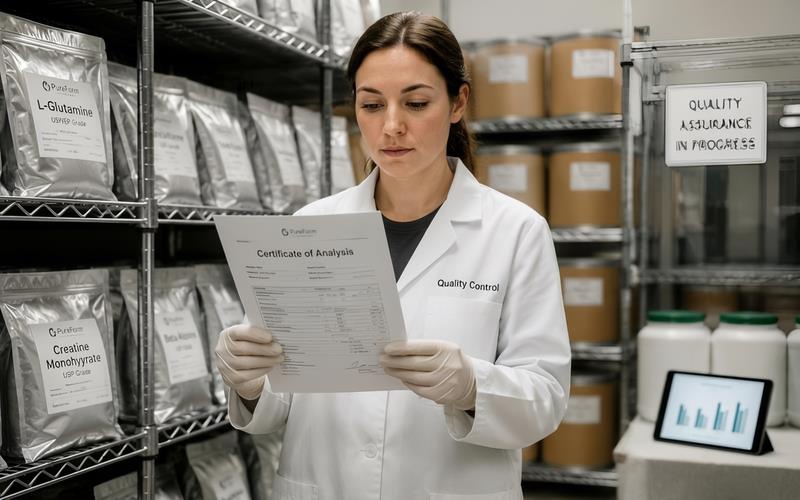
A Certificate of Analysis is a document that reports selected test results for a specific material or batch.
Depending on the supplier and ingredient type, it may include:
Product name and grade
Batch or lot number
Manufacturing date and retest or expiry date
Test parameters
Specification limits
Test methods
Actual test results
Release or approval information
The exact format varies across suppliers and industries. Some COAs provide detailed analytical results, while others contain only a short list of quality parameters.
The most important point is traceability: the document should clearly relate to the material and batch being purchased or received.
A typical product specification describes the quality requirements that a material is expected to meet. A batch COA reports the results for a particular lot. These documents serve different purposes and should not be confused.
Check Product Identity and Batch Traceability First
Before reviewing the analytical values, confirm that the document belongs to the material under consideration.
Start with the product name. Is it the same ingredient, grade, concentration, and form specified in the purchase order?
For botanical extracts, this may include the botanical name, plant part, extract type, and standardization level. For amino acids, it may include the exact amino acid identity and grade. For probiotics, it may include strain identification and the relevant viable count information.
Next, check the batch number. It should correspond to the label, packaging, and shipment documents for the lot being supplied.
Review the manufacturing date and retest or expiry date where applicable. If the label and COA show different dates, do not assume that one is correct without clarification. Request batch-specific documentation and an explanation of the date fields.
A document for a previous or reference batch may help illustrate a typical specification, but it should not be presented as the actual COA for a newly supplied batch.

Specification Limits vs Actual Test Results
One of the most important parts of a COA is the difference between the specification and the actual result.
A specification defines an acceptance range or limit. The actual result reports what was measured for the tested batch.
For example:
| Parameter | Specification | Actual result |
|---|---|---|
| Assay | 98.0–102.0% | 99.4% |
| Moisture | NMT 5.0% | 3.2% |
| Heavy metals | Within stated limits | Reported result |
| Appearance | White crystalline powder | Conforms |
NMT means “not more than.” NLT means “not less than.”
A statement such as “Pass” or “Conforms” may be useful, but it provides less detail than a numerical result. Where the parameter is critical to the application, buyers may need the actual result and the corresponding test method.
The acceptance criteria should also match the buyer’s approved specification. A supplier’s standard limit may not be sufficient for a customer’s particular formulation.
For example, a customer may request a maximum water activity value for a moisture-sensitive ingredient. If the supplier’s COA reports only moisture content, the document does not establish whether the Aw requirement has been met.
Why Test Methods Matter
Two suppliers may report results for the same parameter, but the values may not be directly comparable if different analytical methods are used.
The test method provides important context for interpreting the result.
Depending on the ingredient, relevant methods may include HPLC, GC, titration, loss on drying, Karl Fischer, microbiological enumeration, or other validated analytical procedures.
A COA should identify the test method or provide enough information for the customer to understand how the result was obtained.
When reviewing methods, ask:
Is the method appropriate for the ingredient?
Is it a recognized or validated method?
Does the method measure the parameter required by the specification?
Are the results reported in the correct units?
Are the method and acceptance limits consistent with the customer’s quality requirements?
For probiotic materials, for example, viable count results should be interpreted in the context of the stated unit, test method, strain or blend identity, and sample handling conditions.
A CFU result without sufficient product and batch context is not enough to establish suitability for every application.
COA Review Should Match the Ingredient Type
Different raw materials require different quality checks. A generic checklist is useful, but it should not replace ingredient-specific evaluation.
| Ingredient category | Parameters buyers may need to review |
|---|---|
| Probiotics | Strain identity, viable count, moisture, Aw where relevant, microbiological quality |
| Botanical extracts | Botanical identity, plant part, marker compounds, assay, contaminants, solvent information |
| Amino acids | Identity, assay, related substances or impurities, moisture, relevant physical properties |
| Vitamins and minerals | Identity, assay, relevant impurities, contaminant limits |
| Fruit and vegetable powders | Identity, moisture, Aw, microbiological quality, carrier composition where relevant |
Not every parameter applies to every ingredient. The buyer should define which tests are critical based on the ingredient, application, risk assessment, and applicable regulatory requirements.
Common Warning Signs During COA Review
A COA does not automatically become unreliable because it is short or formatted differently from another supplier’s document. However, certain gaps deserve clarification.
No batch number: Without clear lot identification, it may be difficult to connect the document to the material received.
Only “Pass” or “Conforms”: This may be insufficient when the buyer needs to assess a specific numerical result.
Missing test methods: The buyer may not be able to evaluate how the reported result was obtained.
Product name does not match the order: Differences in grade, concentration, plant part, or strain may indicate that the document refers to another material.
Outdated or reference COA: A historical sample document should not be mistaken for a batch-specific release document.
Unclear dates: Manufacturing, testing, retest, and expiry dates should be distinguishable.
Missing critical parameters: A document may be genuine but still fail to address the customer’s required specification.
The correct response is to request clarification or additional documentation, not to assume misconduct based on one missing field.
Does a COA Replace Supplier Qualification?
No. A COA is one part of supplier quality evaluation.
For US dietary supplement manufacturing, 21 CFR Part 111 establishes requirements concerning component specifications and verification. Under §111.75, manufacturers relying on a supplier’s COA for certain component requirements must qualify the supplier by establishing the reliability of the supplier’s results, document that qualification, and periodically reconfirm it.
The specific requirements depend on the type of component and the regulatory context. Dietary ingredients have separate identity-verification requirements, and buyers should not assume that receiving a COA removes all testing obligations.
In practical supplier qualification, companies may review:
Supplier quality systems and relevant certifications
Product specifications and analytical methods
Batch-specific COAs
Supporting test reports where needed
Traceability and change-control procedures
Historical batch consistency
Corrective action and complaint-handling processes
The objective is to establish whether the supplier can consistently provide material that meets the agreed requirements.
A Practical COA Review Checklist
Before approving a raw material, procurement and QA teams can use the following checklist:
| Review item | Check |
|---|---|
| Product identity | Does the product name and grade match the purchase requirement? |
| Batch traceability | Is the batch number clear and consistent with the label? |
| Dates | Are manufacturing, test, and retest or expiry dates clear? |
| Specifications | Are the limits defined for required parameters? |
| Actual results | Are numerical results available where needed? |
| Test methods | Are methods identified and appropriate? |
| Units | Are units and reporting bases clear? |
| Critical parameters | Are all customer-required tests covered? |
| Supporting documents | Are additional reports or declarations required? |
| Supplier qualification | Has the supplier’s documentation reliability been assessed? |
This review helps distinguish between a document that is complete enough for initial evaluation and one that still needs further verification.
Better Documentation Supports Better Sourcing Decisions
A reliable sourcing process depends on more than comparing prices and product names. Technical specifications, batch traceability, testing methods, and supplier documentation all contribute to a more informed purchasing decision.
At Esubio, we support sourcing projects involving probiotics, botanical extracts, amino acids, vitamins, minerals, and other functional ingredients. For a specific project, buyers can share the ingredient name, target specification, application, and required documentation so that available options can be assessed against the actual requirements.
Explore our Product Catalog or contact our team to request available specifications and batch-related documentation.
The key takeaway: a COA is a valuable quality document, but it is not a universal guarantee of material suitability. Buyers should review identity, batch traceability, methods, actual results, and the requirements of the intended application before making an approval decision.