
Pharmacopoeia Compliance: 5 Costly Gaps Hiding in Your COA
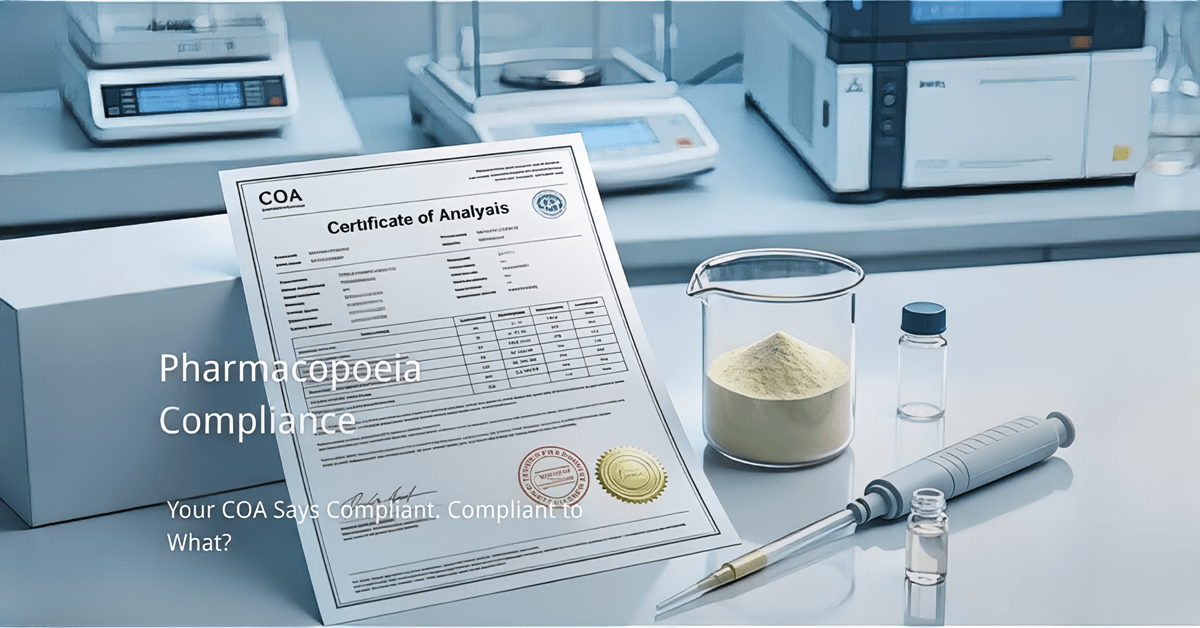
Your COA says compliant. But compliant to which pharmacopoeia, for which target market, and did the test method actually match your finished product’s registration requirements? In nutraceutical ingredient procurement, pharmacopoeia compliance has quietly become the gap that surfaces at the worst possible moment — during a factory audit, an EU Novel Food dossier review, or a TGA registration check, long after the raw material has already been formulated into finished product. For OEM factories, brand owners, and contract manufacturers working across multiple export markets, pharmacopoeia compliance is not a theoretical concern. It is an operational risk sitting inside specification documents that most teams have not looked at closely enough.
Why Pharmacopoeia Compliance Is Not a Single Checkbox
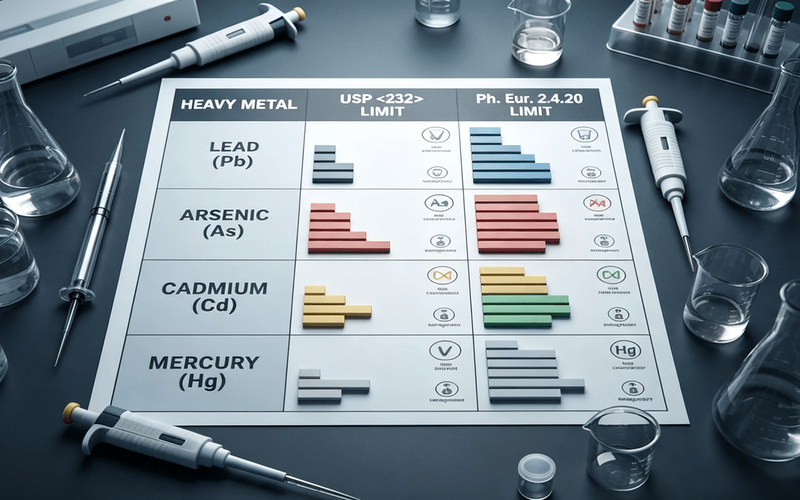
Many procurement teams see Arsenic: Pass on a COA and assume the compliance question is closed. It is not. USP <232> allows total arsenic up to 15 ppm, while Ph. Eur. 2.4.20 caps inorganic arsenic at 1 ppm, a fifteen-fold gap that requires ICP-MS speciation testing to resolve for any product entering the EU, Australian, or Canadian markets. Cadmium shows a five-fold difference between the two standards, and mercury shows the same fifteen-fold gap as arsenic — three separate pharmacopoeia compliance failures hiding behind one passing COA line. A botanical extract tested only against USP <232> can be fully non-compliant the moment it enters an EU or AU formulation, and R&D teams frequently have no visibility into that pharmacopoeia compliance gap until an auditor asks for the underlying method.
Parameter: Lead (Pb) — USP <232>: ≤5 ppm oral — Ph. Eur. 2.4.20: ≤5 ppm — Key Difference: Aligned across standards
Parameter: Arsenic (As) — USP <232>: ≤15 ppm total — Ph. Eur. 2.4.20: ≤1 ppm inorganic — Key Difference: 15x limit gap, ICP-MS speciation required for EU/AU/CA
Parameter: Cadmium (Cd) — USP <232>: ≤5 ppm — Ph. Eur. 2.4.20: ≤1 ppm — Key Difference: 5x difference
Parameter: Mercury (Hg) — USP <232>: ≤15 ppm — Ph. Eur. 2.4.20: ≤1 ppm — Key Difference: 15x difference
The Three Ingredient Categories Under the Most Compliance Pressure
Pharmacopoeia compliance pressure is not spread evenly across ingredient categories. Gut health and postbiotic ingredients sit under an evolving Ph. Eur. 5.1.8 chapter where citation ambiguity is the most common blind spot, and the fix is simply requiring the specific chapter and edition cited on the COA. NMN and NR carry no USP or Ph. Eur. monograph at all, which means any COA describing NMN as USP grade is using marketing language with no regulatory basis — a claim that gets flagged fast during client due diligence, and the correct requirement instead is ICH Q7 GMP documentation plus a validated HPLC method. Botanical extracts carry a residual solvent interpretation gap between markets, and dual-market sellers should request both Ph. Eur. 5.4 and USP <467> annotations on the same COA. Sports nutrition amino acids sit in the safest position, with a full USP monograph and partial Ph. Eur. coverage, though EU client expectations can still diverge from what a USP-only panel confirms.
Why a 95 Percent HPLC Result Doesn’t Always Mean 95 Percent
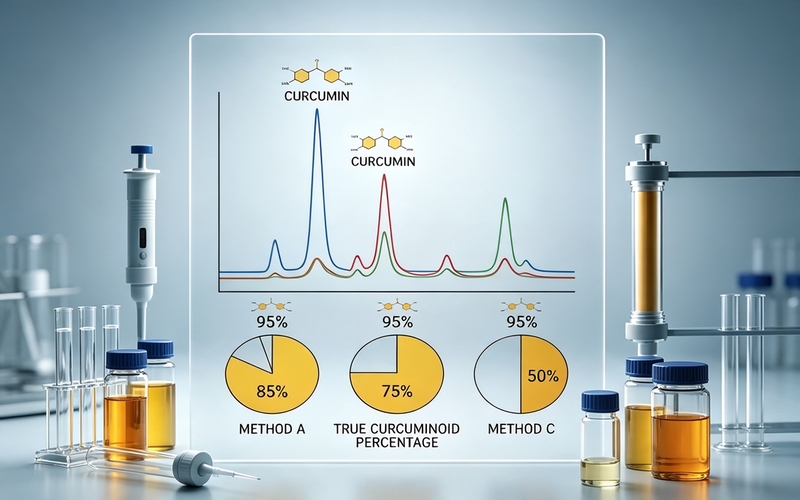
A curcumin extract labeled 95 percent curcuminoids by HPLC looks precise, but that single number can represent three different analytical realities depending on method. A UV method run at 425 nanometers without a certified standard measures total absorbing pigments and can report 95 percent when true curcuminoid content is closer to 60 to 75 percent. A method using a single curcumin standard against a three-curcuminoid mixture typically overstates the result, landing the true figure closer to 85 to 90 percent. Only a full EP or USP method using individual curcumin, DMC, and BDMC standards against a certified reference mixture produces a genuinely defensible 95 percent figure. The practical question for procurement is not what number appears on the COA, but which method generated it, and whether the supplier is willing to provide the underlying chromatogram and reference standard lot number on request — this single check is often where pharmacopoeia compliance is won or lost on botanical extracts.
What This Costs You If You Skip the Verification
A dossier rejection from an EU Novel Food reviewer or a failed TGA registration check does not just cost the fee for resubmission. It costs the production run already sitting in a warehouse waiting on market clearance, the brand client relationship built on a launch date that just slipped by months, and in the worst cases, a full product recall traced back to a heavy metals panel that was never run to the standard the target market actually required. For an OEM or CDMO, that failure lands on your factory’s record with that client, not just on the supplier’s. Verifying pharmacopoeia compliance before the ingredient enters formulation is materially cheaper than discovering the gap after finished product is already on a shelf or in a warehouse, and that timing is the entire point of building pharmacopoeia compliance into ingredient qualification rather than treating it as an audit-week scramble.
What Tier-One Chinese Suppliers Are Actually Doing
At the top of the supply chain, responsible manufacturers no longer claim compliance with a single standard. They run dual-panel or triple-panel testing because their clients span the US, EU, Australia, and Canada simultaneously. This means ICP-MS speciation covering both total arsenic under USP and inorganic arsenic under Ph. Eur. in the same test run, residual solvent panels referencing ICH Q3C classes alongside Ph. Eur. 5.4 annotation, microbial panels reported in TAMC and TYMC format with organism-level confirmation, and reference standards traceable to either USP or EDQM. This is not yet standard market practice, but it represents the pharmacopoeia compliance baseline any supplier formulating for regulated export markets should be able to provide without hesitation.
Practical Checklist for R&D and Procurement Teams
Before your next ingredient qualification round, map your finished product’s target markets and identify the controlling pharmacopoeial standard for each one. Confirm your supplier’s COA specifies which standard each individual test was run against, not just the result value on its own. For heavy metals, confirm ICP-MS testing with speciation for inorganic arsenic on any ingredient entering EU, Australian, or Canadian formulations. For botanical extracts, request both USP and Ph. Eur. residual solvent annotations when selling into dual markets simultaneously. For novel actives such as NMN, Urolithin A, and Spermidine, require the supplier’s validated HPLC method documentation, since no pharmacopoeial monograph shortcut exists for these ingredients. For postbiotics and heat-killed cultures, request the specific Ph. Eur. chapter and edition cited for microbial specification, since this detail is updated more often than most COAs reflect, and staying current on it is a core part of ongoing pharmacopoeia compliance rather than a one-time check.
Where to Verify Pharmacopoeia Compliance Before Your Next Order
Closing this gap starts with asking suppliers for the underlying method documentation, not just the summary result on a COA. esubio provides dual-panel testing documentation, method-level transparency, and chromatogram access on request for botanical extracts, amino acids, probiotics, and novel actives sold into regulated export markets. Explore our botanical extracts range or reach out with your target market’s pharmacopoeial requirements, and our team can confirm test panel coverage before you commit to a sample order.
References
United States Pharmacopeia. General Chapter <232> Elemental Impurities — Limits. https://www.usp.org/chemical-medicines/elemental-impurities-updates
European Directorate for the Quality of Medicines & HealthCare. Ph. Eur. 2.4.20 Determination of Elemental Impurities. https://www.edqm.eu/en/european-pharmacopoeia-ph-eur-11th-edition
International Council for Harmonisation. ICH Q3C(R9) Guideline for Residual Solvents. https://www.ich.org/page/quality-guidelines
European Food Safety Authority. Novel Food. https://www.efsa.europa.eu/en/topics/topic/novel-food