
Powder Caking and Flowability: What Formulators Should Investigate
A powder blend may look uniform when it leaves the production line, but several weeks later it may become difficult to pour, form hard lumps, or show inconsistent flow during filling.
For supplement brands and powder manufacturers, these problems can affect more than appearance. Caking and poor flowability may create difficulties during conveying, blending, filling, packaging, and consumer use.
The first reaction is often to look for a different ingredient or add an anti-caking agent. That may be part of the solution, but it is not always the right starting point.
Powder performance is influenced by several interacting factors, including moisture, water activity, particle characteristics, formulation composition, environmental conditions, and packaging.
Understanding these factors helps R&D and production teams identify the actual cause before changing the formula.

Why Does a Powder Become Lumpy?
Powder caking occurs when particles form stronger connections and gradually aggregate into larger masses. Depending on the material and environmental conditions, moisture can contribute to particle bridging, surface dissolution, recrystallization, or changes in the physical state of the powder.
However, moisture is not the only factor.
Particle size distribution, particle shape, surface characteristics, density, and the presence of other ingredients can also influence how particles interact. Temperature, relative humidity, storage time, and mechanical stress may further affect the result.
This explains why two powders with similar moisture content can behave differently during storage.
A powder’s performance should therefore be assessed as a combination of material properties and actual handling conditions.
Moisture Content and Water Activity Are Not Interchangeable
Moisture content measures the amount of water in a material. Water activity (Aw) describes the availability of water for physical, chemical, and microbiological processes under defined conditions.
Both measurements can be useful, but they answer different questions.
A material may have a relatively low moisture content while still showing a water activity that requires attention. Conversely, two materials with similar Aw values may have different moisture contents.
For powder formulation, neither result should automatically be used as a substitute for the other.
When a moisture-sensitive ingredient is involved, R&D teams should define which parameter is relevant to the product’s stability and processing requirements. If both are important, include both in the evaluation.
Testing conditions also matter. Sample preparation, temperature, equilibration, and measurement method should be consistent when comparing results.

Particle Size and Bulk Density Can Affect Powder Flow
Particle characteristics play an important role in powder handling.
Fine particles may have a greater tendency to form cohesive interactions, while differences in particle size between ingredients can contribute to segregation during transport or handling.
Bulk density also matters. If components have substantially different densities or particle size distributions, a blend may separate under certain handling conditions.
This can create two separate problems:
Poor flow during processing.
Non-uniform distribution of ingredients in the final blend.
A powder that flows well as an individual ingredient may not behave the same way after it is combined with amino acids, minerals, botanical extracts, flavors, sweeteners, or other functional ingredients.
For this reason, R&D should evaluate the complete blend whenever possible rather than relying only on individual ingredient descriptions.
Hygroscopic Ingredients Need Special Attention
Some ingredients absorb moisture from the surrounding environment more readily than others. This property is known as hygroscopicity.
The degree of moisture uptake depends on the material and the surrounding relative humidity, temperature, and exposure time.
In a multi-ingredient powder, one component may absorb moisture more readily than the others. This can change the physical behavior of the blend during storage.
Examples of materials that may require careful moisture evaluation include certain botanical extracts, fruit powders, amino acid blends, mineral salts, probiotics, and other specialty ingredients. Their behavior depends on their specific composition and processing characteristics, so it is not appropriate to assume that every material in a category has the same moisture sensitivity.
For a new formulation, ask suppliers for relevant moisture or Aw data where available. Then evaluate the material under conditions that reflect the intended manufacturing and storage environment.
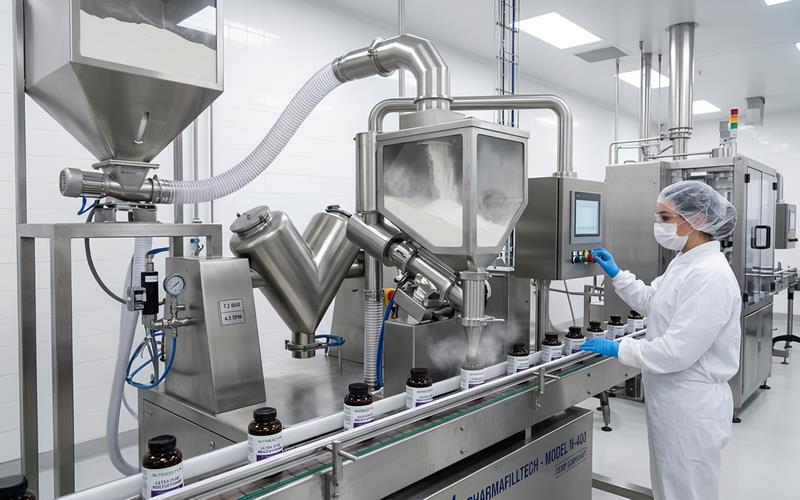
Packaging and Storage Are Part of the Formulation Strategy
A well-designed formula can still experience physical changes if the packaging does not provide suitable protection.
Moisture can enter through packaging materials, seals, or repeated exposure after opening. Temperature fluctuations and long storage periods may also affect powder performance.
For moisture-sensitive products, packaging evaluation should consider:
Moisture barrier properties of the packaging material.
Seal integrity and closure performance.
Headspace and exposure during filling.
Desiccant suitability, if used.
Storage temperature and relative humidity.
Expected shelf life and distribution conditions.
The packaging decision should be based on the product’s actual requirements and supported by appropriate stability or packaging evaluation.
A low moisture result at the time of ingredient release does not guarantee that the finished product will maintain the same characteristics throughout storage.
Should You Add an Anti-Caking Agent?
Anti-caking agents can help improve powder handling in suitable applications. However, selecting one should follow an understanding of the formulation and the cause of the problem.
The choice depends on the ingredient system, intended dosage form, regulatory requirements, labeling considerations, and target market.
Before adding an anti-caking agent, consider whether the problem is caused by moisture exposure, particle characteristics, a packaging issue, or incompatibility between blend components.
A formulation trial should assess more than whether the powder looks free-flowing immediately after mixing. It should also consider flow after storage, blend uniformity, filling performance, sensory properties, and any relevant product specifications.
The use level and suitability of an additive must be confirmed for the intended application and market. Do not assume that an ingredient suitable for one product can automatically be used in another.
A Practical Evaluation Plan for R&D Teams
When a powder shows caking or poor flow, a structured investigation is more useful than changing several variables at once.
Start by documenting the problem: when it appears, where it occurs, whether it affects the whole batch or specific areas, and whether it is associated with a particular production or storage condition.
Then review the following:
Ingredient information: Compare the specifications, moisture results, Aw data where relevant, particle size, and bulk density of the individual components.
Process conditions: Review mixing time, filling environment, exposure to ambient humidity, and any changes in processing conditions.
Packaging: Check the packaging barrier, seal quality, storage temperature, and exposure after opening.
Finished-blend testing: Evaluate flow, appearance, blend uniformity, and physical stability under defined conditions.
Change assessment: If an ingredient or processing aid is changed, record the change and determine whether additional testing is needed.
This approach helps teams identify the most likely contributing factors and avoid unnecessary formulation changes.
What to Ask When Sourcing Powder Ingredients
If you are developing a powder product, include practical performance requirements in your sourcing inquiry.
For example, ask whether the supplier can provide available information on:
Moisture content and water activity.
Particle size distribution.
Bulk density.
Solubility or dispersion behavior, where applicable.
Recommended packaging and storage conditions.
Relevant batch testing and product specifications.
If you have a known flowability or caking issue, describe the application and the conditions under which the problem occurs. A supplier can provide more relevant information when the actual requirement is clear.
Build Powder Performance into Ingredient Selection
Powder flowability should not be treated as a final-stage production issue. It deserves attention during ingredient selection and formulation development.
For supplement brands and manufacturers, a suitable ingredient is one that meets the required quality specification and works within the intended process, packaging, and storage conditions.
Esubio supports sourcing for functional ingredients and specialty raw materials used in powder formulations, including amino acids, botanical extracts, probiotics, fruit and vegetable powders, and selected excipients.
If your team is developing a moisture-sensitive powder or investigating caking and flowability problems, share the ingredient, application, and relevant technical requirements with us.
Visit Esubio to explore ingredient solutions and discuss your formulation requirements.
A powder that passes incoming inspection is not automatically a powder that will perform well in the finished product. Formulation, processing, and storage need to be considered together.
References
Water Activity of Dry Products — technical application note
https://webpages.ciencias.ulisboa.pt/~fjsantos/44388/2006-07/dryprods.pdfPowder Characteristics — Pharmaceutical Manufacturing Handbook excerpt
https://www.uv.mx/personal/izcamacho/files/2012/02/Pharmaceutical-Manufacturing-Handbook-Production-and-Processes-Wiley-2008.pdfFDA — Water Activity (Aw) in Foods
https://www.fda.gov/inspections-compliance-enforcement-and-criminal-investigations/inspection-technical-guides/water-activity-aw-foods