
Prebiotic Ingredient Selection: How to Choose the Right Fiber for Your Formulation
Prebiotic ingredient selection is not simply a matter of choosing a familiar fiber such as inulin, FOS, or GOS.
These ingredients differ in composition, chain length, physical properties, fermentation characteristics, and suitability for different product formats. Choosing the wrong grade can affect taste, texture, solubility, processing, and the overall formulation experience.
For procurement teams, this means that products listed under the same broad category may not be directly comparable. For R&D teams, it means that the ingredient needs to be evaluated in the context of the complete formulation.
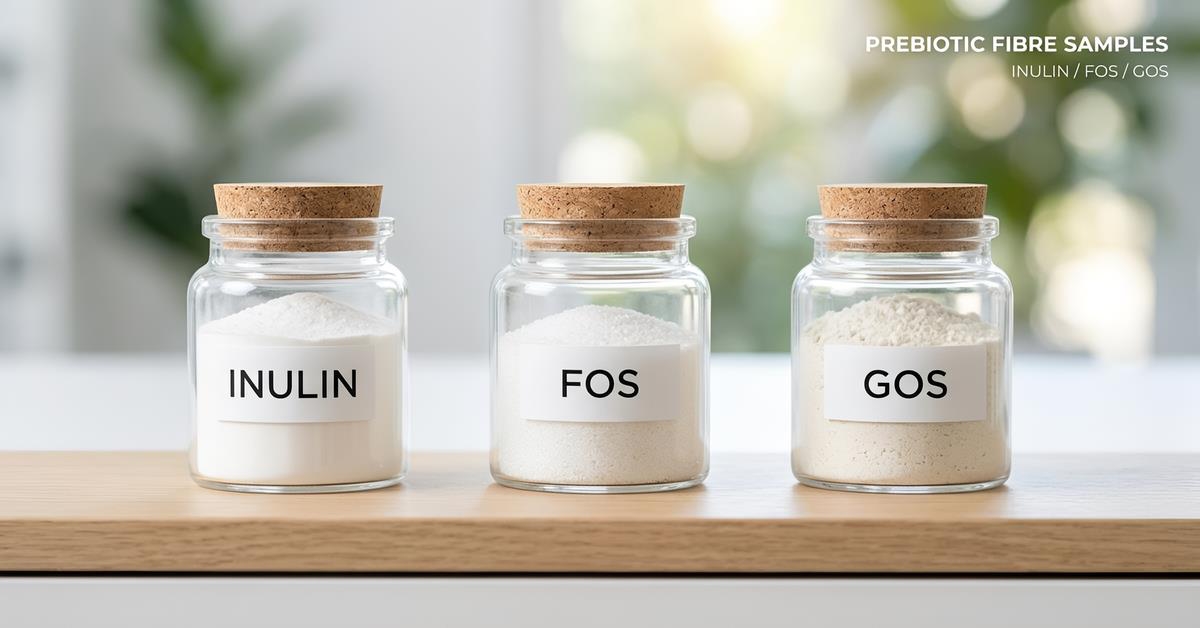
What Makes a Prebiotic Ingredient Different?
The term prebiotic refers to a substrate that is selectively utilized by host microorganisms and confers a health benefit. It is therefore more specific than simply describing a material as dietary fiber.
Not every fiber automatically qualifies as a prebiotic. The intended function and supporting evidence matter.
Commonly used prebiotic-related ingredients include:
Inulin
Fructooligosaccharides (FOS)
Galactooligosaccharides (GOS)
Selected resistant carbohydrates and other fermentable fibers
These materials should not be treated as interchangeable. Their composition and technological properties can differ substantially.
Compare Composition Before Comparing Price
A commercial ingredient name does not always provide enough information about its composition.
For example, inulin products may differ in chain-length distribution and degree of polymerization (DP). FOS products may differ in composition and the distribution of oligosaccharides. GOS products may have different composition profiles depending on the production process.
When comparing quotations, request:
| Evaluation item | What to clarify |
|---|---|
| Ingredient identity | Inulin, FOS, GOS, or another defined material |
| Composition | Declared carbohydrate or oligosaccharide profile |
| DP information | Whether chain-length distribution is available and relevant |
| Purity or content | The analytical definition behind the declared value |
| Residual sugars | Whether glucose, fructose, lactose, or other sugars are present |
| Moisture | Test method and specification |
| Physical form | Powder, syrup, or another commercial form |
| Carrier or additives | Whether other ingredients are included |
The term “purity” should be interpreted carefully. Different analytical methods may measure different components, so buyers should understand exactly what the declared percentage represents.
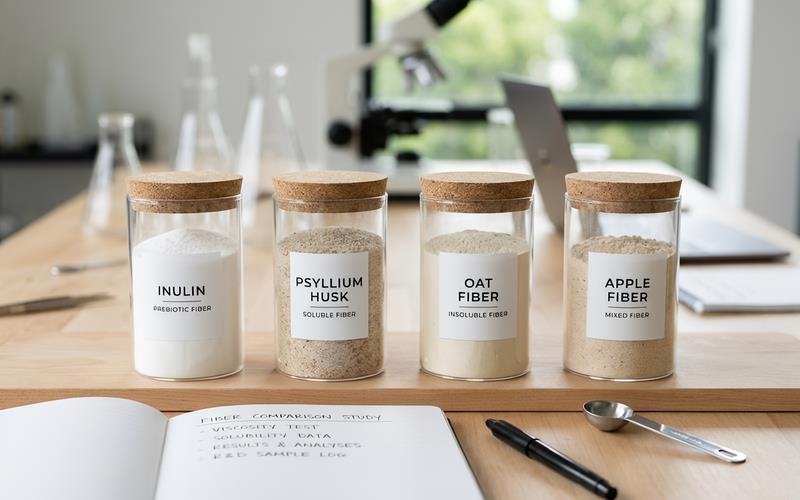
Inulin, FOS, and GOS: What Should Formulators Consider?
Inulin
Inulin is a group of fructan-type carbohydrates found in various plant sources.
Depending on its chain-length distribution and processing, commercial inulin grades can differ in solubility, viscosity, texture contribution, and other functional properties.
Formulators may evaluate inulin for:
Dietary fiber enrichment
Powder and beverage formulations
Texture modification
Selected prebiotic applications
A short-chain and a longer-chain inulin should not automatically be expected to behave identically.
Fructooligosaccharides (FOS)
FOS are short-chain fructans used in functional foods, beverages, and supplement formulations.
Depending on the product, FOS may contribute sweetness and soluble fiber content. However, composition, residual sugars, moisture, and physical form should be checked before selecting a grade.
For beverage applications, solubility and taste are important. For dry blends, moisture behavior and powder handling may deserve more attention.
Galactooligosaccharides (GOS)
GOS are galactose-containing oligosaccharides commonly used in selected functional food and nutritional applications.
Commercial GOS may be supplied in liquid or powder form. Their composition and residual carbohydrate profile should be reviewed, especially when the final product has specific nutritional or labeling requirements.
The choice between GOS, FOS, and inulin should be driven by the intended application and technical requirements—not by the assumption that one is universally better.
Consider Dose, Tolerance, and Finished-Product Experience
A prebiotic ingredient may have a suitable specification but still create formulation challenges when used at the intended dosage.
The amount used per serving, the combination of fermentable fibers, the target population, and the overall product composition all matter.
R&D teams should evaluate:
Intended daily serving and ingredient inclusion level
Total fiber contribution from the complete formulation
Taste and sweetness contribution
Gastrointestinal tolerance considerations
Consumer instructions and target population
Applicable regulatory and labeling requirements
Do not assume that increasing the inclusion level will automatically improve the finished product. Product development should consider both the intended functional purpose and consumer experience.
Any product benefit or health claim must be supported by appropriate evidence and reviewed under the applicable market’s regulatory framework.

Physical Properties Matter in Real Formulations
The ingredient’s technical behavior can influence product development just as much as its composition.
| Property | Why it matters |
|---|---|
| Solubility | Affects suitability for beverage and liquid applications |
| Viscosity | Can influence mouthfeel and processing |
| Particle size | May affect blending and powder handling |
| Moisture content | Relevant to material specifications and storage |
| Water activity | Provides information about water availability under test conditions |
| Hygroscopicity | May affect packaging and handling |
| Color and taste | Can influence the finished product’s sensory profile |
For example, a prebiotic powder that is suitable for a capsule blend may not be the preferred option for an instant beverage.
Likewise, a fiber selected for its texture contribution may require different processing considerations from one selected mainly for soluble fiber enrichment.
Prebiotic and Probiotic Combinations Need Additional Evaluation
Synbiotic formulations combine probiotics and substrates that are selectively utilized by host microorganisms.
However, combining a probiotic with a prebiotic does not automatically establish a synbiotic effect.
R&D teams should evaluate whether the selected components have a scientifically supported rationale for the intended product.
From a formulation perspective, consider:
Compatibility between the probiotic and prebiotic ingredients
Moisture and water activity of the complete blend
Physical properties and blending behavior
Probiotic viability during storage
Packaging and shelf-life requirements
Evidence supporting the intended combination
The complete formulation—not simply the ingredient list—needs to be assessed.
What Procurement Should Include in a Prebiotic RFQ
To receive comparable quotations, procurement teams should define the requirements as clearly as possible.
A useful RFQ may include:
Target ingredient: inulin, FOS, GOS, or another material
Required composition or content
Powder or liquid form
Intended application and dosage format
Target inclusion level, if established
Required quality documents and testing
Packaging and storage requirements
Sample quantity and expected commercial volume
Destination market and delivery requirements
If the formulation is still under development, share the application and key performance requirements first. The exact grade can then be evaluated through technical discussion and sample testing.
How Esubio Supports Prebiotic and Functional Ingredient Sourcing
Esubio supports supplement brands, food manufacturers, and R&D teams with sourcing coordination for selected functional ingredients.
When reviewing prebiotic requirements, we encourage customers to clarify the ingredient type, composition, intended application, dosage format, documentation requirements, and estimated quantity.
This helps procurement and formulation teams compare more relevant supply options rather than relying on product names alone.
If you are developing a prebiotic or synbiotic product, share your target ingredient and formulation requirements with our team.
Explore: https://www.esubio.com/product-catalog/
Contact: https://www.esubio.com/contact/
References
- https://isappscience.org/for-scientists/resources/?utm_source=chatgpt.com ISAPP — The International Scientific Association for Probiotics and Prebiotics
- https://pmc.ncbi.nlm.nih.gov/articles/PMC13742500/?utm_source=chatgpt.com Inulin structure–function relationships across the food–health continuum