
Nutraceutical Ingredient Sourcing From China: The Hidden Cost Guide
Nutraceutical ingredient sourcing from China now accounts for more than 60 percent of global output, and for procurement managers and R&D directors at OEM and ODM factories, that shift changes the math on almost every raw material line item. If your current COA reads 99 percent NMN, compliant, the real question is not whether the ingredient passes spec. It is how much of your unit cost you are paying unnecessarily because your sourcing strategy has not caught up with where the industry actually is. For factories quoting brand clients on tight margins, this gap is not academic. It is the difference between winning the next RFQ and losing it to a competitor who has already made the switch.
Why Nutraceutical Ingredient Sourcing From China Costs Less
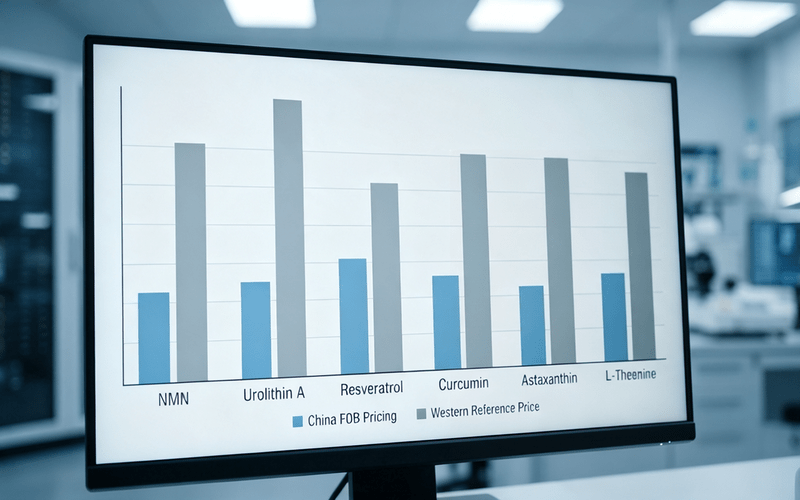
The price gap between Chinese and Western-origin ingredients reflects structural manufacturing advantages, not a race to the bottom. NMN, for example, is available from China at roughly 80 to 120 dollars per kilogram FOB with HPLC purity of 99 percent or higher, COA, and third-party testing, compared with a Western reference price of 350 to 500 dollars per kilogram for equivalent specification. Urolithin A, Resveratrol, Curcumin, Astaxanthin, and L-Theanine show the same pattern, typically two to three times cheaper at comparable purity and certification levels. These are indicative FOB ranges for batch quantities of 25 kilograms or more, and actual quotes vary by specification, MOQ, and certification requirements, but the pattern holds across almost every category once nutraceutical ingredient sourcing shifts toward vetted Chinese manufacturers.
Ingredient: NMN (Beta-NMN) — China Price FOB: 80 to 120 USD/kg — Western Reference Price: 350 to 500 USD/kg — Certifications Available: HPLC ≥99%, COA, 3rd-party tested
Ingredient: Urolithin A — China Price FOB: 90 to 150 USD/kg — Western Reference Price: 400 to 600 USD/kg — Certifications Available: EU Novel Food Ready
Ingredient: Resveratrol — China Price FOB: 40 to 70 USD/kg — Western Reference Price: 150 to 250 USD/kg — Certifications Available: HPLC ≥98%, Kosher/Halal
Ingredient: Curcumin 95% — China Price FOB: 25 to 45 USD/kg — Western Reference Price: 80 to 130 USD/kg — Certifications Available: Organic available, USDA
Ingredient: Astaxanthin — China Price FOB: 800 to 1200 USD/kg — Western Reference Price: 2500 to 4000 USD/kg — Certifications Available: 2%–10% oleoresin, GRAS
Ingredient: L-Theanine — China Price FOB: 35 to 60 USD/kg — Western Reference Price: 120 to 200 USD/kg — Certifications Available: USP grade available
What Nutraceutical Ingredient Sourcing Savings Look Like on Your Production Line
Take a mid-sized OEM factory running a monthly batch of 500 kilograms of NMN capsules for a brand client. At a Western reference price of roughly 400 dollars per kilogram, raw material alone costs 200,000 dollars for that batch. At a vetted China FOB price of around 100 dollars per kilogram for equivalent HPLC-99 specification, the same batch costs 50,000 dollars, a difference of 150,000 dollars per month before freight and duties are even factored in. That gap does not disappear into your margin automatically. It becomes negotiating room on the next contract, budget for a second production line, or the difference between a quote that wins the account and one that does not, and it is the direct output of smarter nutraceutical ingredient sourcing decisions made months before the RFQ lands.
Full Compliance Coverage Changes the Nutraceutical Ingredient Sourcing Calculation
Three years ago, incomplete compliance documentation was the primary concern in nutraceutical ingredient sourcing from China. For leading-tier manufacturers, that gap has been systematically closed. FDA GRAS and NDI documentation is now widely available for DSHEA-compliant products entering the US market. EU Novel Food dossiers with EFSA support cover the major novel actives. TGA-listed, ARTG-registered ingredients are available for the Australian market, and NPN application support is common for Health Canada filings. Halal certification through IFANCA or JAKIM is now standard rather than exceptional, and documentation compatible with JHFA and KFDA requirements is available with specification confirmed separately per market. For an OEM factory serving multiple brand clients across different export markets simultaneously, this means one qualified supplier relationship can often cover several regional filings instead of requiring a separate vendor per market, which is exactly the kind of consolidation that makes nutraceutical ingredient sourcing manageable at scale.
The Real Risk in Nutraceutical Ingredient Sourcing Isn’t Price
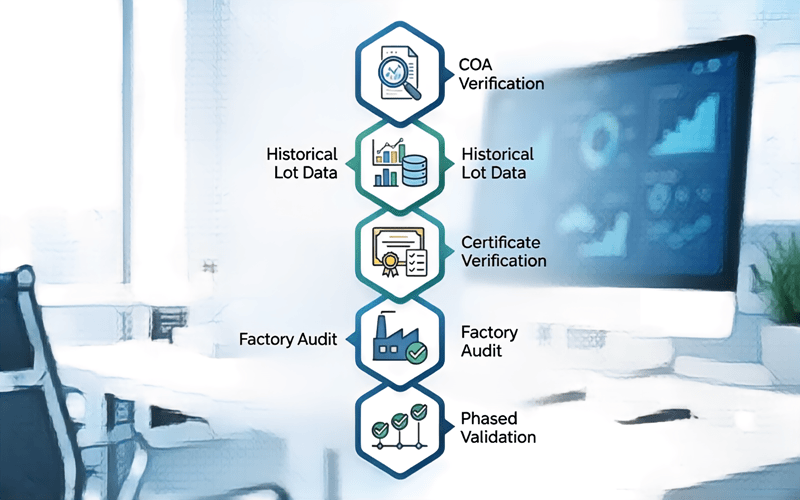
Not every Chinese supplier operates at the same level, and price alone tells you nothing about which ones are worth a long-term relationship. Suppliers worth building a relationship with should pass five checks without hesitation. First, they provide a full COA plus independent third-party lab reports from SGS, Eurofins, or Intertek, since internal-only testing is not verification. Second, they can produce historical COA data across at least three production lots to demonstrate batch-to-batch consistency, not just a single clean result used to win the initial order. Third, their certificates can be verified directly with the issuing body rather than taken at face value from a PDF. Fourth, they can provide a factory audit report or qualify for an on-site audit for any ingredient going into products sold in regulated markets, which matters more for an OEM than for a brand, since your factory is the one that answers to the client’s own auditors. Fifth, they support a phased validation path from sample to a 25-kilogram pilot batch to commercial volume, without pressuring you to skip a stage just to close the order faster. A supplier who resists any one of these five checks is signaling exactly where the risk in the relationship sits, and that risk is what separates disciplined nutraceutical ingredient sourcing from simply chasing the lowest quote.
High-Growth Ingredients to Watch for 2026 and Beyond
Several categories are scaling rapidly in China right now, with prices dropping as capacity comes online, which means the buyers who lock in supplier relationships early get the most pricing leverage before demand catches up with supply. Spermidine, sourced from autolyzed yeast, is often described as the next NMN for the anti-aging category and is approaching the 150 to 250 dollar per kilogram range as Chinese capacity scales, making it worth qualifying now rather than after your competitors have already secured allocation. Nicotinamide Riboside remains a strong NAD+ precursor with clinical backing and expanding Chinese production capacity. Functional dietary fiber, including inulin and FOS, continues to anchor the prebiotic category on the back of China’s agricultural and fermentation infrastructure, and is a practical category for OEMs already running powder-blend lines to add without new equipment. Crocetin and crocin from saffron extract are driving explosive demand in the mood and sleep category, with Gansu-origin material now available at commercial volumes. For an OEM factory, being able to offer any of these four categories on short lead time is a genuine differentiator when a brand client is shopping formulation ideas across multiple manufacturers. These are the clearest signal of where nutraceutical ingredient sourcing is heading over the next two years, and factories that qualify suppliers ahead of the demand curve are the ones capturing the pricing advantage rather than paying the premium once it becomes common knowledge.
Action Checklist for Procurement and R&D Teams
Before qualifying a new ingredient as part of your nutraceutical ingredient sourcing process, map your finished product’s target markets and identify the controlling pharmacopoeial standard for each one, whether USP, Ph. Eur., BP, or TGA. Confirm your supplier’s COA specifies which standard each test was run against, not just the numerical result. For heavy metals, confirm ICP-MS testing with speciation for inorganic arsenic when selling into the EU, Australia, or Canada. For botanical extracts, request both USP and Ph. Eur. residual solvent annotations if you are selling into dual markets at once. For novel actives such as NMN, Urolithin A, and Spermidine, require the supplier’s validated HPLC method documentation, since there is no pharmacopoeial shortcut for these ingredients. For postbiotics and heat-killed cultures, request the specific Ph. Eur. chapter cited for microbial specification. Run through this list before every new ingredient qualification, not just the first one, since specification and documentation requirements can shift between production lots even with the same supplier, and this checklist is what keeps nutraceutical ingredient sourcing repeatable instead of a one-off win.
Where to Start Your Nutraceutical Ingredient Sourcing
Getting the cost advantage without the compliance risk comes down to supplier selection, not just price comparison. esubio supplies NMN, Urolithin A, Resveratrol, and a wider range of botanical extracts and functional ingredients with full COA, third-party lab reports, and market-specific compliance documentation, and works directly with OEM and ODM factories on phased qualification from sample through commercial volume. Explore our botanical extracts range or reach out with your target market and specification, and our team can confirm certification coverage before you commit to a sample order.
References
U.S. Food and Drug Administration. GRAS Notice Inventory. https://www.fda.gov/food/generally-recognized-safe-gras/gras-notice-inventory
European Food Safety Authority. Novel Food. https://www.efsa.europa.eu/en/topics/topic/novel-food
Therapeutic Goods Administration. Australian Register of Therapeutic Goods. https://www.tga.gov.au/resources/artg
Health Canada. Natural and Non-prescription Health Products Directorate. https://www.canada.ca/en/health-canada/services/drugs-health-products/natural-non-prescription.html