
COA for Raw Materials: What Quality Teams Should Check Before Approving a New Ingredient
COA for Raw Materials is often the first document a quality team requests when evaluating a new ingredient supplier. But a COA alone rarely provides enough information to complete supplier and raw material qualification.
A certificate of analysis can show that a particular batch met specified requirements. It does not necessarily answer every question about identity, testing methods, traceability, safety documentation, certifications, or regulatory suitability.
For R&D, procurement, and quality teams, the more useful question is not:
“Does the supplier have a COA?”
It is:
“Does the supplier have enough reliable documentation for us to evaluate and approve this raw material?”

Why a COA for Raw Materials Is Only the Starting Point
A COA normally focuses on a specific batch and reports selected test items, specifications, and results.
For example, a botanical extract COA may include:
- Appearance
- Identification
- Assay or active compounds
- Moisture or loss on drying
- Heavy metals
- Microbiological limits
- Batch number
- Manufacturing date
- Expiration or retest date
These are important, but they may not cover every requirement of a customer’s raw material specification.
For dietary supplement manufacturers, quality systems also need to address the identity, purity, strength, composition, and contamination limits of components used in manufacturing. FDA’s dietary supplement CGMP framework specifically addresses these types of specifications.
That is why a visually complete COA should not automatically be treated as a complete qualification package.
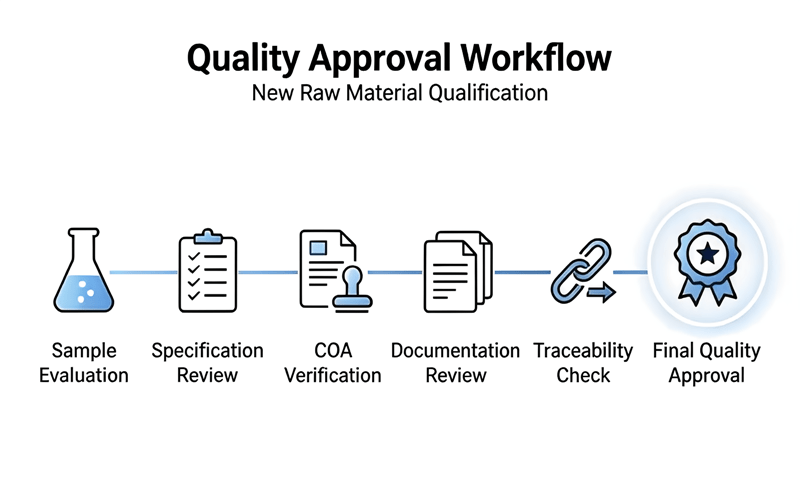
1. Check the Raw Material Specification
Before reviewing individual batch results, confirm that the supplier has a clear product specification.
A specification should define the characteristics that matter for the intended application, which may include:
- Product identity
- Assay or active content
- Physical characteristics
- Particle size
- Moisture
- Microbiological limits
- Heavy metals
- Other contaminants relevant to the ingredient
- Packaging and storage requirements
The exact testing requirements should be based on the ingredient and intended use rather than copied from a generic template.
For example, the critical parameters for a botanical extract may be different from those for an amino acid, probiotic, vitamin, or functional blend.
The key question is:
Does the supplier’s specification match the parameters your quality team actually needs to control?
2. Review the COA for Raw Materials at Batch Level
Once the product specification is established, review the actual batch COA.
The COA should allow your team to connect the test results to a specific batch.
Look for information such as:
- Product name
- Batch or lot number
- Manufacturing date
- Expiration or retest date
- Specification
- Actual result
- Testing or analysis date, where applicable
- Authorized approval
Batch traceability is particularly important when raw materials are used in regulated food or supplement manufacturing.
A passing sample is useful for initial evaluation, but it does not replace batch-level verification.
3. Ask How the Critical Parameters Are Tested
A common weakness in supplier documentation is that the specification is listed but the testing approach is unclear.
For critical parameters, quality teams may need to understand:
- What analytical method is used?
- Is the method an established compendial method or an internal method?
- Is the result quantitative or simply reported as pass/fail?
- Is testing performed on every batch or periodically?
- Is the test performed by the manufacturer or an external laboratory?
The appropriate level of detail depends on the ingredient and the customer’s quality system.
The objective is not to demand unnecessary paperwork.
The objective is to make sure that a reported result is meaningful, reproducible, and appropriate for the parameter being controlled.
4. Don’t Forget the SDS and Other Safety Documentation
A COA answers a quality question. It does not replace safety documentation.
For products covered by applicable workplace hazard communication requirements, a Safety Data Sheet provides information about hazards, handling, storage, emergency measures, and other relevant safety information. OSHA’s Hazard Communication Standard specifies required SDS information and structure for covered hazardous chemicals.
For this reason, a supplier qualification package may need to include both:
Quality documentation
- COA
- Product specification
- Testing information
- Batch traceability
Safety documentation
- SDS
- Handling and storage information
- Applicable hazard classification
Not every food ingredient will require the same documentation, so the document package should be matched to the actual material and market.
5. Verify Certifications and Market-Specific Documents
Quality approval often goes beyond analytical specifications.
Depending on the customer and target market, additional documentation may be requested, such as:
- Halal
- Kosher
- Non-GMO documentation
- Organic certification
- Allergen statement
- BSE/TSE statement
- Irradiation statement
- Residual solvent statement
- Pesticide or herbicide testing
- Country-of-origin information
- Quality-system certificates
These should not be treated as a universal checklist for every ingredient.
The correct question is:
Which documents are actually required for this ingredient, customer, application, and target market?
For example, the U.S. National Bioengineered Food Disclosure Standard is a specific regulatory framework concerning bioengineered food disclosure. It should not simply be equated with a blanket “Non-GMO certification” requirement. USDA also states that the absence of a required bioengineered disclosure does not by itself establish a Non-GMO claim.
That distinction matters when building a defensible supplier documentation package.
6. Make Traceability Part of the Approval Process
A quality document is much more useful when it can be connected to a physical batch.
At minimum, your purchasing and quality records should allow you to connect:
Supplier → Product → Batch → COA → Shipment → Your receiving records
This becomes especially important when investigating deviations, customer complaints, or potential recalls.
EU food law, for example, defines traceability as the ability to track food and substances intended to be incorporated into food through relevant stages of production, processing, and distribution.
For suppliers serving international customers, clear batch identification and documentation can therefore be an important part of supplier qualification.
7. Separate Raw Material Approval From Finished Product Registration
This distinction is often misunderstood.
A supplier can provide documentation for the raw material without being responsible for the regulatory registration or approval of the customer’s finished product.
For example, a supplier may provide:
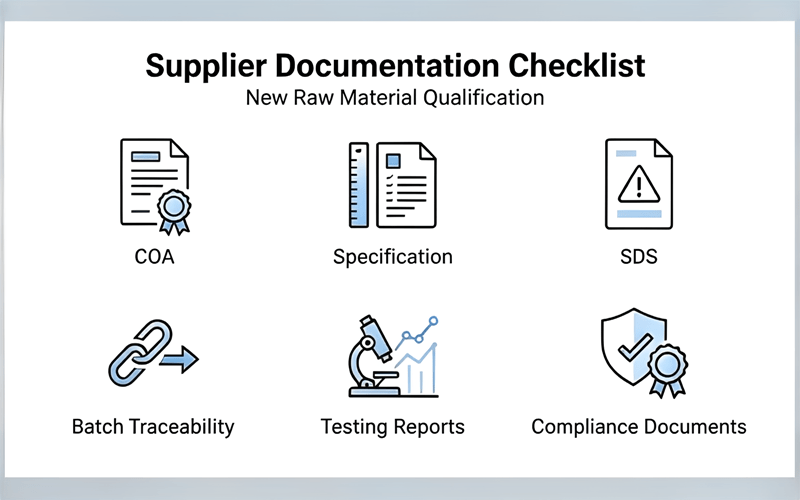
- COA
- Specification
- SDS
- Batch information
- Relevant testing reports
- Certification documents
- Product statements
But the finished supplement or food product may have separate regulatory, labeling, notification, or registration requirements depending on the market and product category.
These are different responsibilities.
A good raw material supplier should therefore be clear about what it can document and what remains the responsibility of the finished-product manufacturer or brand owner.
What Should a Practical Supplier Qualification Package Include?
For many ingredient qualification projects, a practical starting checklist could look like this:
Core quality documents
- COA
- Product specification
- Batch/lot information
- Manufacturing and expiration/retest information
- Relevant analytical methods or testing information
Safety and compliance documents
- SDS, where applicable
- Allergen statement
- Country of origin
- Relevant contaminant testing
- Residual solvent statement, where applicable
Certification and market documents
- Halal, where required
- Kosher, where required
- Organic, where applicable
- Non-GMO or bioengineering-related documentation, where applicable
- Quality-system certificates
- Other customer-specific declarations
The exact package should be determined by the raw material, application, customer requirements, and target market.
Common Mistakes When Reviewing Raw Material Documents
Mistake 1: Approving a supplier because the COA looks complete
A professional-looking COA is not necessarily a complete qualification package.
The question is whether the document contains the information required by your own specification and quality system.
Mistake 2: Requesting every possible document
The opposite mistake is also common.
Requesting dozens of documents that have no relevance to the ingredient or market creates administrative work without necessarily improving quality control.
The better approach is risk-based documentation.
Mistake 3: Ignoring batch traceability
A supplier may provide an excellent specification and certification package, but if the documents cannot be clearly connected to the delivered batch, quality investigations become much harder.
Mistake 4: Treating supplier documentation as finished-product regulatory approval
Raw material qualification and finished-product registration are different processes.
Keeping this boundary clear helps avoid unrealistic expectations on both sides.
A Better Way to Evaluate Ingredient Suppliers
Instead of asking suppliers only:
“Can you send the COA?”
try asking:
“Can you provide the specification, batch COA, SDS, traceability information, and the compliance documents relevant to our target market?”
Then evaluate whether the supplier can provide these documents consistently rather than only for the first sample.
This approach gives R&D, procurement, and quality teams a clearer picture of the supplier’s actual documentation capability.
How Esubio Supports Raw Material Qualification
Esubio focuses on supplying functional ingredients for dietary supplements, functional foods, sports nutrition, and related applications.
For applicable products, we can provide documentation such as:
- COA
- Specification
- SDS
- Batch information
- Relevant testing reports
- Applicable certification or compliance documents
The exact documentation depends on the product, supplier, destination market, and customer requirements.
The goal is straightforward:
Make the raw material easier for your quality team to evaluate, verify, and approve.
Raw material documentation should not create unnecessary delays between supplier selection and production.
Key Takeaways
- A COA for Raw Materials is an important starting point, but it is not always a complete qualification package.
- Quality teams should review the specification, batch COA, testing information, traceability, and relevant safety documentation together.
- Additional certifications and declarations should be selected according to the ingredient, customer, application, and target market.
- Raw material qualification is different from finished-product regulatory registration.
- A reliable supplier should be able to provide appropriate documentation consistently, not only when a customer asks for it during initial sampling.
Conclusion
A COA for Raw Materials can tell you whether a particular batch meets stated specifications, but quality approval requires a broader view.
The real question is not whether a supplier can send one COA.
It is whether the supplier can provide a consistent, traceable, and application-appropriate documentation package that allows your R&D, procurement, and quality teams to make a confident decision.
For a new ingredient, the strongest supplier relationship begins before the purchase order — with clear specifications, transparent documentation, and an agreed qualification process.
References
- U.S. Food and Drug Administration (FDA) — Current Good Manufacturing Practices (CGMPs) for Food and Dietary Supplements
FDA explains the CGMP requirements applicable to food and dietary supplement manufacturing, including specifications related to identity, purity, strength, composition, and contamination controls. - U.S. Food and Drug Administration — Dietary Supplement CGMP Requirements
Useful background for understanding why component specifications and quality controls matter in dietary supplement manufacturing. - U.S. Occupational Safety and Health Administration (OSHA) — Hazard Communication Standard
Reference for Safety Data Sheet requirements and hazard communication. - U.S. Department of Agriculture (USDA) — National Bioengineered Food Disclosure Standard
Useful reference when discussing bioengineered food disclosure and the distinction between BE disclosure and Non-GMO claims. - European Union — Regulation (EC) No 178/2002, Traceability
Reference for food traceability principles across production, processing, and distribution.