
Low Water Activity Probiotics: 7 Powerful Ways to Improve Formulation Stability
Low water activity probiotics are an important consideration for supplement brands and formulation teams developing dry probiotic powders, capsules, sachets, and blended nutritional ingredients. However, achieving a stable probiotic formula requires more than choosing a probiotic ingredient with a low water activity value. The surrounding excipients, manufacturing environment, packaging system, and storage conditions can all influence the performance of the finished product.
For product developers, the practical challenge is to maintain probiotic viability throughout processing and storage while achieving the required flowability, blend uniformity, filling performance, and shelf life.
This is why probiotic ingredients and low water activity excipients should be evaluated as parts of one formulation system rather than as completely independent purchasing decisions.
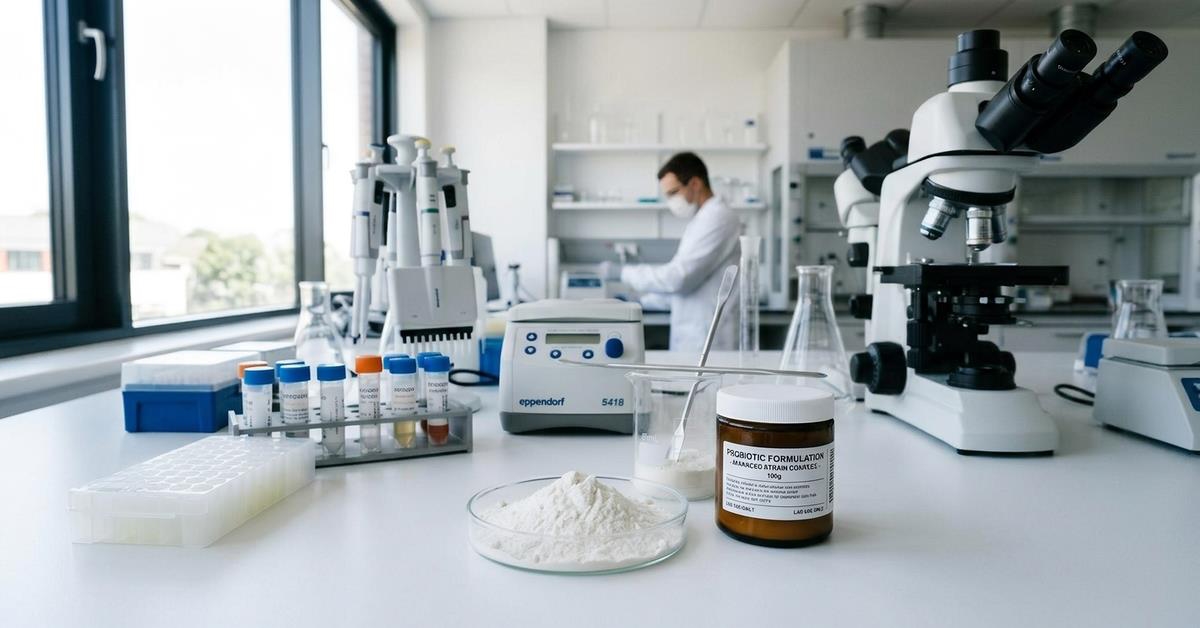
1. What Does Low Water Activity Mean for Probiotics?
Water activity, commonly written as Aw or \(a_w\), describes the availability of water for physical, chemical, and biological processes. It is different from moisture content, which measures the total amount of water present in a material.
Two ingredients can have similar moisture contents but different water activity values because water interacts differently with their respective chemical structures and matrices.
For probiotic powders, water activity is especially important because moisture-related changes can influence microbial stability during storage. A low Aw value is often a useful formulation target, but it should not be interpreted as a complete prediction of shelf life.
According to the review The Production and Delivery of Probiotics: A Review of a Practical Approach, water activity and storage temperature are major factors affecting probiotic stability. The authors also emphasize the importance of selecting dry carriers and excipients, controlling processing conditions, and choosing appropriate packaging.
Reference: https://pmc.ncbi.nlm.nih.gov/articles/PMC6463069/
For buyers, the key question is therefore not simply, “Does this ingredient have low Aw?” It is also, “Will the ingredient maintain suitable water activity and probiotic viability in my actual formulation?”
2. Why Moisture Content and Water Activity Should Be Evaluated Separately
Moisture content and water activity provide different types of information. Moisture content indicates how much water is present, while Aw indicates how available that water is under the measurement conditions.
Both parameters can be relevant to a probiotic ingredient specification. Neither should automatically replace the other.
For example, a powder may meet its moisture specification but still show an Aw value that is unsuitable for a particular formulation target. Conversely, a low Aw result does not automatically establish that the ingredient has the required moisture content, microbial quality, flow properties, or long-term stability.
The appropriate acceptance criteria depend on the ingredient, intended application, testing method, and finished-product requirements.
The International Organization for Standardization provides a method framework for water activity determination in ISO 18787:2017.
Reference: https://www.iso.org/standard/63379.html
When comparing suppliers, request both moisture content and Aw data when these parameters are relevant to the product. Confirm the test method, measurement conditions, and whether the result applies to a representative production batch.
3. Low Water Activity Probiotics Need Compatible Excipients
A probiotic ingredient may have a suitable initial Aw value, but the final blend can behave differently after additional ingredients are introduced.
Common formulation components include carriers, diluents, flow aids, sweeteners, prebiotic fibers, botanical powders, and other functional ingredients. Each component can influence the physical and moisture-related properties of the blend.
Hygroscopic ingredients deserve particular attention because they can absorb moisture from the surrounding environment. Certain prebiotic ingredients, for example, may create additional formulation challenges when combined with moisture-sensitive probiotics.
This does not mean that every hygroscopic ingredient must be excluded. Instead, the ingredient should be assessed in the context of its concentration, grade, packaging, processing environment, and interaction with the other components.
A practical development process should compare:
The Aw of each key ingredient before blending.
The Aw of the finished blend after equilibration.
Moisture content and flow properties.
Probiotic viability before and after blending.
Changes during storage under defined conditions.
These measurements help determine whether a low water activity excipient is appropriate for the intended application rather than relying on the ingredient specification alone.

4. Why Low Water Activity Excipients Matter
Low water activity excipients can help formulation teams manage moisture-related risks in dry probiotic products. Depending on the application, these materials may serve as carriers, diluents, sweetening agents, or other functional components of a powder blend.
However, the term “low water activity excipient” should not be treated as a universal performance guarantee. A particular excipient may have a low initial Aw but still absorb moisture during handling or storage. Its performance also depends on the full formulation and packaging system.
When selecting an excipient, buyers should evaluate at least four factors.
First, review the Aw and moisture specifications for the actual grade being supplied. Second, consider hygroscopicity and the ingredient’s behavior under the expected manufacturing and storage conditions. Third, confirm that the excipient supports the required flowability, bulk density, and filling process. Fourth, check whether it is compatible with the probiotic strain and the rest of the formula.
The broader literature on probiotic preparations shows that stability depends on multiple factors, including formulation composition, processing, oxygen exposure, temperature, and storage conditions.
Reference: https://pmc.ncbi.nlm.nih.gov/articles/PMC9407510/
For product developers, the best excipient is not necessarily the ingredient with the lowest reported Aw. It is the ingredient that meets the moisture target while also performing reliably in the complete formulation.
5. Should Probiotics and Low Water Activity Excipients Be Purchased Separately or as a Blend?
Both approaches can work. The better option depends on the development stage, manufacturing capability, and required degree of formulation control.
Purchasing probiotic ingredients and excipients separately provides flexibility. Formulation teams can adjust the ratio, compare multiple grades, and optimize the final formula internally. This approach may be appropriate when a company has established blending capabilities and wants direct control over each component.
A pre-blended solution may reduce some of the work involved in ingredient selection, weighing, and initial formulation development. It can also simplify procurement when the required probiotic ingredient and supporting excipient system have already been defined.
However, a pre-blend should not be assumed to be more stable merely because it is supplied as one material. The blend ratio, mixing uniformity, batch consistency, Aw, and probiotic viability still need to be evaluated against the customer’s requirements.
When reviewing a pre-blended ingredient, ask for the composition or applicable specification, the probiotic strain and potency information, the relevant Aw data, and evidence of batch-level quality control. If the full formula is confidential, request sufficient technical information to assess suitability without requiring disclosure of proprietary details.
6. Packaging and Manufacturing Conditions Can Change the Result
A suitable ingredient can still lose performance if it absorbs moisture during manufacturing or storage.
Relative humidity in the production area, exposure time during open handling, the moisture barrier of the packaging, seal integrity, and the use of desiccants can all affect the finished product.
The review on probiotic production and delivery discusses the importance of humidity-controlled processing and packaging that limits moisture ingress. It also explains that other active ingredients may increase the water activity of a probiotic formula.
Reference: https://pmc.ncbi.nlm.nih.gov/articles/PMC6463069/
For this reason, ingredient qualification should be linked to the intended manufacturing process. A material that performs well in a tightly controlled pilot trial may behave differently in a production facility with longer exposure times or higher humidity.
Before commercial production, consider a practical trial using the actual mixing equipment, process sequence, packaging format, and expected environmental conditions.
7. How to Set a Meaningful Low Water Activity Target
There is no single Aw target that is automatically suitable for every probiotic strain, excipient system, or finished product.
Some technical reviews describe low Aw targets, including values below 0.2, as useful starting points for certain dry probiotic applications. These values should not be applied as universal guarantees of shelf life or viability.
The correct target should be established for the specific formulation and supported by stability data.
A meaningful development plan should include the following:
Define the target shelf life, storage temperature, and intended packaging.
Identify the probiotic strain, initial potency, and required end-of-shelf-life count.
Establish Aw and moisture specifications for critical ingredients.
Test the finished blend rather than relying only on individual ingredient values.
Measure probiotic viability at defined intervals under relevant storage conditions.
Confirm that the product maintains its physical properties and meets applicable quality requirements.
This approach helps connect raw-material specifications to finished-product performance.
Bringing Probiotic Ingredients and Low Water Activity Excipients Together
For supplement brands, OEM/ODM manufacturers, and R&D teams, ingredient sourcing is most effective when it reflects the needs of the complete formulation.
A supplier that can support low water activity probiotic ingredients, low water activity excipients, and probiotic–excipient blends may help simplify technical discussions and reduce the number of separate ingredient evaluations required at the early development stage.
At Esubio, we support ingredient sourcing for functional nutrition and supplement applications, including probiotic ingredients, low water activity excipients, and formulation-oriented ingredient combinations. Suitability, specifications, and availability should be confirmed against each project’s requirements.
If you are developing a probiotic powder, capsule, sachet, or multi-ingredient blend, share your target Aw, probiotic strain or potency requirements, dosage form, and approximate order quantity. These details provide a practical starting point for identifying suitable ingredient options.
References
The Production and Delivery of Probiotics: A Review of a Practical Approach. https://pmc.ncbi.nlm.nih.gov/articles/PMC6463069/
Characteristics of Probiotic Preparations and Their Applications. https://pmc.ncbi.nlm.nih.gov/articles/PMC9407510/
ISO 18787:2017 — Foodstuffs: Determination of Water Activity. https://www.iso.org/standard/63379.html
Probiotic Triangle of Success: Strain Production, Clinical Studies and Product Development. https://pmc.ncbi.nlm.nih.gov/articles/PMC7578568/