
Ingredient Supply Chain: How OEMs Can Move From Small-Batch Trials to Stable Commercial Supply
Choosing the right OEM ingredient supplier can become surprisingly difficult when a product moves from R&D testing to commercial production.
Many overseas OEM manufacturers face the same problem: the supplier that supports samples and small orders cannot always support commercial volumes, while large bulk suppliers may not be willing to support small-scale testing.
This creates a gap between product development and commercial production.
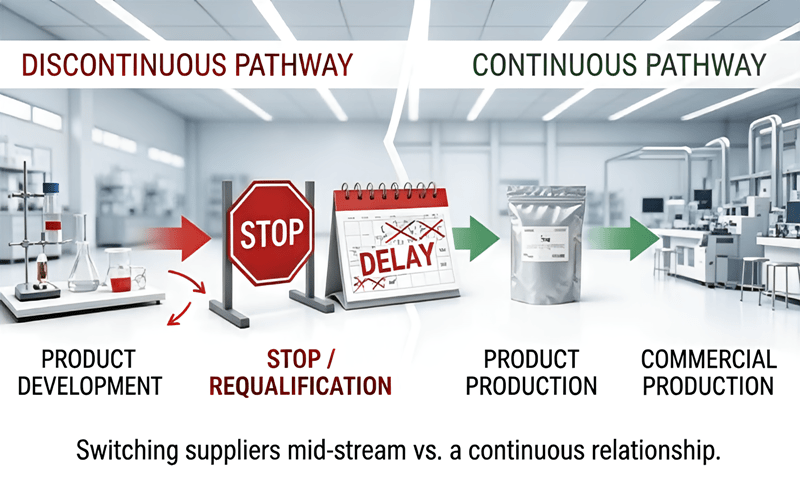
For an OEM manufacturer, that gap can be expensive. A formulation may be successfully validated using one supplier’s ingredient during the R&D stage, only for the supplier to become unsuitable when the project moves into pilot production or commercial scale. The manufacturer then has to find another source, repeat testing, verify specifications again, and potentially explain the change to its customer.
The real challenge is not simply finding an ingredient supplier. It is finding an OEM ingredient supplier that can support the product through the entire development cycle.
Why OEM Manufacturers Often Face a Supply Gap
A common situation looks like this:
The customer confirms a product concept. The R&D team develops the initial formulation and identifies several ingredients for evaluation. Samples are requested, the formulation is tested, and eventually a pilot batch is planned.
Then the supply problem appears.
The original supplier may support a few kilograms for testing but have limited capacity for larger orders. Another supplier may have sufficient production capacity but require a much higher MOQ than the manufacturer needs during the development stage.
The manufacturer is then forced to choose between two imperfect options:
- Keep using a small supplier that may not support commercial volumes.
- Switch to a larger supplier and repeat part of the qualification process.
Neither option is ideal.
For contract manufacturers, consistency between R&D and commercial production is particularly important because changing an ingredient source can affect specifications, sensory characteristics, processing performance, documentation, and customer approval.
What to Look for in an OEM Ingredient Supplier
A reliable OEM ingredient supplier should be able to support more than the initial sample stage.
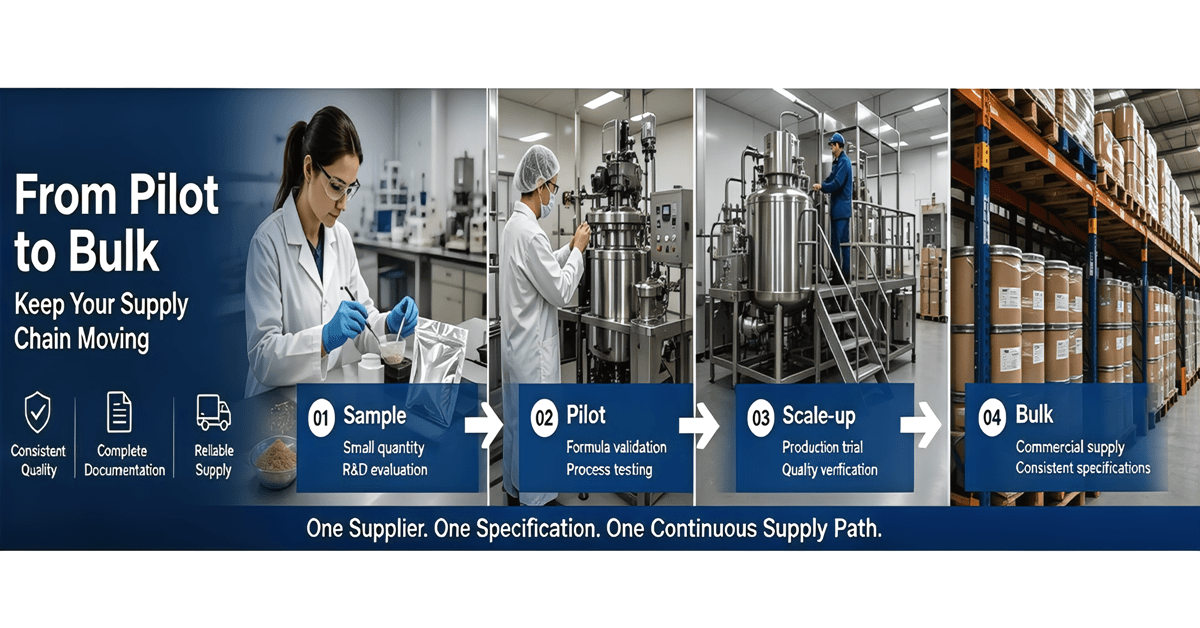
The ideal supply model connects the full development path:
Requirement → Sample → Pilot → Scale-Up → Commercial Supply
At the sample stage, the supplier needs to provide appropriate quantities and responsive sampling.
During pilot production, the supplier should be able to maintain consistent specifications and provide the documentation required for internal quality review.
As the project moves into scale-up, supply capacity, batch consistency, lead time, and commercial pricing become increasingly important.
Finally, during commercial production, the manufacturer needs reliable bulk supply and consistent quality over time.
The value of a supplier is therefore not determined only by whether it can provide a sample today. The more important question is whether the same supply system can continue supporting the product as demand grows.
Why Changing Suppliers During Scale-Up Creates Risk
Switching suppliers may appear straightforward, but it can introduce several additional variables.
Even when two suppliers provide an ingredient under the same general product name, their products may differ in areas such as:
- Active ingredient content
- Particle size
- Solubility
- Appearance
- Sensory profile
- Moisture
- Microbiological specifications
- Heavy metal limits
- Processing characteristics
- Documentation
A formulation that performs well with the original material may therefore require additional evaluation after a supplier change.
For an OEM manufacturer, this can mean repeating laboratory tests, adjusting the formulation, conducting another pilot run, or waiting for customer approval.
The cost is not limited to the ingredient itself. The greater cost may be the additional time required to revalidate the project.
Low MOQ Matters Most During R&D and Pilot Production
During early-stage development, ingredient demand is usually uncertain.
A manufacturer may need only 1–5 kg to evaluate an ingredient, while the commercial requirement could eventually reach hundreds of kilograms or several metric tons.
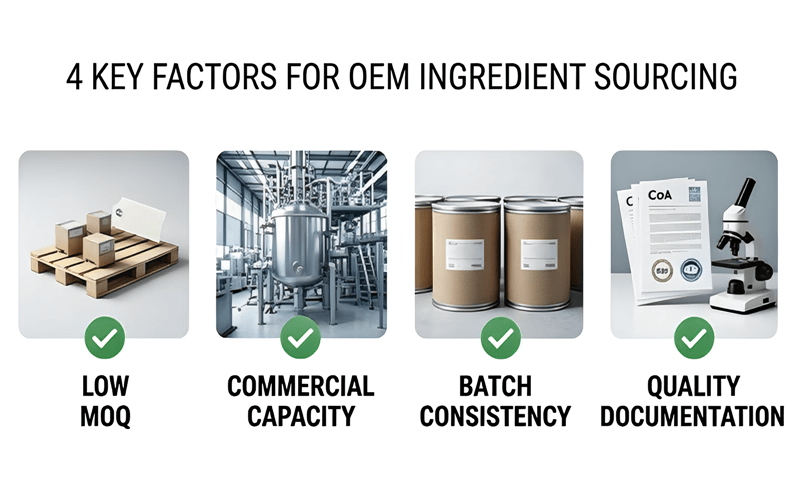
This is why low MOQ ingredient suppliers can be particularly useful during the R&D and pilot stages.
Low MOQ allows manufacturers to test an ingredient before making a large inventory commitment.
However, low MOQ alone is not enough.
A supplier that offers small quantities but cannot support the next stage creates the same supply gap in another form.
The more useful model is a supplier that can start with a small quantity and then scale with the project.
From Sample to Bulk: Why Supply Continuity Matters
The transition from sample to commercial production should ideally happen without changing the underlying supply system.
A manufacturer should be able to move from:
Sample → Pilot → Scale-Up → Bulk
without having to restart supplier qualification at every stage.
This does not mean every order must come from the same production batch. It means that the supplier should have a clear and reliable supply structure capable of supporting different order volumes while maintaining agreed specifications and documentation.
For procurement teams, this continuity can simplify supplier management and reduce the number of variables introduced during scale-up.
For R&D teams, it can reduce the risk of having to reformulate after a supplier change.
For customers, it can provide greater confidence that the ingredient used during development can continue to support commercial production.
Fast Sampling Is Only the First Step
Fast sampling can accelerate the beginning of a project, but it should not be viewed separately from commercial supply capability.
An ingredient supplier may deliver a sample quickly, but if the required quantity takes weeks to arrange later, the initial speed does not solve the overall problem.
A more useful approach is to evaluate the supplier across the entire project timeline:
- How quickly can samples be arranged?
- What MOQ is available for testing?
- Can the same specification be maintained during scale-up?
- Can larger quantities be supplied when the project moves into production?
- Are CoA, MSDS, and specification documents available?
- Can batch information and quality documentation be provided consistently?
- Can lead times remain predictable as order volume increases?
These questions help distinguish a supplier that is simply good at sampling from an OEM ingredient supplier capable of supporting a complete product development cycle.
Quality and Documentation Should Scale with the Order
Supply continuity is not only about physical inventory.
Documentation needs to remain consistent and usable as the project progresses.
During initial evaluation, an R&D team may only need a specification sheet and sample CoA.
As the project moves toward commercial production, procurement and quality teams may require additional information such as:
- Batch-specific CoA
- Product specification
- MSDS/SDS
- Microbiological data
- Heavy metal testing
- Allergen information
- Non-GMO documentation
- Halal or Kosher documentation where applicable
- Other market-specific documents
The exact requirements depend on the ingredient, application, and target market.
A supplier should therefore be evaluated not only on price and availability, but also on its ability to provide the documentation needed at each stage.
How to Evaluate an OEM Ingredient Supplier
Instead of asking only, “Can you supply this ingredient?”, OEM manufacturers can evaluate potential suppliers across five areas:
1. Sampling Capability
Can the supplier provide the quantity needed for R&D testing without forcing the manufacturer into unnecessary inventory?
2. Scale-Up Capability
Can the supplier support increasing quantities when the project moves from laboratory testing to pilot and commercial production?
3. Quality Consistency
Can the supplier maintain the agreed specifications across different batches?
4. Documentation
Can the supplier provide appropriate quality and regulatory documents throughout the supply relationship?
5. Supply Reliability
Can the supplier provide predictable lead times and communicate clearly when production or delivery conditions change?
This broader evaluation provides a more realistic picture than comparing suppliers based on sample price alone.
How Esubio Supports the Development-to-Bulk Process
Esubio focuses on supporting ingredient sourcing from pilot orders to bulk shipments.
The supply model is designed around flexible quantities, with selected ingredients available from approximately 1 kg for development and testing.
Samples can typically be arranged within 3–5 days, depending on product availability and requirements.
The product range covers botanical extracts, amino acids, probiotics, functional blends, and other functional ingredients.
For quality and procurement teams, CoA, MSDS, and specification documents are provided as part of the ingredient supply process, subject to the specific product and supplier documentation available.
The objective is straightforward: allow manufacturers to start with a practical testing quantity and continue toward larger orders without unnecessarily changing the supply system midway through development.
Key Takeaways
- Choosing an OEM ingredient supplier should involve more than evaluating sample availability or price.
- The ideal supplier can support the full path from sample testing to pilot production, scale-up, and bulk supply.
- Low MOQ is valuable during R&D, but it becomes more useful when the supplier can also support larger commercial requirements.
- Changing suppliers during scale-up can introduce additional quality, formulation, documentation, and approval risks.
- Consistent specifications and batch documentation are important throughout the development-to-commercial process.
- Procurement teams should evaluate sampling, scale-up capability, quality consistency, documentation, and supply reliability together.
Conclusion
The real challenge for overseas OEM manufacturers is not simply finding a supplier that can provide an ingredient.
It is finding an OEM ingredient supplier that can support the product as it moves from an initial idea to laboratory testing, pilot production, scale-up, and commercial manufacturing.
A continuous supply path can reduce unnecessary supplier changes, simplify qualification, and help manufacturers move from R&D to production with fewer disruptions.
For OEM manufacturers, the right supplier is therefore not necessarily the one offering the lowest sample price or the largest production capacity.
It is the supplier that can provide the right combination of flexibility, quality consistency, documentation, scalability, and reliable supply at each stage of the product lifecycle.
References
- U.S. Food and Drug Administration (FDA) — Current Good Manufacturing Practice (CGMP) in Manufacturing, Packaging, Labeling, or Holding Operations for Dietary Supplements
Useful background on specifications, quality control, and manufacturing controls for dietary supplement operations.
FDA — Dietary Supplement CGMP - U.S. Food and Drug Administration (FDA) — Dietary Supplement CGMPs
Relevant to supplier specifications and quality controls used when receiving and evaluating dietary supplement components.
FDA — Dietary Supplement Quality Guidance - European Commission — General Food Law and Traceability
Useful reference for the role of traceability within food supply chains.
European Commission — Food Safety / General Food Law