
5 Powerful Ways to Prevent Raw Material Specification Mismatches
Raw material specification is often treated as a technical document that tells procurement what to buy. In practice, it is much more than that.
A specification is the bridge between R&D, procurement, suppliers, quality control, and the final formulation. When that bridge is incomplete, the same ingredient name can lead to very different raw materials.
R&D may specify a botanical extract standardized to a certain marker compound. Procurement sends the product name to several suppliers. A supplier responds with a product that appears to match the request. The sample arrives, but its assay, particle size, solubility, extraction profile, or application performance is different from what R&D expected.
No single person necessarily made a mistake. The problem is that the original requirement was not defined precisely enough.
This is especially common with botanical extracts, standardized ingredients, probiotics, amino acids, vitamins, functional blends, and other ingredients where the commercial product name does not fully describe the material.

Why a Raw Material Specification Is More Than an Ingredient Name
An ingredient name is usually only the starting point.
For example, “Green Tea Extract” can refer to products with different botanical sources, extraction ratios, solvents, marker compounds, assay levels, particle sizes, carriers, and processing methods.
The same situation occurs with many standardized botanical extracts. Two suppliers may both offer an ingredient under the same commercial name while using different standardization methods or different quality parameters.
Research on botanical quality control has emphasized that proper characterization can involve identity, marker compounds, purity, contaminants, analytical methods, packaging, and storage conditions rather than relying on a single characteristic.
This is why a specification should answer a more important question:
What exactly does the formulation need this raw material to do?
Once that question is answered, the procurement requirement becomes much clearer.
1. Start With the Application, Not Just the Product Name
One of the most common procurement mistakes is starting with the ingredient name.
For example:
“Need Ashwagandha Extract, please quote.”
This may be enough for an initial market inquiry, but it is rarely enough for accurate sourcing.
A supplier may need to know:
- What is the intended dosage form?
- Is the ingredient going into capsules, tablets, powders, gummies, or beverages?
- What is the target marker compound or assay?
- Is a specific extraction ratio required?
- Is the ingredient expected to dissolve easily?
- Is particle size important?
- Are there restrictions on carriers or excipients?
- What are the target market and regulatory requirements?
- Is the ingredient intended for a specific formulation or processing condition?
These details can significantly change which raw material is appropriate.
The same principle applies beyond botanical extracts. An amino acid for a powder formulation may have different requirements from one used in a tablet. A probiotic may need a specific strain, viable count, moisture level, stability profile, and packaging configuration. A powder intended for direct blending may require different particle characteristics from one used in a liquid application.
The specification should therefore begin with the application requirement, not simply the commercial ingredient name.
2. Define the Critical Quality Attributes Clearly
A useful raw material specification separates “nice to have” information from parameters that actually determine whether the ingredient is acceptable.
Depending on the ingredient, critical parameters may include:
- Botanical species and plant part
- Extraction ratio or extraction method
- Standardization level
- Marker or active compounds
- Assay method
- Particle size
- Bulk density
- Solubility or dispersibility
- Moisture content
- Water activity
- Microbiological limits
- Heavy metals
- Pesticide residues
- Residual solvents
- Allergen status
- Carrier or excipient composition
- Shelf life and storage conditions
- Packaging requirements
For botanical ingredients, marker compounds can be useful for identification and quality control, but they do not necessarily describe the entire chemical profile or biological behavior of an extract. Scientific literature has pointed out that botanical extracts are chemically complex and can vary according to plant material, geography, harvest conditions, extraction procedures, and storage.
That means “standardized to X%” should not automatically be treated as a complete specification.
A better specification defines the parameters that matter to the actual formulation.
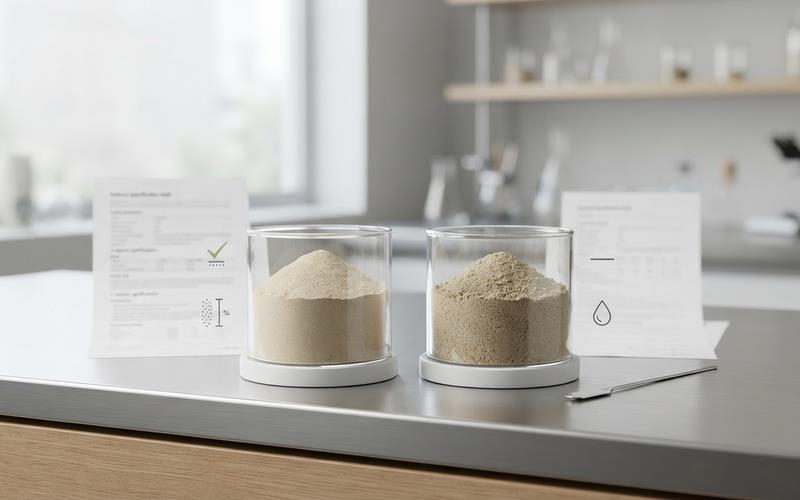
3. Specify the Test Method When the Result Matters
Another hidden source of mismatch is the analytical method.
Two suppliers may report the same marker compound but use different analytical procedures, reference standards, sample preparation methods, or calculation approaches.
For example, if a formulation requires a specific marker compound at a defined concentration, simply writing “≥10%” may leave important questions unanswered:
- Which analytical method?
- Which reference standard?
- What is the acceptance range?
- Is the result reported on an as-is or dry basis?
- Is the value based on a specific chromatographic method?
For regulated or technically sensitive ingredients, the test method can be part of the specification rather than an afterthought.
USP and other scientific references describe specifications as a combination of tests, analytical procedures, and acceptance criteria.
This distinction becomes particularly important when comparing quotations from multiple suppliers. If suppliers are not quoting against the same analytical definition, comparing the prices alone can be misleading.
4. Separate “Must Have” From “Preferred”
Not every requirement deserves the same status.
A specification can become unnecessarily restrictive when every preferred characteristic is written as a mandatory requirement.
A more practical structure is to divide requirements into three levels:
Mandatory requirements
These determine whether the raw material can be used at all.
Examples include the correct species, minimum assay, required strain, contaminant limits, or regulatory restrictions.
Preferred requirements
These improve formulation performance but may have acceptable alternatives.
Examples include a preferred particle size, color, odor, bulk density, or specific processing characteristic.
Commercial requirements
These determine whether the material is commercially viable.
Examples include MOQ, lead time, packaging, payment terms, sample availability, and target price.
This structure gives procurement more room to source intelligently without changing the technical intent of R&D.
It also makes supplier discussions much more productive.
Instead of asking:
“Can you supply this ingredient?”
procurement can ask:
“Can you supply a material meeting these mandatory parameters, and what alternatives are available for the preferred parameters?”
That is a much more useful sourcing conversation.
5. Make the Supplier Part of the Specification Process
The final step is often overlooked: specifications should be discussed with suppliers, not simply sent to them.
A capable supplier or sourcing partner can identify potential gaps before a sample is purchased.
For example, the supplier may recognize that a requested marker level is normally associated with a particular extraction process, that a target particle size is uncommon for the requested material, or that the stated specification does not include a parameter that is important for the intended dosage form.
This does not mean allowing suppliers to redefine the R&D requirement.
It means using supplier knowledge to test whether the requirement is technically and commercially realistic.
For botanical ingredients, scientific guidance also emphasizes the importance of identifying the botanical material, extraction information, marker compounds, supplier information, and characterization of the final material.
The strongest sourcing process therefore creates a feedback loop:
R&D requirement → technical specification → supplier review → sample → testing → formulation evaluation → final approved specification
This is much more reliable than:
Product name → quotation → purchase order → unexpected sample

What a Better Raw Material Specification Should Look Like
A practical specification does not have to be excessively complicated.
For many projects, a one-page technical requirement can include:
Ingredient identity
Exact ingredient name, botanical species, plant part, strain, grade, or chemical form.
Functional requirement
What the ingredient needs to achieve in the formulation.
Critical quality parameters
Assay, marker compounds, purity, particle size, moisture, water activity, microbial limits, contaminants, and other relevant parameters.
Analytical requirements
Test method, reference standard, calculation basis, and acceptance criteria where necessary.
Physical requirements
Appearance, color, odor, solubility, bulk density, flowability, or dispersibility when relevant.
Documentation
COA, specification sheet, MSDS/SDS, allergen statement, GMO statement, origin information, certifications, and other market-specific documents.
Commercial requirements
MOQ, sample quantity, lead time, packaging, and target delivery terms.
This format gives procurement enough information to source the correct material while giving suppliers enough context to identify realistic options.
Why This Matters for Small-Quantity and Multi-Supplier Sourcing
The problem becomes even more important when buying small quantities.
A large-volume buyer may have an established approved supplier and a fixed raw material specification. A smaller buyer often needs to compare several suppliers, request samples, test alternatives, and balance technical requirements with MOQ and cost.
In this situation, a supplier that simply matches product names may create more work rather than less.
A sourcing partner should help translate the formulation requirement into a practical purchasing specification, compare available materials, identify differences between suppliers, and make those differences visible before the order is placed.
At Esubio, we approach ingredient sourcing from this perspective.
We do not treat a product name as the complete requirement. We first look at the intended application and then help match the relevant parameters, such as marker compounds, assay, particle size, solubility, stability, water activity, and documentation requirements.
Depending on the project, we can also support sourcing across botanical extracts, standardized extracts, fruit and vegetable powders, amino acids, vitamins, probiotics, postbiotics, and other functional ingredients.
The goal is straightforward: the material quoted by the supplier should be as close as possible to the material R&D actually intended to use.
A well-written specification does not eliminate every sourcing problem. But it removes one of the most preventable ones: buying an ingredient that technically has the right name but does not actually meet the formulation requirement.
When R&D, procurement, and suppliers are working from the same technical definition, the purchasing process becomes clearer, sample evaluation becomes faster, and the risk of reformulation or repeat sourcing can be significantly reduced.
References