
When Your Ingredient Supplier Suddenly Stops: How OEMs Can Find an Equivalent Replacement Fast
Raw material replacement becomes a serious problem when an OEM manufacturer learns that an ingredient it has been using for months or years is suddenly no longer available.
The supplier may discontinue the product, change its production strategy, lose access to a raw material, change its manufacturing site, or simply decide that the business is no longer commercially attractive. Whatever the reason, the OEM is left with a much bigger problem than finding another supplier.
The replacement must work.
It needs to match the original ingredient closely enough in identity, specification, functionality, documentation, regulatory suitability, and commercial terms. In some applications, even a small difference in particle size, active content, moisture, solubility, carrier system, or processing method can affect the finished product.
That is why replacing an ingredient in an existing formula is usually more demanding than sourcing an ingredient for a new product.
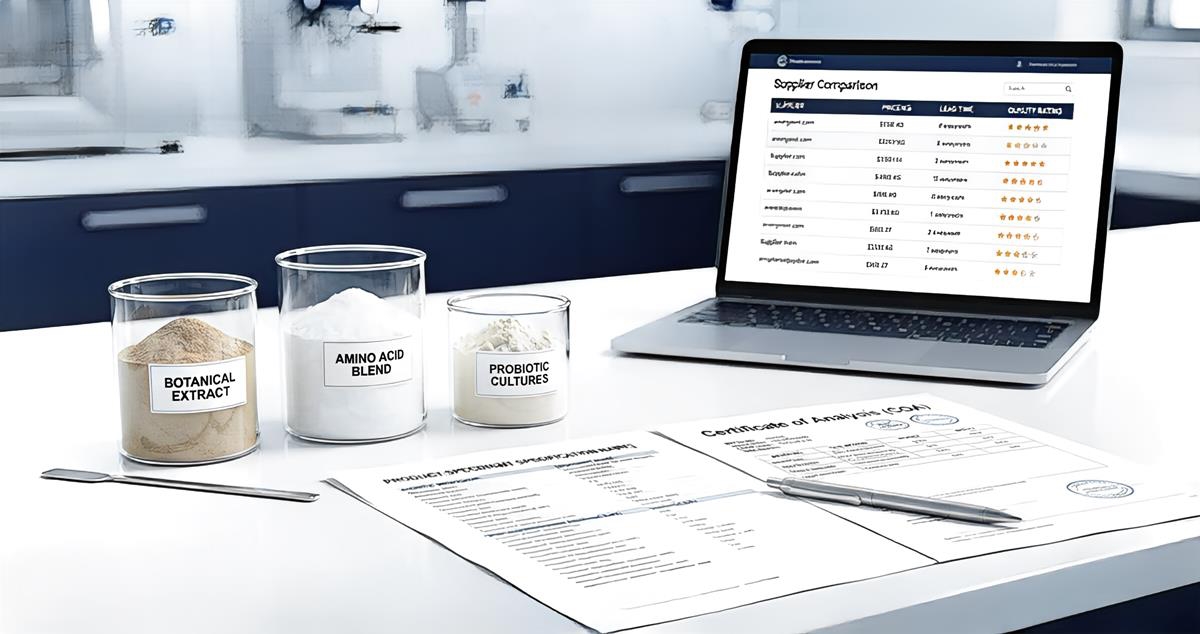
Why Raw Material Replacement Is Different From New Ingredient Sourcing
When developing a new product, an R&D team can often evaluate several ingredients and choose the one that performs best in the formulation.
Replacement sourcing is different.
The starting point is an existing material that has already been incorporated into a validated formula. The objective is not simply to find a “good” ingredient. The objective is to find a material that is sufficiently equivalent to the original one.
For example, a botanical extract may be described as a 10:1 extract, but that information alone may not be enough to establish equivalence. The original specification may also include:
- Botanical species and plant part
- Country or region of origin
- Extraction ratio and extraction solvent
- Marker compounds or active content
- Carrier or excipient
- Particle size
- Bulk density
- Moisture or water activity
- Microbiological limits
- Heavy metals and pesticide requirements
- Appearance, color, odor and taste
- Solubility or dispersibility
- Packaging and storage conditions
For amino acids, vitamins, probiotics, enzymes and specialty functional ingredients, the critical parameters can be very different.
The first step is therefore to understand the original material before searching for a replacement.
1. Turn the Existing Specification Into a Replacement Checklist
The fastest way to slow down a replacement project is to send suppliers only the ingredient name.
“Need 10:1 Ashwagandha extract” is not enough.
A better approach is to convert the existing specification into a structured sourcing checklist. Start with the original specification, COA and technical documents, then separate requirements into three categories: must-match parameters, preferred parameters and negotiable parameters.
For example, if the original ingredient requires a minimum percentage of a specific marker compound, that may be a must-match requirement.
If the original material has a particular mesh size but the manufacturing process can tolerate a wider range, particle size may be negotiable.
This distinction helps suppliers search more intelligently and prevents the purchasing team from rejecting potentially suitable alternatives simply because one non-critical parameter is different.
2. Compare More Than the Name and Assay
A common mistake in ingredient replacement is comparing only the ingredient name and active percentage.
Two materials can have the same declared active content but behave differently during manufacturing.
For powders, particle size, bulk density, moisture and flowability may affect blending and filling.
For botanical extracts, extraction method, carrier, marker profile and source material can influence appearance, taste and formulation performance.
For probiotics, strain identity, viable count, moisture exposure, water activity and storage conditions can become critical.
For functional blends, the ratio of individual components, processing method and physical characteristics may matter as much as the ingredient list itself.
The goal of replacement sourcing should therefore be specification equivalence, not simply name equivalence.
A useful comparison table can include:
| Parameter | Original Material | Candidate A | Candidate B |
|---|---|---|---|
| Identity | Required | Match / Gap | Match / Gap |
| Active Content | Required | Result | Result |
| Particle Size | Required | Result | Result |
| Moisture / Aw | Required | Result | Result |
| Microbiology | Required | Result | Result |
| Heavy Metals | Required | Result | Result |
| Carrier | Required | Match / Gap | Match / Gap |
| Country of Origin | Preferred | Result | Result |
| MOQ | Commercial | Result | Result |
| Lead Time | Commercial | Result | Result |
This makes technical differences visible before samples are sent to the formulation team.
3. Separate “Equivalent” From “Alternative”
Not every replacement is truly equivalent.
This distinction is important for OEM manufacturers because a material can be commercially attractive while still requiring formulation work.
An equivalent replacement is one that closely matches the original specification and expected processing characteristics.
An alternative ingredient may perform a similar function but differ in composition, source, processing characteristics or regulatory profile.
For example, replacing one standardized botanical extract with another extract containing a different marker profile may create a technically viable alternative, but it should not automatically be presented as a direct equivalent.
The sourcing team should clearly identify whether a candidate is:
- A specification match
- A close technical match requiring validation
- A functional alternative requiring formulation adjustment
This classification makes communication between purchasing, R&D and quality teams much more efficient.
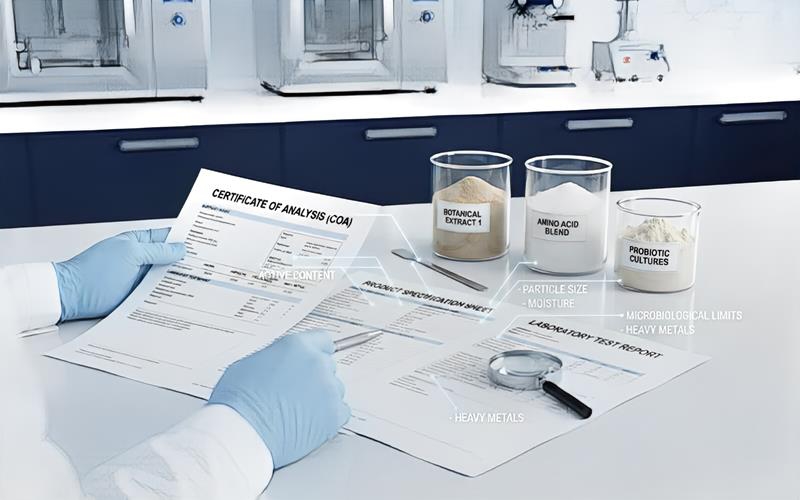
4. Qualify the Supplier at the Same Time as the Ingredient
Finding a technically suitable ingredient is only half of the replacement process.
The new supplier also needs to be evaluated.
For a replacement project, OEMs should consider:
- Manufacturing or sourcing location
- Production capacity
- MOQ
- Typical lead time
- Batch-to-batch consistency
- Quality management system
- Available certifications
- COA and testing capability
- Traceability
- Change-notification practices
- Export experience
- Sample availability
This matters because replacing one unreliable source with another does not actually solve the supply problem.
For dietary supplements, quality control is particularly important. FDA’s dietary supplement CGMP framework addresses requirements related to the identity, purity, strength and composition of dietary supplements and their components.
USP also identifies identity, purity, composition or strength, and performance as important dimensions of dietary supplement quality.
In other words, supplier replacement should be treated as a qualification project, not simply a purchasing exercise.
5. Test the Replacement Before the Original Stock Runs Out
The most expensive time to start a replacement project is after the existing inventory has already reached zero.
A better strategy is to maintain a replacement window.
Once a supplier announces a potential discontinuation or supply problem, immediately calculate:
Current inventory + confirmed incoming quantity ÷ average consumption rate = estimated remaining supply window.
Then work backward from that date.
Allow time for supplier screening, quotation, sample delivery, laboratory testing, formulation trials, documentation review and, where required, production validation.
For an OEM manufacturer, the replacement process may involve several departments:
Purchasing identifies potential suppliers.
Quality reviews specifications and documentation.
R&D evaluates technical performance.
Regulatory checks market-specific requirements.
Production confirms process compatibility.
Finance evaluates the commercial impact.
A replacement project can therefore become slow if every department starts from zero.
What Should an OEM Send to a Sourcing Partner?
The more complete the starting information, the faster the search can usually become.
Instead of sending only an ingredient name, provide:
- Current ingredient name
- Existing specification
- Latest COA
- Target active content
- Critical physical parameters
- Required certifications
- Country or market requirements
- Current packaging format
- Estimated annual volume
- Immediate sample quantity
- Target delivery date
- Whether the replacement must be an exact match or whether a technical alternative is acceptable
The original COA is particularly useful because it can reveal parameters that are not obvious from the commercial product name.
For example, two suppliers may both quote the same botanical extract, but their actual products may differ significantly in marker content, excipients, particle size or microbiological specifications.

Build a Second Source Before You Need One
The best replacement strategy is not waiting until a supplier disappears.
For critical ingredients, OEM manufacturers can consider maintaining an approved secondary source before a supply disruption occurs.
This does not necessarily mean purchasing from two suppliers at the same time.
It can mean identifying a technically acceptable backup supplier, reviewing its documentation, keeping a sample or retaining a current quotation so that the company has a starting point if the primary source becomes unavailable.
This is particularly useful for ingredients exposed to agricultural seasonality, geographic concentration, regulatory changes, production shutdowns or volatile demand.
A qualified second source can turn an emergency replacement project into a routine supplier switch.
A Faster Way to Handle Raw Material Replacement
For many OEM manufacturers, the real difficulty is not finding suppliers. It is filtering the market quickly enough to identify suppliers whose materials actually match the original specification.
This is where a sourcing partner with access to multiple ingredient categories and supplier networks can add value.
At Esubio, we work across botanical extracts, amino acids, probiotics, functional blends, vitamins, specialty actives and other functional ingredients. Rather than starting with a generic product search, we can work from the customer’s existing specification and identify potential sources based on the parameters that actually matter.
The process can include specification review, supplier screening, sample coordination and documentation collection such as COA, MSDS and product specifications.
The objective is not to replace an ingredient simply because another supplier has it in stock.
The objective is to help OEM manufacturers find a technically suitable source while reducing unnecessary back-and-forth between purchasing, quality and R&D.
When a supplier suddenly stops supplying a critical ingredient, the situation is already time-sensitive. A structured replacement process helps turn an unexpected supply problem into a manageable qualification project.
For OEM manufacturers, the most valuable replacement is not necessarily the cheapest alternative.
It is the one that can be technically evaluated, documented, tested and introduced without creating a new problem downstream.
References
U.S. FDA — Current Good Manufacturing Practices (CGMPs) for Food and Dietary Supplements
FDA — Current Good Manufacturing Practices (CGMPs) for Food and Dietary Supplements2. U.S. FDA — Backgrounder on the Final Rule for Current Good Manufacturing Practices (CGMPs) for Dietary Supplements
FDA — Dietary Supplement CGMP Backgrounder3. U.S. Pharmacopeia — Defining Quality in Dietary Supplements
USP — Defining Quality in Dietary Supplements4. NIH Office of Dietary Supplements — Dietary Supplements: What You Need to Know
NIH Office of Dietary Supplements — Dietary Supplements: What You Need to Know5. NIH Office of Dietary Supplements — Product Integrity Guidance
NIH ODS — Product Integrity Guidance