
GLP-1 Nutrition Support: Building a Broader Metabolic Health Ecosystem
The rise of GLP-1-based therapies has changed the conversation around weight management. However, the opportunity for nutrition brands and ingredient developers extends beyond weight loss alone.
GLP-1 nutrition support is emerging as a broader formulation concept that connects appetite management, satiety, metabolic health, digestive health, nutrient intake, body composition and long-term weight maintenance.
GLP-1 receptor agonists can influence appetite and food intake, and prescription weight-management medications are generally used alongside healthy eating and physical activity rather than as a replacement for them.
This creates a wider product-development opportunity: instead of developing a single “weight-loss ingredient,” brands can build an ecosystem of complementary ingredients around different stages of the metabolic-health journey.
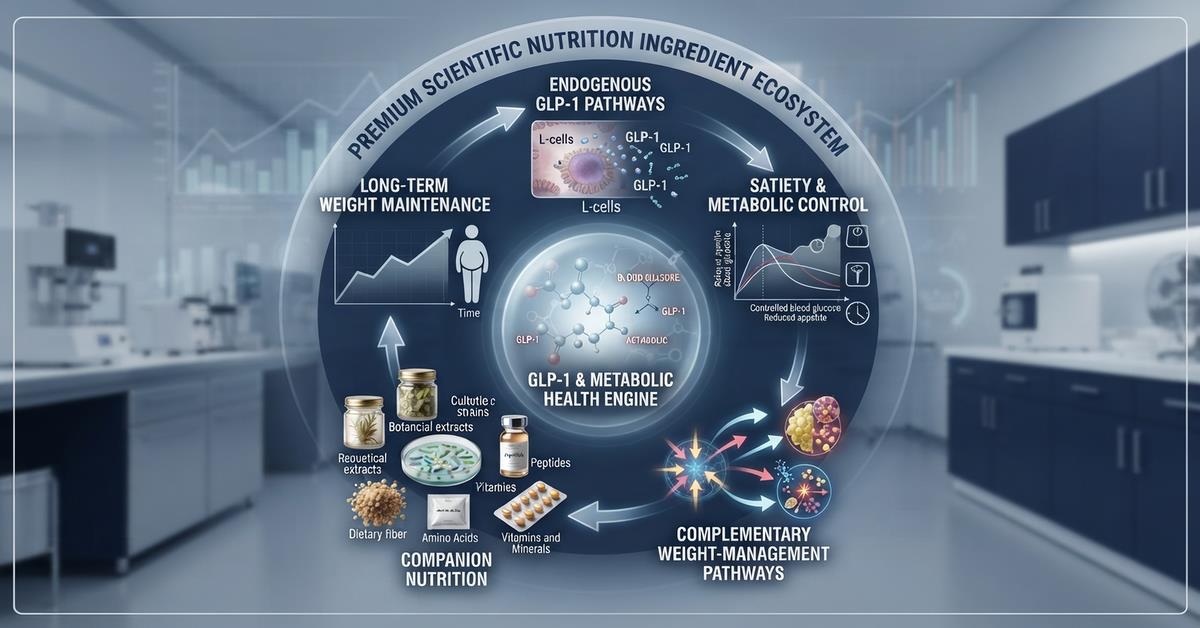
1. Supporting Endogenous GLP-1 Pathways
One area of interest is the relationship between nutrition, the gut and endogenous GLP-1 signaling.
GLP-1 is an incretin hormone involved in glucose regulation, appetite and gastrointestinal functions. Because the gastrointestinal tract plays an important role in nutrient sensing and hormone signaling, researchers and formulators continue to explore how dietary components and the gut microbiome may interact with these pathways.
Potential ingredient categories include botanical extracts, probiotics, postbiotics, dietary fibers and functional peptides.
For ingredient suppliers, however, scientific positioning is important. Not every ingredient associated with appetite or metabolic health should be marketed as a direct “GLP-1 booster.” Evidence should be evaluated according to the ingredient, dosage, study design and endpoint.
A more responsible positioning is to describe these ingredients as supporting metabolic health, satiety, digestive function or pathways related to endogenous GLP-1 activity when the available evidence supports such language.
2. Enhancing Satiety and Metabolic Control
Satiety is one of the most important formulation considerations surrounding modern weight-management products.
A lower appetite can also mean lower total food intake. From a formulation perspective, this makes nutrient density particularly important. A product designed for people experiencing reduced appetite should not focus only on reducing calorie intake; it should also consider protein, fiber, micronutrients and overall nutritional quality.
Dietary fibers are particularly relevant because different fibers can contribute to fullness, gastrointestinal function and carbohydrate-related formulation strategies. Botanical extracts and other functional ingredients may also be considered depending on the intended product concept and available evidence.
This opens several formulation directions:
- Fiber-based satiety formulas
- Fiber and botanical combinations
- Protein-supported meal replacement concepts
- Metabolic-health blends
- Digestive-health and satiety formulations
The objective is not simply to create a “stronger” weight-management formula. It is to build a formulation that addresses several nutritional needs at the same time.
3. Complementary Weight-Management Pathways
Weight management is a multifactorial process. GLP-1-related strategies therefore do not have to be limited to a single biological pathway.
Several established ingredient categories are already used in weight-management and metabolic-health formulations, including white kidney bean, white mulberry leaf, green tea catechins such as EGCG, berberine, chromium and L-carnitine.
Their mechanisms and evidence are not interchangeable.
For example, white kidney bean is commonly positioned around carbohydrate digestion, while green tea catechins have been investigated in relation to energy metabolism. Chromium is associated with normal macronutrient metabolism, while L-carnitine is commonly used in sports nutrition and energy-metabolism formulations.
The key opportunity is therefore not to claim that these ingredients “act like GLP-1.” Instead, they can be evaluated as components of a broader metabolic-health formulation where their individual functions are clearly defined.
For B2B product developers, this distinction matters. A credible formulation should be built around documented mechanisms and appropriate claims rather than simply combining every popular weight-management ingredient.
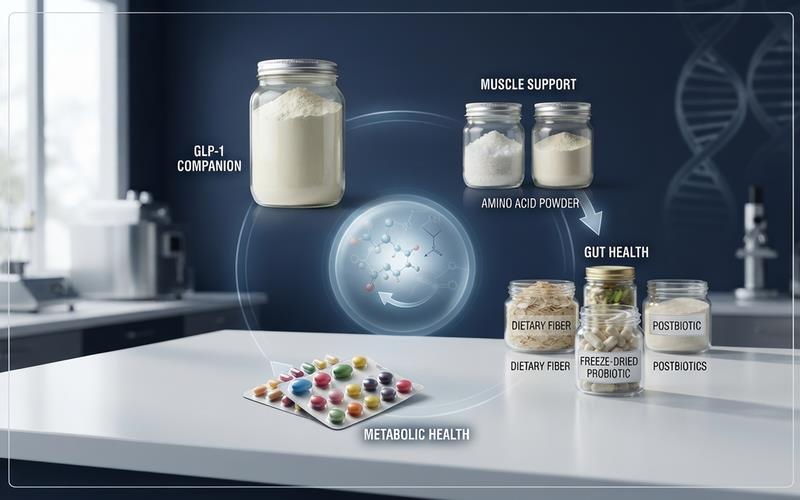
4. GLP-1 Companion Nutrition: Protein, Muscle and Gut Health
One of the most important developments in the GLP-1 market is the shift from asking “How much weight can be lost?” to asking “What happens to body composition and nutritional status during weight loss?”
Recent research has increased attention on lean mass, protein intake, resistance training and nutritional adequacy during significant weight reduction. A 2026 systematic review and meta-analysis found that lean mass represented a meaningful proportion of weight lost during incretin-based therapy, while programs incorporating resistance training showed a more favorable lean-mass profile.
A recent review also highlighted nutrition, exercise, supplementation and monitoring as important considerations when aiming to preserve lean mass and nutritional adequacy during GLP-1-based obesity treatment.
This creates a distinct opportunity for GLP-1 nutrition support products.
Potential ingredient categories include:
- Protein and amino acids
- Creatine and other muscle-support ingredients
- Essential vitamins and minerals
- Prebiotics and probiotics
- Postbiotics
- Digestive-health ingredients
- Fiber and functional carbohydrate ingredients
For product developers, the concept is straightforward: if food intake changes substantially, the formulation strategy should consider what nutrients may become harder to obtain from the diet.
This does not mean every GLP-1 user requires supplementation. Individual nutritional needs vary, and medical or nutritional advice should be provided by qualified professionals. But from an ingredient-development perspective, nutritional adequacy is becoming an increasingly relevant part of the market conversation.
5. Post-GLP-1 Strategies and Long-Term Weight Maintenance
The final stage of the ecosystem is long-term maintenance.
Weight management is not necessarily finished when a person reaches a target weight. NIDDK notes that some people may regain weight after stopping weight-management medication and emphasizes continued healthy eating and physical activity as part of long-term weight management.
This creates another formulation opportunity around appetite control, body composition, muscle maintenance, digestive health and sustainable nutrition.
Instead of positioning a product simply as a “post-GLP-1 supplement,” brands may consider broader concepts such as:
- Long-term weight maintenance
- Appetite and satiety support
- Healthy body composition
- Muscle maintenance
- Protein and amino acid support
- Gut health
- Metabolic wellness
This approach also makes the product concept less dependent on a single pharmaceutical trend.
From a Single Ingredient to a GLP-1 Ecosystem
The development of the GLP-1 market is creating a more sophisticated opportunity for ingredient suppliers and nutrition brands.
The next generation of products may not be defined by one “hero ingredient.” Instead, successful formulations may combine different ingredient categories according to specific needs:
Endogenous GLP-1 pathways → Satiety and metabolic control → Complementary weight-management pathways → Companion nutrition → Long-term weight maintenance
This framework allows product developers to think in terms of the complete consumer journey rather than a single weight-loss endpoint.
For ingredient sourcing, this also changes the procurement question.
A formulation company may not simply need one standardized botanical extract. It may need a combination of fiber, botanical extracts, probiotics, postbiotics, amino acids, vitamins, minerals or other functional ingredients, each with different specifications, documentation, MOQ requirements and quality considerations.
That makes supplier flexibility increasingly important.
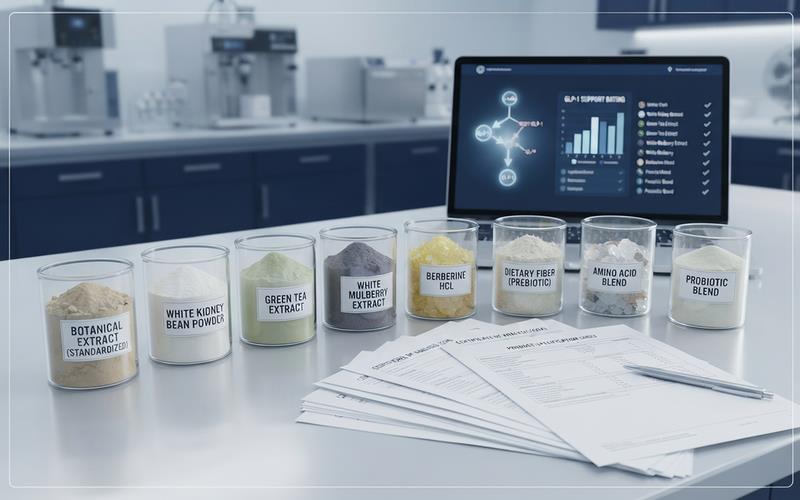
What Should Ingredient Buyers Evaluate?
When sourcing ingredients for GLP-1-related formulations, buyers should evaluate more than price.
Key considerations include:
1. Standardization and active content
For botanical extracts and specialty ingredients, the declared active marker and analytical method should be clearly defined.
2. Evidence and positioning
The available scientific evidence should match the intended product claim. Ingredients should not be positioned as GLP-1 mimetics or pharmaceutical substitutes without appropriate evidence.
3. Quality documentation
COA, specifications, microbiological limits, heavy metals, residual solvents and other relevant testing should be reviewed according to the ingredient and destination market.
4. Formulation compatibility
Particle size, solubility, hygroscopicity, stability, taste and odor can significantly influence the final product.
5. MOQ and supply flexibility
Emerging brands and R&D teams may require small pilot quantities before committing to larger volumes. Flexible sourcing can reduce the barrier between formulation testing and commercial production.
The Opportunity Beyond Weight Loss
The GLP-1 market is increasingly becoming a broader metabolic-health ecosystem.
For formulators, this means looking beyond appetite suppression and asking a more complete set of questions: How can a product support satiety? How can nutritional adequacy be maintained? How can muscle and lean mass be considered? What role can gut health play? And how can long-term weight maintenance be supported?
These questions create opportunities across botanical extracts, dietary fibers, probiotics, postbiotics, amino acids, vitamins, minerals and other functional ingredients.
For ingredient buyers, the most useful approach is not to chase every ingredient associated with GLP-1. It is to evaluate each ingredient according to its evidence, specification, formulation role, regulatory positioning and supply requirements.
The future of the category may therefore be less about finding one “GLP-1 ingredient” and more about building science-driven, complementary ingredient systems for metabolic health.