
Critical Relative Humidity Excipients: The One Number That Predicts Moisture Failure
Every hygroscopic powder has a tipping point. Below a certain ambient relative humidity, it barely absorbs water. Cross that threshold, and absorption accelerates sharply. Understanding critical relative humidity excipients — and where that threshold sits for the specific materials in your formulation — is often the difference between a product that survives a humid warehouse and one that doesn’t.
What critical relative humidity actually measures
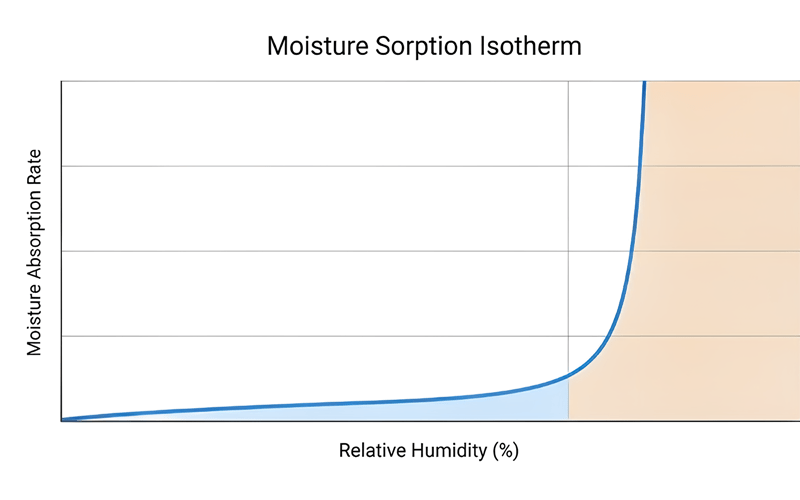
Critical relative humidity, or CRH, is the ambient RH level above which a powder’s moisture absorption rate increases sharply rather than gradually. It’s a threshold, not a straight line — a material can sit comfortably at 70% ambient humidity and start absorbing water rapidly at 75%. That non-linear behavior is exactly why a single “acceptable humidity” rule of thumb across your whole facility can quietly fail for specific ingredients.
Why CRH matters more than a single moisture spec
Water activity tells you a material’s current state. CRH tells you where that state is headed under real storage and processing conditions. A powder with excellent Aw at time of manufacture can still fail in the field if your production floor or warehouse regularly exceeds its CRH. Humid coastal climates, poorly dehumidified production rooms, and long transit times in non-climate-controlled shipping containers are the most common failure points we see raised by formulators.
Typical CRH ranges for common excipients
These are indicative ranges commonly reported in the literature; actual CRH varies by manufacturer, crystal form, and batch, so request current data for formulation-critical decisions rather than relying on general figures alone.
Excipient | Approximate CRH | Notes |
Mannitol | ~98% | Among the most humidity-resistant common fillers |
Erythritol | ~90% | Common default for probiotic carrier work |
Maltitol (crystalline) | ~89% |
|
Isomalt | ~85% | Still solidly low-Aw, more borderline than mannitol |
Xylitol | ~80% | Edge case — flag for formulation review |
Sorbitol | ~65% | Clearly hygroscopic in most applications |
What this means for packaging and export markets
If you’re formulating for a hot, humid export market — Southeast Asia, parts of the Middle East, coastal Latin America — CRH should factor into both excipient selection and packaging specification. Desiccant use, barrier film selection, and container humidity control during ocean freight all become more important as a material’s CRH gets lower. A filler with a CRH around 65% needs meaningfully more packaging protection during a six-week sea shipment than one sitting closer to 95%.

How CRH and Aw work together
Aw and CRH answer related but different questions, and formulators sourcing critical relative humidity excipients generally want both, not one or the other. Aw tells you whether a material is a risk today. CRH tells you the conditions under which that risk changes tomorrow. A complete excipient spec sheet should show both, alongside the equilibrium testing conditions used to generate them — see our companion piece, Water Activity Excipients: 7 Facts Formulators Get Wrong About Moisture, for more on how Aw itself is measured and reported.
Building CRH into your supplier evaluation
Few Chinese manufacturers currently publish CRH data as a standard part of their CoA. When it is available, it’s frequently a literature value rather than a batch-specific measurement. If your process runs in a humid facility or ships to humid markets, it’s worth asking directly: is this CRH figure tested on this batch, or cited from a general reference? The distinction matters more the closer your operating conditions sit to the threshold.
Esubio publishes CRH alongside Aw and LOD for the critical relative humidity excipients we source, labeled by whether the figure is manufacturer-tested or literature-reported. Browse our Low Water Activity Excipients range or reach out with your target climate and packaging conditions — we’ll help you match the CRH profile to your actual storage environment.
References
- S. FDA, “Water Activity (aw) in Foods” — https://www.fda.gov/inspections-compliance-enforcement-and-criminal-investigations/inspection-technical-guides/water-activity-aw-foods
- Food Safety Magazine, “Water Activity’s Role in Food Safety and Quality” — https://www.food-safety.com/articles/4420-water-activitye28099s-role-in-food-safety-and-quality
- Wikipedia, “Potentially Hazardous Food” — https://en.wikipedia.org/wiki/Potentially_Hazardous_Food