
Water Activity Excipients: 7 Facts Formulators Get Wrong About Moisture
Most Certificates of Analysis for water activity excipients still report only one moisture number: LOD, loss on drying. It’s easy to measure and easy to put on a spec sheet. On its own, though, it’s a surprisingly poor predictor of whether an excipient will destabilize a moisture-sensitive active or shorten a probiotic’s shelf life. Here are seven things worth knowing before your next round of samples arrives.
1.Water activity excipients are not the same as low-moisture excipients
Total moisture content and water activity answer two different questions. LOD tells you how much water is present overall. Water activity (Aw) tells you how much of that water is actually free to move — the fraction available to migrate into an active ingredient, drive hydrolysis, or support microbial growth. Two materials can carry identical LOD values and behave completely differently in a formulation if their Aw values diverge.
2.The clearest counterexample is pregelatinized starch
Pregelatinized starch is the textbook case for why LOD alone misleads. It can hold meaningfully more total moisture than a crystalline sugar alcohol and still register a lower water activity, because that moisture is bound tightly within the modified starch structure rather than sitting free. In practice, this means the material can pull free water away from a hygroscopic API elsewhere in the same formulation, rather than adding to the problem.
3. Water activity excipients fall into three distinct mechanism families
It helps to think about water activity excipients by mechanism rather than by chemical family. Intrinsically low-Aw materials — mannitol, erythritol, isomalt — simply have crystal structures that don’t hold water in the first place. Moisture-scavenging materials — pregelatinized starch, certain microcrystalline cellulose grades — have high bound-water capacity and actively draw free water out of the surrounding system. Anhydrous materials — anhydrous dibasic calcium phosphate, anhydrous lactose — remove water of crystallization at the source. Knowing which family a material belongs to tells you more about how it will perform than its chemical name does.
4. Critical relative humidity tells you where trouble starts
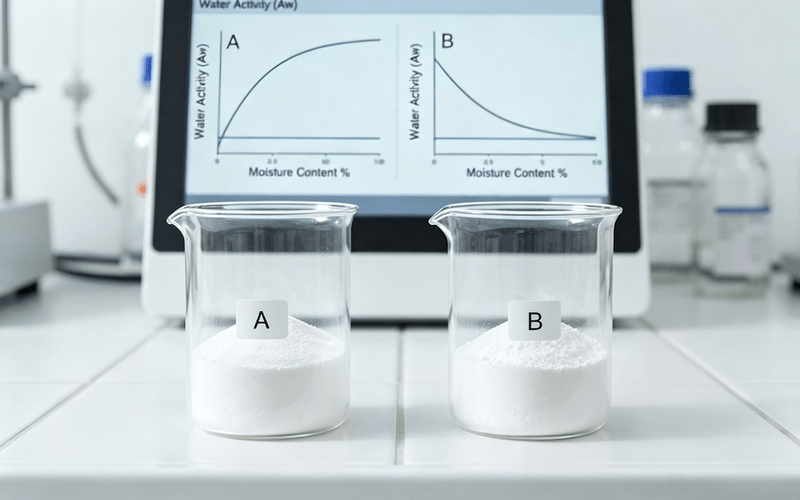
Aw describes a material’s current state. Critical relative humidity (CRH) describes the ambient humidity threshold above which that material starts absorbing moisture rapidly — a separate but related number worth understanding before you finalize packaging and storage conditions. We cover this in more detail in Critical Relative Humidity Excipients: The One Number That Predicts Moisture Failure.
5. Most Chinese-origin water activity excipients still don’t publish Aw
China holds a dominant share of global production capacity for erythritol, xylitol, maltitol, and maltodextrin, yet most of that capacity is still listed on B2B platforms as generic chemical commodities, with LOD as the only moisture figure on the CoA. That’s a documentation gap across the industry, not necessarily a quality gap — but it means buyers sourcing from China are often working with an incomplete technical picture unless they ask specifically. Our guide on Sourcing Excipients from China: 10 Things to Verify Before You Qualify a Supplier walks through what to request.
6. Aw is a hard cutoff for probiotics, a softer factor elsewhere
In most solid dosage formulation, water activity is one of several variables weighed against compressibility, flow, and cost. In probiotic formulation, it often functions closer to a pass/fail gate — a carrier with excellent flow properties and a poor Aw value simply doesn’t make the shortlist. See Probiotic Carrier Water Activity: 5 Rules for Choosing the Right Filler for more on how that threshold gets applied in practice.
7. Ask for the testing method, not just the number
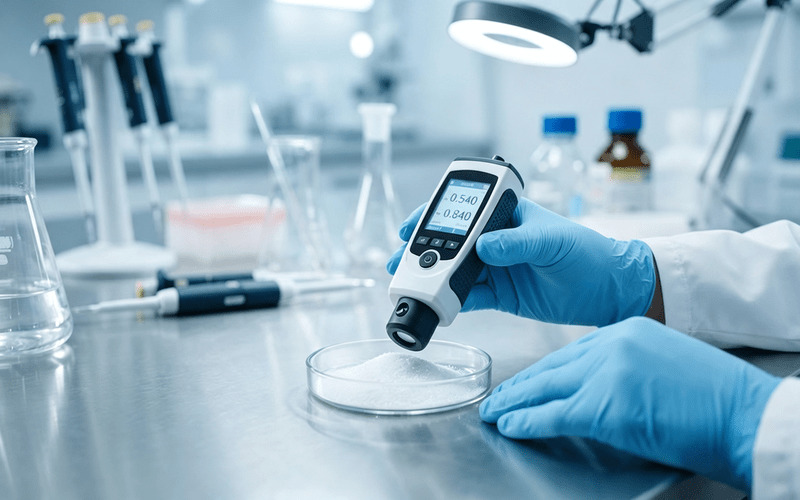
A single Aw value in isolation is only as useful as the method behind it. Ask suppliers what temperature the measurement was taken at (25°C is standard), what equilibrium criteria were used, and whether the instrument was a chilled-mirror dew point meter or a capacitance sensor — the two most common methods can show small but meaningful discrepancies near critical thresholds. USP General Chapter <1112>, Application of Water Activity Determination to Nonsterile Pharmaceutical Products, is a useful reference point for how the pharmaceutical industry frames this testing.
Water activity excipients reward the formulator who asks one extra question on the CoA request. Esubio sources and supplies low water activity excipients from qualified Chinese manufacturers and discloses Aw, LOD, and CRH — along with testing method — on every product page. Browse our full Low Water Activity Excipients range or get in touch with our sourcing team for current specs and samples.
References
- USP General Chapter <1112>, Application of Water Activity Determination to Nonsterile Pharmaceutical Products — https://doi.usp.org/USPNF/USPNF_M402_01_01.html
- S. FDA, “Water Activity (aw) in Foods” — https://www.fda.gov/inspections-compliance-enforcement-and-criminal-investigations/inspection-technical-guides/water-activity-aw-foods
- Wikipedia, “Water activity” — https://en.wikipedia.org/wiki/Water_activity