
Probiotic Ingredient Stability and COA Specifications: 7 Essential Checks
Probiotic ingredient stability and COA specifications are important considerations when sourcing live microbial ingredients for dietary supplements, functional foods, capsules, and powder formulations. A certificate of analysis (COA) helps buyers determine whether a specific batch meets its stated requirements. However, a COA alone cannot establish how well the ingredient will perform throughout its intended shelf life.
For procurement, quality assurance, and product development teams, the key is to connect batch-level test results with strain identity, viable count, water activity, microbiological quality, storage conditions, and stability evidence.
A clear qualification process can help identify specification gaps before production and reduce the risk of selecting an ingredient that is unsuitable for the finished product.

1. Confirm Strain Identity and Product Description
The first step is to establish exactly what the supplier is offering. A generic description such as “Lactobacillus powder” is not sufficient for a technical qualification process.
The product documentation should identify the microorganism at the level relevant to the product specification. Where applicable, confirm the genus, species, strain designation, and any strain combination. Check that the product name and identity information are consistent across the quotation, technical data sheet, COA, and packaging documents.
Strain identity matters because probiotic characteristics and performance are not interchangeable across all microorganisms. Stability information for one strain should not automatically be applied to another strain, even when the organisms belong to the same species.
If the ingredient contains multiple strains, ask how the composition is defined and whether the viable count is reported for the total blend or individual strains. The answer should be clear enough for your technical team to assess whether the ingredient meets the formulation requirements.
2. Review CFU/g and Understand What the Result Represents
Viable count is one of the most important specifications for a probiotic ingredient. It is commonly expressed as colony-forming units per gram (CFU/g), based on a defined microbiological method.
When reviewing the COA, confirm the reported result, acceptance limits, test method, and batch identification. Check whether the result is reported at release or represents a guaranteed level through the end of shelf life.
These distinctions matter when calculating the quantity of ingredient needed per serving. The amount required depends on the ingredient’s viable count, the target CFU per serving, the formulation’s total weight, and any validated allowance for viability loss during processing and storage.
For example, a calculation based only on the initial CFU/g may be insufficient if the finished product must meet a declared viable count at expiry. Any overage should be based on product requirements and supporting stability evidence rather than an arbitrary percentage.
A supplier’s batch COA is an important starting point, but finished-product testing may still be necessary to confirm that the formulated product meets its target.
3. Check Water Activity and Moisture Content Separately
Water activity and moisture content provide different information and should not be treated as equivalent COA parameters.
Moisture content measures the amount of water in the material. Water activity, expressed as aw, describes how available that water is. Both may be useful when evaluating a dried probiotic powder, but their relevance depends on the formulation and the agreed specification.
Ask the supplier to identify the method used for each test and the corresponding acceptance criteria. If water activity is a critical requirement for your application, establish the target before placing the order and verify that the supplied batch meets it.
The sampling and testing process also matters. A powder can absorb moisture during handling, so poor sample control may affect the measured result. Testing should follow a suitable method with appropriate sample handling and equipment controls.
Most importantly, a low water activity result should not be interpreted as proof of a specific shelf life. Stability also depends on the strain, protective matrix, temperature, packaging, oxygen exposure, and the conditions under which the product is stored.

4. Review Microbiological and Other Quality Requirements
The required microbiological quality parameters depend on the ingredient, intended use, market, and applicable regulations or customer specifications.
A COA may include tests for specified undesirable microorganisms, total counts, or other relevant microbiological criteria. The exact panel should be established according to the product’s risk assessment and intended application rather than copied indiscriminately from another ingredient.
Other parameters may also be relevant, such as appearance, carrier composition, moisture, heavy metals, or residual processing-related substances where applicable. Not every parameter is necessary for every probiotic ingredient, and the appropriate test panel should be justified.
Ask whether the results are reported as actual values, pass/fail statements, or results below a defined detection limit. For important quality attributes, the test method and acceptance criteria should be clear.
A COA should also be traceable to the specific batch being purchased. Confirm that the lot number on the document matches the supplied material and that the supplier can provide supporting technical documentation when required.
5. Evaluate Stability Evidence and Shelf-Life Claims
A stated shelf life is meaningful only when it is supported by appropriate product-specific evidence and defined storage conditions.
For probiotic ingredients, stability assessment may track viable count over time under specified conditions. Depending on the application, water activity, moisture content, appearance, and other relevant parameters may also be monitored.
Ask whether the available data relate to the exact strain or blend, carrier system, packaging configuration, and storage conditions you intend to use. Evidence generated for a different formulation or package may not be directly transferable.
It is also important to distinguish ingredient shelf life from finished-product shelf life. A probiotic raw material can meet its specification when supplied, while the finished capsule or powder may experience different conditions because of excipients, processing, package design, or consumer handling.
Where a finished product requires a defined viable count through expiry, the manufacturer should establish suitable acceptance criteria and stability protocols. Accelerated testing may help identify risks, but real-time evidence and appropriate scientific justification remain important when substantiating shelf-life expectations.
6. Confirm Packaging and Storage Requirements
Probiotic powders can be sensitive to moisture and temperature. Packaging and storage instructions therefore form part of the technical information needed for ingredient qualification.
Review the recommended storage temperature, humidity precautions, shelf-life period, and any special handling requirements. Confirm whether the ingredient is supplied in moisture-barrier packaging and whether additional protection is recommended after opening.
Do not assume that all dried or freeze-dried probiotics can be stored at ambient temperature. Requirements vary by strain, formulation, and product design.
For large-volume orders, also consider how the ingredient will be stored after receipt. The original shipping container may not be the final packaging used in manufacturing. Repackaging, repeated opening, and extended exposure to the production environment can introduce additional risks.
The quality team should make sure that incoming inspection, storage, dispensing, and in-process handling follow the supplier’s recommendations and the manufacturer’s internal procedures.
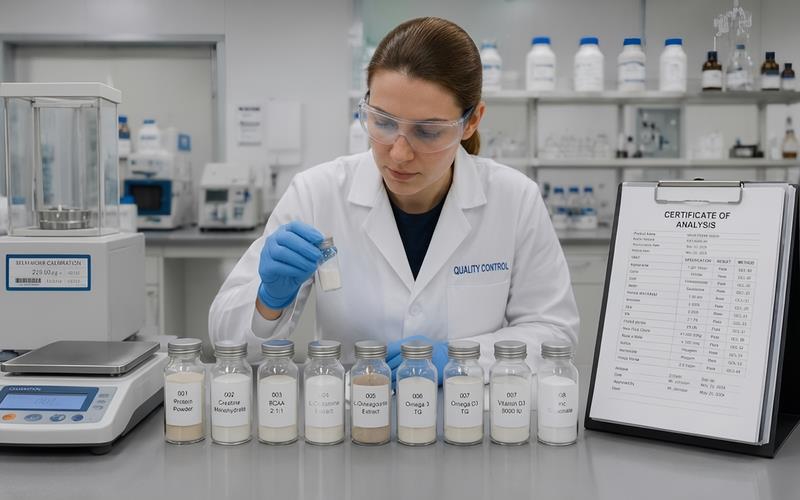
7. Request a Complete and Consistent Technical Document Package
A useful supplier qualification process looks beyond the COA. Depending on the project, the document package may include:
A technical data sheet or product specification.
A batch-specific COA with relevant results and test methods.
Strain identity and product composition information.
Storage and handling instructions.
Shelf-life information and supporting stability data, where available.
Safety data sheet, where applicable.
Relevant allergen, microbiological, contaminant, and regulatory declarations.
Batch traceability and change-control information.
Not every document applies to every product or market. Buyers should identify the required documents during supplier qualification and confirm that the information is current and consistent.
If a supplier cannot provide a requested item immediately, ask what information is available and whether the missing document can be supplied before approval or shipment. Avoid assuming that a document exists or that a particular test has been performed unless the supplier confirms it.
A Practical COA Review Checklist for Probiotic Buyers
Before approving a batch, check that the product identity and lot number are correct, the viable count meets the agreed specification, the water activity and moisture results are acceptable where required, the relevant microbiological criteria are addressed, and the storage and shelf-life information is clear.
Then review the COA alongside the technical data sheet and the requirements for the intended formulation. If a critical parameter is missing or ambiguous, request clarification before making a purchasing decision.
This approach helps distinguish between a document that simply accompanies a shipment and a quality package that supports a meaningful technical assessment.
Request Probiotic Specifications for Your Project
Reliable probiotic sourcing requires a clear understanding of the material, its batch results, and its expected performance in the intended application. A COA is essential for batch review, but strain identity, viable count, water activity, packaging, storage, and stability evidence must be considered together.
If you are sourcing probiotic ingredients for capsules, powder sachets, functional foods, or synbiotic formulations, define your target CFU/g, strain requirements, dosage form, and storage conditions before requesting a quotation.
Contact our team to request available probiotic ingredient specifications, a batch COA, and relevant technical information. Include your intended application, target quantity, and key quality requirements so the appropriate documentation can be identified for your project.
References
Wang, A., & Zhong, Q. (2024). Drying of probiotics to enhance the viability during preparation, storage, food application, and digestion: A review. Comprehensive Reviews in Food Science and Food Safety. https://doi.org/10.1111/1541-4337.13287
Silva, C. C. G., et al. (2022). Current Trends in the Production of Probiotic Formulations. Foods. https://pmc.ncbi.nlm.nih.gov/articles/PMC9368262/
Characteristics of Probiotic Preparations and Their Applications. https://pmc.ncbi.nlm.nih.gov/articles/PMC9407510/
The Production and Delivery of Probiotics: A Review of a Practical Approach. https://pmc.ncbi.nlm.nih.gov/articles/PMC6463069/
Mechanisms of Water Migration and Their Impact on Probiotic Stability During Freeze-Drying: A Comprehensive Review. Cryobiology (2026). https://pubmed.ncbi.nlm.nih.gov/42140154/