
Single Amino Acid Ingredients: What Buyers Should Check Before Sourcing
Single amino acid ingredients are important building blocks for sports nutrition products, dietary supplements, and specialized nutritional formulations. For supplement brands and powder contract manufacturers, choosing an amino acid is not simply a matter of comparing prices or checking the headline purity on a specification sheet. The ingredient must meet the intended formulation requirements, fit the manufacturing process, and maintain consistent quality across commercial batches.
A supplier quotation may look attractive, but the practical value of an ingredient depends on several factors: identity, assay, impurity profile, physical properties, documentation, packaging, and supply continuity. Understanding these factors before placing an order can help purchasing and R&D teams reduce avoidable formulation and production risks.
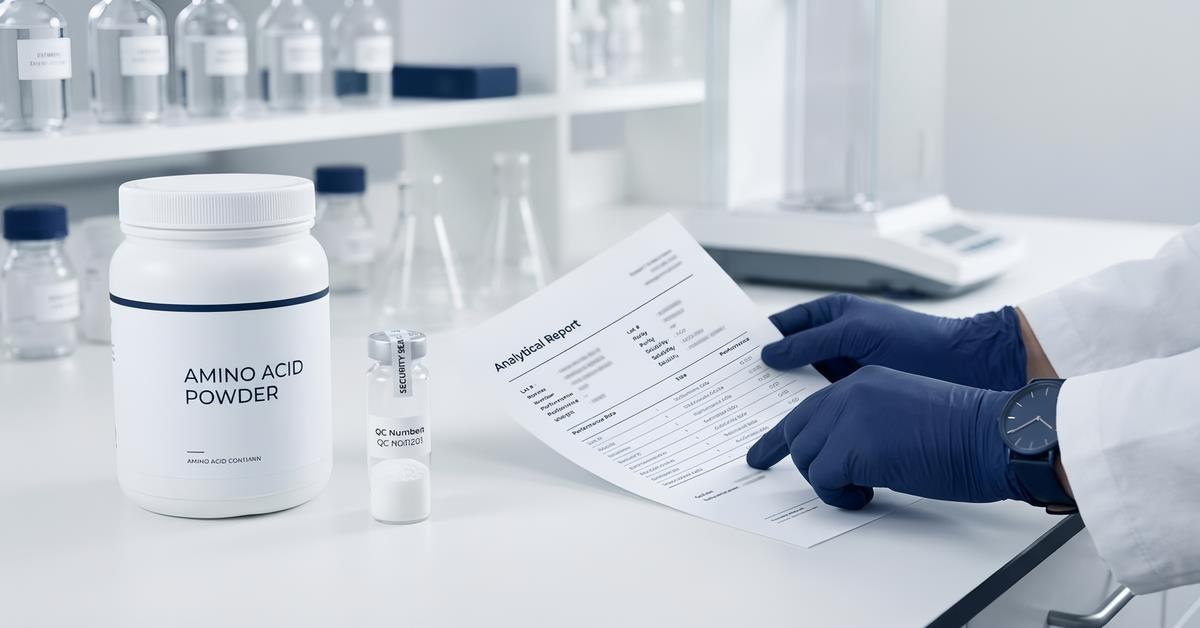
Single Amino Acid Ingredients Start With the Right Specification
The first step is to define the material precisely. An amino acid name alone may not be sufficient for procurement. Buyers should confirm the chemical identity, applicable form, grade, assay method, and intended application.
For example, a formulation using L-leucine should not be evaluated solely by a general statement such as “high purity.” The specification should define how identity and assay are assessed and which limits apply to relevant impurities. Where different grades, forms, or manufacturing routes are available, the selected option should match the product’s technical and regulatory requirements.
The specification should be agreed upon before the first commercial purchase, not after the material arrives. This is especially important when an ingredient will be used in a high-volume powder blend, a flavored drink mix, or a product with tightly controlled label claims.
Buyers should also clarify whether assay results are expressed on an as-is basis or a dried basis. These values are not always directly comparable. Moisture content and the reporting basis can influence how the result is interpreted, so the testing method and calculation basis should be understood by both parties.
How to Evaluate Purity and Impurity Control
Purity is a key purchasing parameter, but a single percentage cannot describe every aspect of ingredient quality. Two materials with similar assay results may differ in their impurity profiles, test methods, or suitability for a specific application.
A useful review begins with the certificate of analysis (COA). Check the reported assay, identity result, test method, specification limit, and actual batch result. Where applicable, review relevant limits for residual solvents, elemental impurities, process-related impurities, microbiological parameters, or other contaminants based on the ingredient’s manufacturing process, risk assessment, and intended use.
Not every parameter is relevant to every amino acid. A technically sound specification should be risk-based rather than an indiscriminate list of tests. The objective is to establish that the material meets appropriate requirements for identity, purity, strength, composition, and contaminant limits.
The analytical method also matters. Ask whether the test method is suitable for the analyte and whether the reported result can be compared with the specification. When evaluating suppliers, distinguish between a specification limit and a measured result: “meets the requirement” is not the same as providing the actual test value.
A COA is a valuable quality document, but it should not be treated as a substitute for supplier qualification or any verification required by the buyer’s quality system. The U.S. FDA’s dietary supplement CGMP guidance discusses component specifications, supplier qualification, COAs, and identity verification in detail.

Why Solubility and Physical Properties Matter
For powder supplement manufacturers, a chemically acceptable amino acid may still present formulation challenges. Solubility, dissolution behavior, particle size, bulk density, flowability, and sensory characteristics can influence processing and the consumer’s preparation experience.
These properties should be evaluated in the context of the finished product. An amino acid used in a capsule may have different physical requirements from one used in an instant beverage powder. A drink mix may require rapid dispersion and an acceptable appearance after mixing, while a dry blend may place greater emphasis on flow, segregation control, and accurate filling.
Solubility should be assessed under defined conditions. Temperature, pH, concentration, mixing time, and the presence of other ingredients can all affect observed behavior. A statement such as “soluble in water” may not answer the formulation team’s actual question: how does the ingredient perform at the intended use level in the complete formula?
Where dissolution or dispersion is a critical requirement, ask for test conditions or conduct a formulation trial. Record the water temperature, mixing method, concentration, time, and any visible residue. These observations help distinguish a raw-material issue from a problem caused by the overall formula.
Fermentation Origin: Ask for Evidence, Not Assumptions
Some amino acids are produced through fermentation, while manufacturing routes can vary by ingredient and supplier. Buyers who require fermentation-derived materials should make the requirement explicit and request supporting documentation.
Do not infer production origin from the amino acid name, a supplier’s location, or a general marketing statement. Confirm the manufacturing route for the specific product and grade. If the claim is important for customer communication, sustainability positioning, or regulatory review, establish what documentation is available and what exactly it supports.
The same principle applies to claims such as non-GMO, vegan, allergen-related status, or specific country of origin. Each claim should be supported by relevant records rather than assumed from the product category.

Batch Consistency Is a Commercial Requirement
A successful sample does not automatically guarantee that future commercial lots will behave identically. For ongoing production, buyers should compare COAs across multiple batches when available and identify which parameters are critical to the finished formula.
Consider the assay, impurity limits, moisture, physical appearance, particle characteristics, and any application-specific properties. The relevant comparison depends on the amino acid and the production process. Changes outside the agreed specification should be investigated before the material is released for use.
It is also useful to establish a change-notification process. Buyers should understand how a supplier communicates material changes to manufacturing route, specification, test method, production site, or packaging that could affect product quality or qualification status.
For a contract manufacturer serving multiple brands, documented batch consistency can reduce the risk of unexpected adjustments during blending, filling, or quality review. It also makes supplier performance easier to assess over time.
What to Request Before Placing an Order
Before approving a new amino acid source, request a current specification sheet, a representative COA, available safety documentation, packaging details, shelf-life and storage information, lead time, MOQ, and sample availability.
The review should also cover order-specific details: batch identification, traceability, shipment conditions where relevant, and the process for handling nonconforming material. If the ingredient will be used in a regulated market, the buyer’s quality and regulatory teams should confirm that the documentation is adequate for the intended application.
A practical qualification process is more useful than relying on a broad supplier claim. Define the essential requirements first, assess the documents, test the sample in the actual formulation, and confirm the acceptance criteria before commercial production.
Source Single Amino Acid Ingredients With a Clearer Specification
Choosing an amino acid source is a technical and commercial decision. The right material should meet the agreed specification, fit the formulation process, and offer a level of documentation and supply continuity appropriate to the product.
Esubio supports B2B ingredient sourcing for nutrition brands, powder contract manufacturers, and supplement producers. If you are evaluating single amino acid ingredients, share your target amino acid, required grade, specification limits, estimated quantity, and application.
**Explore amino acid ingredients at https://www.esubio.com/** or contact the Esubio team to request product specifications, a COA for review, and a quotation based on your project requirements.
References
- https://www.fda.gov/regulatory-information/search-fda-guidance-documents/small-entity-compliance-guide-current-good-manufacturing-practice-manufacturing-packaging-labeling
- https://pubmed.ncbi.nlm.nih.gov/35889795/
- https://pubmed.ncbi.nlm.nih.gov/39198298/