
5 Critical Supplier Responsiveness Signals That Protect Your Supply Chain
Supplier responsiveness is one of the easiest supplier-performance signals to observe before placing an order — yet it is often overlooked.
A new ingredient supplier may offer a competitive price, attractive specifications, or an impressive product catalog. But when you send a detailed inquiry and wait three days for a useful answer, the problem is no longer just communication.
For procurement and R&D teams, slow or incomplete responses can create friction throughout the sourcing process. A specification needs clarification. A sample needs to be arranged. A COA needs to be reviewed. Additional documentation is requested by quality. Then another person needs to follow up because the previous question was only partially answered.
None of these delays necessarily proves that a supplier is unreliable. But together, they provide useful information about how the supplier operates.
In ingredient sourcing, where projects often move from inquiry to sample testing, supplier qualification, pilot production and commercial purchasing, that information matters.
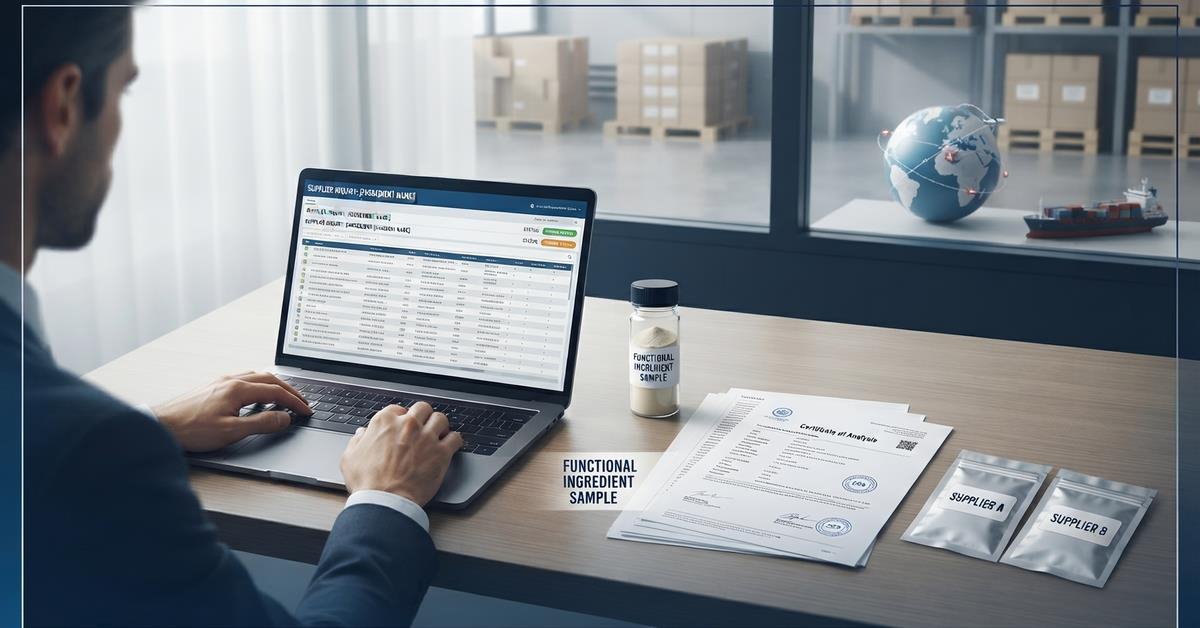
Why Supplier Responsiveness Matters in Ingredient Sourcing
Supplier performance is not simply about the price of the raw material.
The American Society for Quality (ASQ) notes that supplier quality management extends beyond product quality and includes factors such as delivery reliability, communication, problem resolution and the total cost of dealing with a supplier. Supplier selection can also consider technical support, capacity, delivery schedules and previous performance.
This is particularly relevant to functional ingredients.
An inquiry for something such as a botanical extract, probiotic, amino acid or specialty active rarely requires only a price.
A buyer may need to confirm:
- Exact specification and active content
- Grade and intended application
- MOQ
- Sample availability
- Lead time
- Batch-specific COA
- MSDS or SDS
- Certifications
- Packaging
- Storage requirements
- Shipping options
- Additional testing requirements
The faster a supplier can understand these requirements and organize the relevant information, the easier it becomes for procurement, quality and R&D teams to evaluate the opportunity.
That does not mean the fastest supplier should automatically be selected.
Instead, response speed should be viewed together with response quality.
5 Supplier Responsiveness Signals to Watch
1. Does the supplier understand the requirement?
A fast answer is not necessarily a useful answer.
One common problem in ingredient sourcing is receiving a quotation that technically responds to the inquiry but ignores important requirements.
For example, a buyer may specify a particular particle size, active percentage, target market, certification or application. If the supplier simply replies with a price without addressing those requirements, the conversation has not actually moved forward.
Good supplier responsiveness starts with understanding the request.
A useful response should identify the key requirements, clarify missing information when necessary, and explain what can be confirmed immediately versus what requires further checking.
This is especially important for customized specifications or less common ingredients, where the first inquiry may require technical communication between sales, quality and production teams.
2. Can the supplier provide the right documents without repeated follow-up?
Documentation is often where sourcing projects lose time.
A buyer may initially request a specification and COA. After receiving the quotation, quality asks for an MSDS. Then regulatory asks for another statement. Then R&D needs additional technical information.
Some of this is unavoidable. Different ingredients and markets have different documentation requirements.
The useful signal is how the supplier handles the process.
A supplier with an organized documentation workflow should be able to identify the standard technical package available for the ingredient and provide it efficiently.
ASQ specifically identifies communication methods, incoming verification requirements and supplier technical support as part of the broader cost of dealing with suppliers.
The real procurement cost is therefore not only the price per kilogram. Time spent chasing documents, clarifying specifications and resolving avoidable communication gaps also affects the project.

3. How quickly can the supplier move from inquiry to sample?
For many nutrition and supplement projects, the sample is the first real test of a supplier relationship.
Before commercial production, the buyer may need to evaluate:
- Appearance
- Odor
- Solubility
- Flowability
- Particle size
- Taste
- Compatibility
- Active content
- Microbiological parameters
- Formulation performance
The exact testing depends on the ingredient and application.
A supplier that can quickly confirm sample availability, sample quantity, documentation and estimated dispatch timing reduces the administrative gap between sourcing and technical evaluation.
Again, speed alone is not enough.
A sample that arrives quickly but does not match the requested specification creates another problem. The meaningful metric is therefore not simply “How fast did the supplier respond?” but “How efficiently did the supplier move the project to the next useful step?”
4. Does the supplier communicate clearly when something cannot be confirmed?
This may be one of the most important signals.
No supplier can guarantee that every request will be immediately available.
A particular batch may be out of stock. A specification may require confirmation. A test may take several days. A certification may apply only to certain production sites or batches.
The question is how the supplier communicates that limitation.
A clear answer might say:
“We can provide the standard specification now, but the additional test needs to be confirmed with our quality team.”
Or:
“We have a sample available, but the requested particle size needs to be checked before we confirm commercial supply.”
This type of communication is much more useful than giving an uncertain answer simply to keep the inquiry moving.
Supplier responsiveness is therefore also about transparency.
A fast “yes” that later becomes a “no” can create more procurement risk than a slower but accurate answer.
5. Does the response remain consistent as the project develops?
The first quotation is only the beginning.
A supplier may respond quickly during the initial inquiry but become difficult to reach once the project enters sample testing, qualification or commercial negotiation.
This is why supplier responsiveness should be observed across several stages.
For example:
Inquiry → Specification → Quotation → Sample → Documentation → Testing → Order → Shipment
At each stage, the buyer can observe whether the supplier follows through.
Does the supplier remember the agreed specification?
Does the sample match the quotation?
Are documents provided when promised?
Are changes communicated before shipment?
Can questions from quality or R&D be passed to the appropriate technical person?
This broader view is more useful than judging a supplier from one email.
Supplier Responsiveness Should Be Evaluated With Other Criteria
There is an important distinction here.
Supplier responsiveness is a useful signal, but it should not become a substitute for supplier qualification.
A supplier can answer every email within an hour and still fail to meet quality, regulatory, capacity or delivery requirements.
Likewise, a technically strong supplier may need more time to answer a complex question because the information requires confirmation from quality or production.
A more complete supplier evaluation should therefore consider several dimensions:
Quality: Can the supplier consistently meet the required specification?
Delivery: Can the supplier meet the required timeline and quantity?
Technical support: Can the supplier understand and address application-specific requirements?
Documentation: Can the supplier provide the necessary quality and regulatory documents?
Communication: Can the supplier provide accurate and timely information?
Commercial fit: Are MOQ, pricing, payment terms and logistics workable for the project?
Capacity: Can the supplier support both the initial order and potential repeat demand?
ASQ similarly identifies quality, delivery, cost and supplier support among the major considerations in supplier evaluation.

The objective is not to find the supplier that answers the fastest.
It is to identify a supplier whose communication and operational behavior fit the requirements and risk level of the project.
A Simple Way to Test Supplier Responsiveness Before Ordering
Procurement teams do not necessarily need a complicated scorecard for every new supplier.
A practical approach is to send a structured inquiry containing the information that actually matters:
Ingredient:
Specification:
Quantity:
Application:
Target market:
Required certifications:
Required documents:
Destination:
Sample requirement:
Expected timeline:
Then observe what happens.
Did the supplier understand the request?
Did it identify missing information?
Did it answer each major question?
Were the quotation and specification consistent?
Could it arrange the requested documentation?
Could it explain what was available immediately and what needed confirmation?
Most importantly, did the response reduce the buyer’s workload?
That last question is often overlooked.
A good supplier should make the sourcing process easier, not create another administrative layer for the procurement team.
Why Communication Becomes More Important as Orders Scale
The consequences of poor communication become more visible when an ingredient moves from sampling to commercial supply.
During the sample stage, a delayed response may cost a few days.
During commercial production, the same communication problem can affect purchasing schedules, quality release, production planning, shipment arrangements or customer delivery.
This is why supplier qualification should not focus only on the product itself.
The supplier is part of the operating process.
The quality of that operating relationship can influence how quickly problems are identified, how efficiently information moves between teams and how easily changes are handled.
The Institute for Supply Management (ISM) also emphasizes communication, performance tracking and structured supplier relationships as important elements of supplier relationship management.
For international ingredient sourcing, this becomes even more relevant because procurement teams may already be coordinating across different time zones, languages, documentation systems and logistics providers.
Clear communication reduces unnecessary friction.
How Esubio Approaches Supplier Responsiveness
At Esubio, we treat responsiveness as part of the sourcing process rather than simply a customer-service promise.
For ingredient inquiries, our objective is to understand the buyer’s actual requirement first — including specification, quantity, application, target market and documentation needs — and then identify the most relevant sourcing option.
We typically respond to inquiries within 24 hours and arrange samples within 3–5 days when the ingredient is available and project requirements allow.
Depending on the ingredient, the sourcing process may include product specifications, COA, MSDS/SDS, MOQ, quotation, lead-time information and other available documentation.
The goal is not simply to send a price list.
It is to help the buyer move from requirement to evaluation with fewer unnecessary steps.
For brands, OEM manufacturers and R&D teams working with functional ingredients, that can be especially valuable when the required ingredient is not part of their existing supplier network.
The First Signal Is Often the Easiest One to Observe
A supplier’s first response cannot tell you everything about its supply capability.
But it can tell you something.
If the supplier understands the requirement, asks relevant questions, provides accurate information, organizes documentation efficiently and keeps communication consistent as the project develops, you have already observed several aspects of its operating process before placing a commercial order.
That makes supplier responsiveness worth tracking as part of supplier qualification.
Price tells you what the material costs.
Specifications tell you what the material is supposed to be.
Testing tells you whether the sample meets your requirements.
But communication shows you how the supplier operates with you.
For ingredient procurement, that is not a minor service detail. It is part of the supply relationship itself.