
Botanical Ingredient Price Volatility: 7 Powerful Ways to Reduce Cost Surprises
Botanical Ingredient Price Volatility is one of the most difficult cost variables for companies sourcing natural ingredients.
A price that worked last quarter may no longer be available when the next purchase is made. The problem is not simply that an ingredient becomes more expensive. The bigger problem is that the price used for formulation costing, customer quotations, and production planning may no longer reflect the replacement cost.
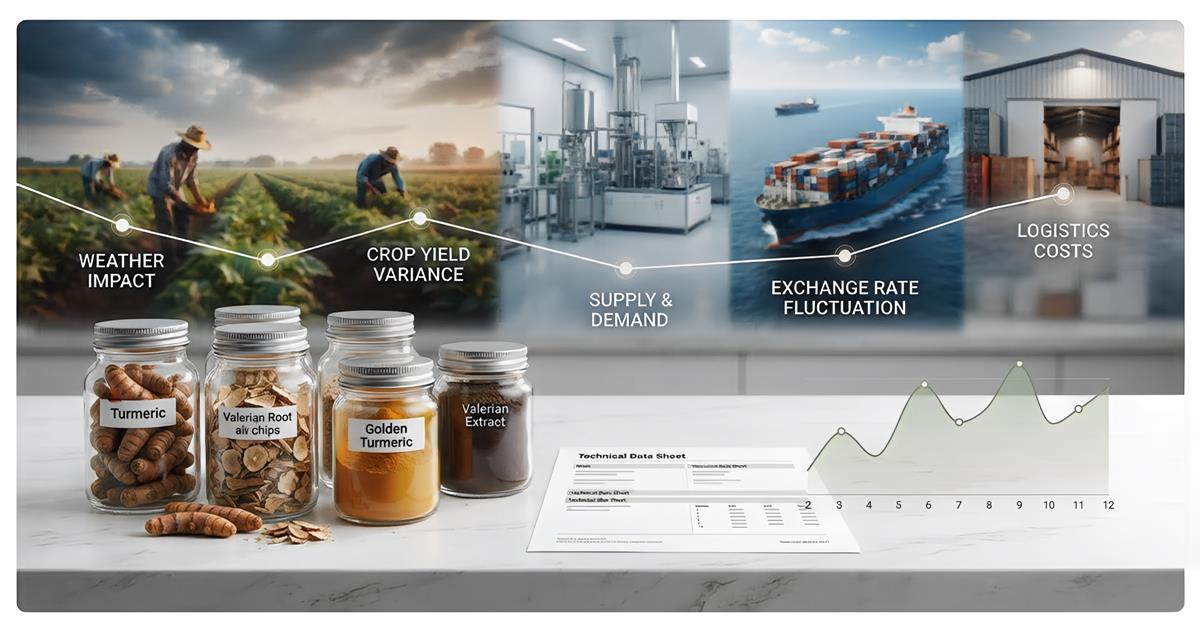
This is particularly relevant for botanical extracts and other plant-derived ingredients. Their supply can be influenced by harvest conditions, weather, crop yields, production costs, inventories, exchange rates, transportation, trade conditions, and changes in demand.
Global agricultural markets are exposed to many of these factors. The FAO notes that agricultural commodity prices reflect changes in supply and demand, while the World Bank identifies weather, exchange rates, energy costs, trade conditions, and other macroeconomic factors as important sources of commodity price movement.
For ingredient procurement teams, the practical question is therefore not whether prices will ever change.
It is how much of that change can be anticipated and managed.
Why Botanical Ingredient Price Volatility Is Difficult to Manage
A manufactured ingredient can often be produced according to a relatively controlled production plan. A botanical ingredient starts much earlier in the supply chain—with agricultural production and the availability of plant material.
That creates another layer of uncertainty.
A poor harvest can reduce available raw material. A change in weather can affect yield or quality. Higher labor, energy, fertilizer, processing, or transportation costs can increase the cost of bringing the ingredient to market. Currency movements can also change the effective cost for international buyers.
These factors do not affect every botanical ingredient in the same way or at the same time.
That is why simply asking a supplier, “How long is this price valid?” does not solve the underlying procurement problem.
A price-validity period tells you how long a quotation stands.
It does not tell you how exposed the supply is to the next production cycle.
1. Understand What Is Actually Driving the Price
Before trying to negotiate a lower price, understand what is behind the quotation.
For a botanical extract, the price may reflect much more than the extraction process itself.
Relevant factors can include:
- Availability and cost of the botanical raw material
- Harvest timing and crop yield
- Plant part used
- Extraction ratio and process
- Standardization requirements
- Testing and quality-control requirements
- Packaging
- Transportation and logistics
- Exchange-rate movements
- Current supply and demand
This distinction matters because not every price increase can be negotiated away.
If the underlying raw material has become more expensive, asking for an arbitrary reduction may only lead to a supplier switching to a different specification, source, or commercial condition.
A better procurement discussion starts with the question:
What has changed in the supply chain since the previous quotation?
2. Separate Market Volatility From Supplier Pricing
Not every price change is a market event.
Sometimes different suppliers simply have different sourcing structures, inventories, production arrangements, or commercial margins.
This is why comparing quotations can be useful—but comparing only the final USD/kg number can be misleading.
Two suppliers may quote the same botanical extract at different prices because they are working with different:
- Raw material origins
- Extraction ratios
- Marker-compound specifications
- Production batches
- Inventory positions
- Order quantities
- Delivery terms
- Payment terms
Before concluding that one supplier is “too expensive,” procurement should make sure the specifications and commercial terms are genuinely comparable.
This is especially important when replacing an approved ingredient. A lower price is not necessarily a lower total cost if the replacement requires additional formulation work, testing, qualification, or regulatory review.
3. Avoid Building the Entire Cost Model Around One Spot Quote
One of the most common procurement mistakes is treating a current quotation as if it were a long-term cost assumption.
Imagine a product is being developed with a botanical extract quoted at $40/kg.
The formulation team uses that number to calculate the product cost. Sales uses the result to prepare a customer quotation. Several months later, the product is ready for commercial production—but the replacement price is $48/kg.
The original calculation may no longer work.
The issue was not necessarily that the supplier acted unexpectedly.
The issue was that a short-term market quotation was treated as a stable long-term cost.
For ingredients with meaningful price exposure, procurement can instead work with a cost range or scenario model.
For example:
Base case: current market quotation
Higher-cost case: potential supply tightening
Planning case: expected purchasing price for the next procurement cycle
This does not predict the market.
It simply prevents one quotation from becoming an unquestioned assumption.
4. Plan Around Purchasing Cycles, Not Just Individual Orders
Price discussions become more meaningful when the supplier understands the expected purchasing pattern.
A buyer ordering 10 kg every few months presents a different commercial situation from a buyer with predictable quarterly demand or an annual requirement of several hundred kilograms.
The important information may include:
- Estimated annual demand
- Typical order quantity
- Expected purchasing frequency
- Target delivery period
- Whether demand is seasonal
- Whether the ingredient is critical to the formulation
- Whether alternative specifications are acceptable
This information does not guarantee a fixed price.
However, it gives both sides a basis for discussing supply planning rather than negotiating every order from zero.
That can make price changes more understandable and potentially more manageable.
5. Look Beyond the Lowest Current Price
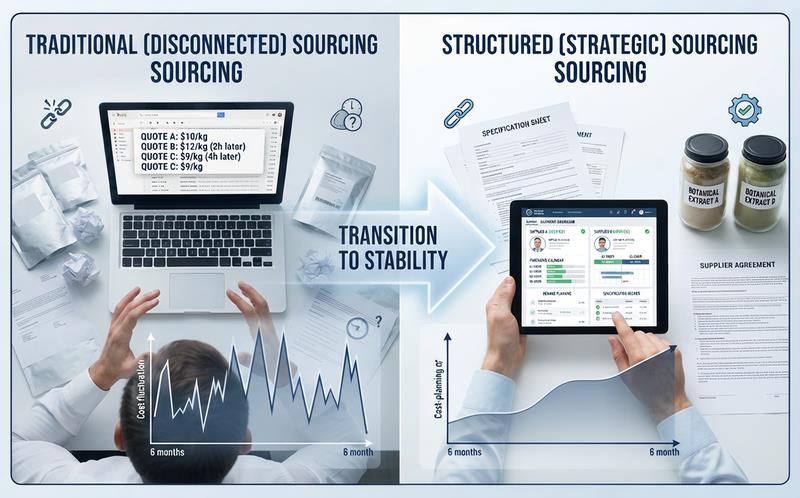
When prices are moving, it is tempting to search for the lowest quotation available in the market.
But this can create another problem.
A very low quotation may reflect temporary inventory, a different specification, a different origin, a lower order quantity, or a commercial strategy that cannot be repeated later.
If the supplier cannot maintain the same specification or availability when the next order arrives, the apparent saving may disappear.
This is why procurement should consider total sourcing risk, not just the lowest USD/kg.
For a critical botanical ingredient, a slightly higher but more transparent and dependable supply option may make budgeting easier than repeatedly switching between uncertain sources.
The objective is not to eliminate price competition.
It is to avoid making the supply chain dependent on one unusually low quotation.
6. Build More Visibility Before the Next Reorder
The best time to discuss price risk is usually before the next purchase becomes urgent.
For regularly used botanical ingredients, procurement can maintain a simple supply-monitoring record covering:
- Current quotation
- Previous quotation
- Quotation validity
- Expected purchasing cycle
- Available stock or lead time information
- Major specification changes
- Origin or raw-material changes
- Relevant market developments
This creates a basic purchasing history.
Over time, the company can see whether a price change is an isolated quotation adjustment or part of a broader market movement.
FAO emphasizes the value of timely and transparent market information in understanding agricultural price movements and supporting better decision-making.
For smaller companies, this does not require a sophisticated commodity-trading system.
Even a structured supplier comparison and purchasing history can provide much more visibility than starting every purchase with a completely new quotation.
7. Turn Price Volatility Into a Planning Variable
The most useful change in procurement thinking is to stop treating price movement as a surprise.
A botanical ingredient does not need to have a permanently fixed price to be commercially manageable.
Instead, procurement can ask:
What is the current price?
What factors could move it?
When are we likely to buy again?
How much volume do we expect to need?
What alternatives exist if the specification or price changes?
How much cost variation can the product absorb?
These questions turn price volatility from an unexpected event into a variable that can be discussed during product planning.
This is especially important when an ingredient is a small part of the formulation by weight but a significant contributor to the finished product cost.
The Real Cost of Unstable Sourcing
The financial impact of price volatility is not always visible on the supplier quotation.
Consider what happens when a botanical ingredient suddenly becomes more expensive.
The higher raw-material cost may reduce the product margin. Procurement may need to renegotiate. R&D may need to evaluate an alternative grade. Regulatory or quality teams may need to review a new source. Production may need another qualification run.
The actual cost can therefore be much larger than the difference in USD/kg.
This is why supplier continuity and communication matter.
A sourcing relationship that gives early visibility into potential changes can create more value than one that simply provides the lowest price on the day of inquiry.
From Price Buying to Supply Planning
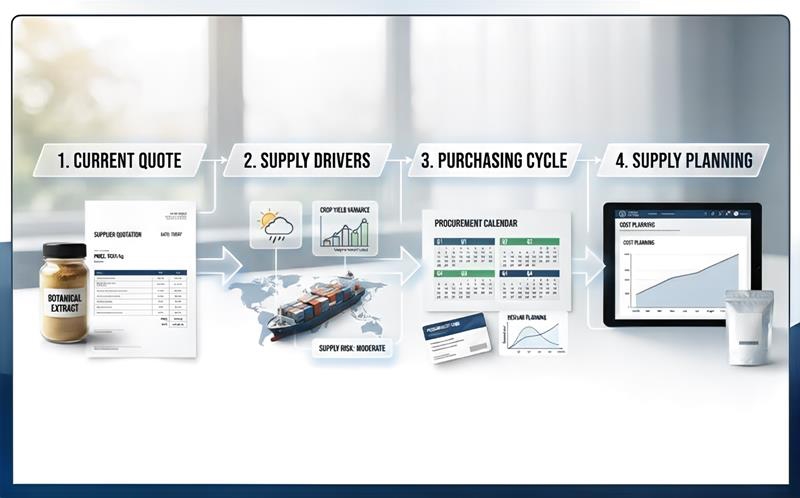
There is a fundamental difference between buying an ingredient and planning an ingredient supply.
Buying asks:
“What is your price today?”
Supply planning asks:
“What will we need, when will we need it, and what could affect availability or cost before then?”
Neither approach eliminates market risk.
But the second approach gives procurement more information to work with.
At Esubio, we use a verified-supplier approach across botanical extracts, amino acids, probiotics, and other functional ingredients for international customers.
For regularly purchased ingredients, we can discuss expected quantities, purchasing cycles, specifications, and supply requirements before matching an appropriate sourcing option.
We cannot promise that a botanical ingredient price will remain unchanged. No responsible supplier can guarantee that when the underlying market is exposed to agricultural and supply-chain variables.
What we can do is make the supply discussion more structured: understand the application, confirm the specification, communicate the expected purchasing pattern, and provide the available commercial information clearly.
That can help move price volatility from an unexpected problem to a variable that procurement can plan around.
The Bottom Line
Botanical Ingredient Price Volatility is not simply a supplier pricing problem.
It is a supply-planning problem.
Weather, harvest conditions, crop availability, production costs, logistics, exchange rates, demand, and broader commodity-market conditions can all influence agricultural and natural-material prices.
Procurement cannot control all of these variables.
But it can control how much uncertainty is built into the purchasing process.
Understand the price drivers. Compare equivalent specifications. Avoid relying on one spot quotation. Communicate expected purchasing cycles. Monitor changes before the next order becomes urgent.
The goal is not to find a price that never changes.
The goal is to build a supply relationship where changes are visible early enough to be planned.