
Choosing the Right Stevia Grade: A Decision Framework for R&D and Procurement Teams
Choosing the right stevia grade is not a single decision. It involves several factors that need to be considered together: steviol glycoside profile, sweetness potency, taste curve, blending requirements, regulatory documentation, and the specific application.
A grade that performs well in one product may not be the best choice for another.
For R&D and procurement teams, the goal is to identify the grade that provides the right balance of sensory performance, sweetness potency, formulation fit, documentation, and commercial cost.
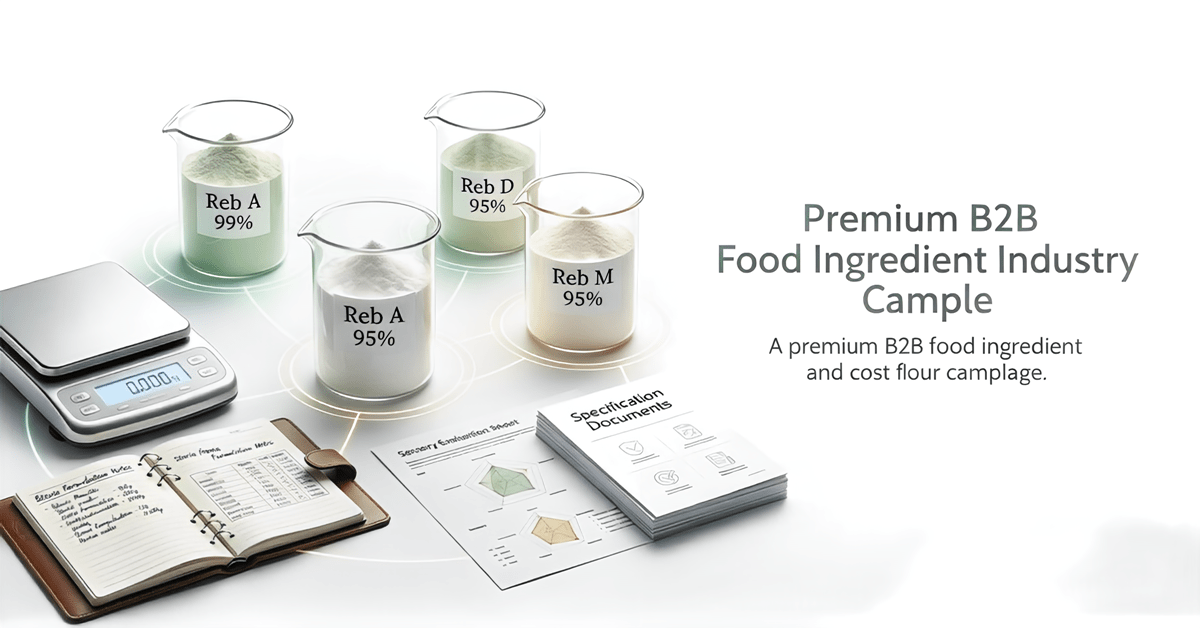
Start with Taste Sensitivity, Not Your Budget
One of the most common mistakes is selecting a stevia grade based primarily on price.
A better approach is to start by asking how sensitive the application is to stevia’s sensory characteristics.
In a clear beverage or lightly flavored dairy product, bitterness or lingering sweetness may be relatively easy to detect. These applications may benefit from a higher-purity Reb D or Reb M grade, or a blend containing more advanced steviol glycoside profiles.
By contrast, a strongly flavored product such as a chocolate, coffee, or flavored sauce may provide more natural masking of stevia’s aftertaste. In these applications, a standard Reb A grade may be sufficient depending on the formulation.
The right grade therefore depends not only on the ingredient itself, but also on how much sensory tolerance the final product has.
For more detail, see Steviol Glycoside Components: Why Reb A, Reb D, and Reb M Taste Different and Glucosylated Steviol Glycosides: What Formulators Need to Know About GSG.
Compare Cost on a Potency Basis, Not Just Per Kilogram
Once the sensory requirements have narrowed the options, the next step is to compare commercial value.
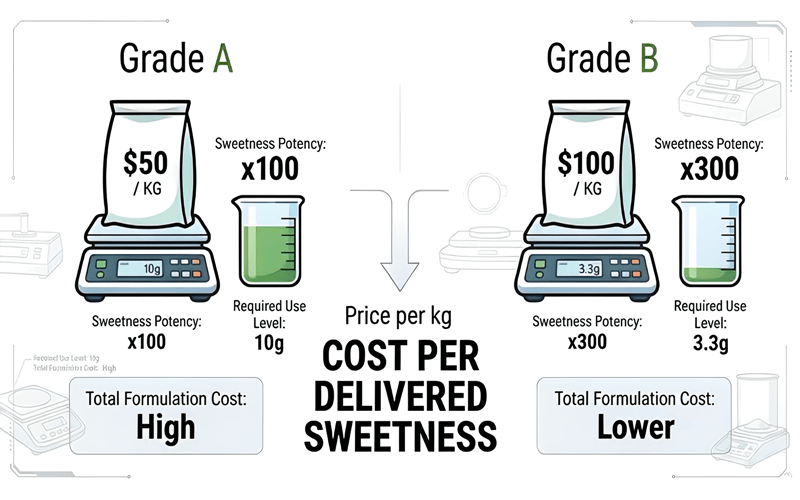
Price per kilogram alone can be misleading because different stevia grades can have different sweetness potency.
A higher-priced grade may require a lower use level, while a lower-priced grade may need to be used at a higher level to achieve the same sweetness.
For this reason, compare candidates based on cost per unit of sweetness delivered, rather than simply comparing the purchase price per kilogram.
This approach provides a more meaningful basis for commercial formulation decisions.
For more information, see What Is SEV? A Practical Guide to Comparing Stevia Sweetness Potency.
Match the Taste Curve to Your Product
Sweetness intensity is only one part of sensory performance.
The timing of sweetness onset, peak sweetness, and lingering sweetness can also influence how a stevia grade performs in the finished product.
A product with strong competing flavors such as citrus, coffee, or chocolate may tolerate a less refined sweetness profile because the flavor system provides some masking.
A lightly flavored or neutral product may require a stevia grade with a cleaner and more balanced taste curve.
Therefore, evaluate the stevia grade in the context of the actual formulation rather than testing it only in water.
For more detail, see The Stevia Taste Curve: Understanding Onset, Peak, and Lingering Sweetness.
Decide on Blending Based on the Actual Formulation Gap
Sometimes selecting a different stevia grade is enough.
In other cases, the formulation may still have a specific gap that needs to be addressed.
That gap could involve:
• Taste profile
• Sweetness curve
• Mouthfeel
• Bulk
• Processing performance
• Cost
Depending on the application, stevia may be combined with another high-intensity sweetener, a bulking sweetener, or a functional ingredient.
The important point is not to start with a predetermined ratio.
Instead, identify the specific formulation gap first and then select the complementary ingredient accordingly.
For more information, see Stevia Blending Strategies: How Formulators Balance Taste, Cost, and Shelf Life.
For bakery and high-heat applications, see Formulating Stevia for Bakery and High-Heat Applications.
Confirm the Source Can Document the Grade
A stevia grade that performs well in sensory testing is not necessarily a commercially usable ingredient.
Before final qualification, confirm that the supplier can provide the documentation required for the intended market and application.
Depending on the product, this may include:
• Individual steviol glycoside profile
• Total steviol glycoside content
• Product specification
• Batch-specific CoA
• Regulatory compliance information
• Production method where relevant
• Stability information
• Required certifications
• Traceability documentation
This verification should happen in parallel with sensory evaluation rather than after the grade has already been selected.
A technically suitable grade that cannot be properly documented for the target market may not be a practical commercial option.
For a more detailed qualification process, see Sourcing Stevia Ingredients: A Procurement Checklist for Compliance and Specification Verification.
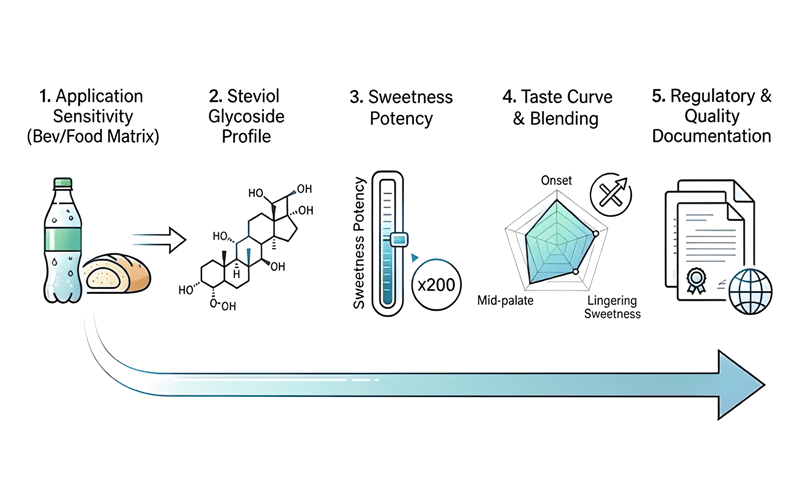
Choosing the Right Stevia Grade: A 5-Step Selection Sequence
A practical selection process can follow five steps.
1. Assess Application Sensitivity
Determine how sensitive the final product is to bitterness, astringency, lingering sweetness, and other stevia-related sensory characteristics.
2. Narrow the Stevia Grade
Based on the sensory requirements, compare suitable steviol glycoside profiles such as Reb A, Reb D, Reb M, or other relevant options.
3. Compare Cost per Sweetness Delivered
Evaluate the actual use level and compare cost on a sweetness basis rather than relying only on price per kilogram.
4. Evaluate the Taste Curve in the Final Matrix
Test the selected grade in the actual product formulation and assess sweetness onset, peak, lingering, and overall flavor balance.
5. Confirm Documentation
Verify composition, regulatory status, stability, certifications, and traceability before final commercial qualification.
Practical Considerations
A systematic approach to choosing the right stevia grade can also improve future formulation work.
A grade that performs well in a beverage may behave differently in a protein powder, dairy product, confectionery, sauce, or baked application.
Application conditions, flavor intensity, pH, processing conditions, and the surrounding formulation can all influence sensory performance.
For this reason, keep a record of which stevia grades and blends have been validated for each application type.
This makes future formulation work more efficient without assuming that one grade is universally suitable.
Common Mistakes
Selecting the Lowest-Cost Grade First
The lowest price per kilogram does not necessarily result in the lowest formulation cost.
A less expensive grade may require a higher use level or additional masking ingredients to achieve the desired sensory result.
Choosing a Grade Before Understanding the Application
A stevia grade should be selected according to the product matrix and sensory requirements, not simply according to its specification or purity level.
Finalizing a Sensory-Preferred Grade Before Checking Documentation
A grade may perform well in sensory testing but still require additional regulatory, stability, or certification documentation before it can be used commercially.
Assuming One Grade Works for Every Product
Different applications can have very different tolerance levels for bitterness, astringency, and lingering sweetness.
A grade validated for one product should not automatically be transferred to another application without testing.
Key Takeaways
• Choosing the right stevia grade involves component profile, potency, taste curve, blending requirements, and documentation.
• Start with the sensory requirements of the application rather than selecting the lowest-cost ingredient first.
• Compare stevia grades based on cost per delivered sweetness, not only price per kilogram.
• Evaluate the taste curve in the actual product matrix whenever possible.
• Confirm regulatory, quality, stability, and certification documentation before final supplier qualification.
• A stevia grade that works well in one application may not be the best choice for another.
Conclusion
Choosing the right stevia grade is a multi-step formulation and procurement decision rather than a simple comparison of purity or price.
The most reliable approach is to start with the application’s sensory requirements, narrow the appropriate steviol glycoside profile, compare sweetness potency and commercial cost, evaluate the taste curve in the final formulation, and confirm that the selected source can provide the required documentation.
There is no universal “best” stevia grade.
The right choice is the grade that fits the taste profile, product matrix, sweetness requirement, regulatory positioning, processing conditions, and commercial cost target of the finished product.
For teams working through a new stevia formulation, the articles throughout this series provide a step-by-step framework covering taste profile, sweetness potency, blending, bakery applications, and supplier qualification.
References
- Joint FAO/WHO Expert Committee on Food Additives (JECFA). Steviol Glycosides — Specifications and Safety Evaluations. WHO JECFA Database.
- Food Standards Australia New Zealand (FSANZ). Steviol Glycosides (960) — Intense Sweetener (Stevia).
- DuBois, G. E. et al. / Scientific literature on the sensory and sweetness characteristics of steviol glycosides, including Reb A, Reb D and Reb M.
- Taste profiles of steviol glycoside blends and their application in ice cream. International Journal of Gastronomy and Food Science, 2025.