
Sourcing Stevia Ingredients: A Procurement Checklist for Compliance and Specification Verification
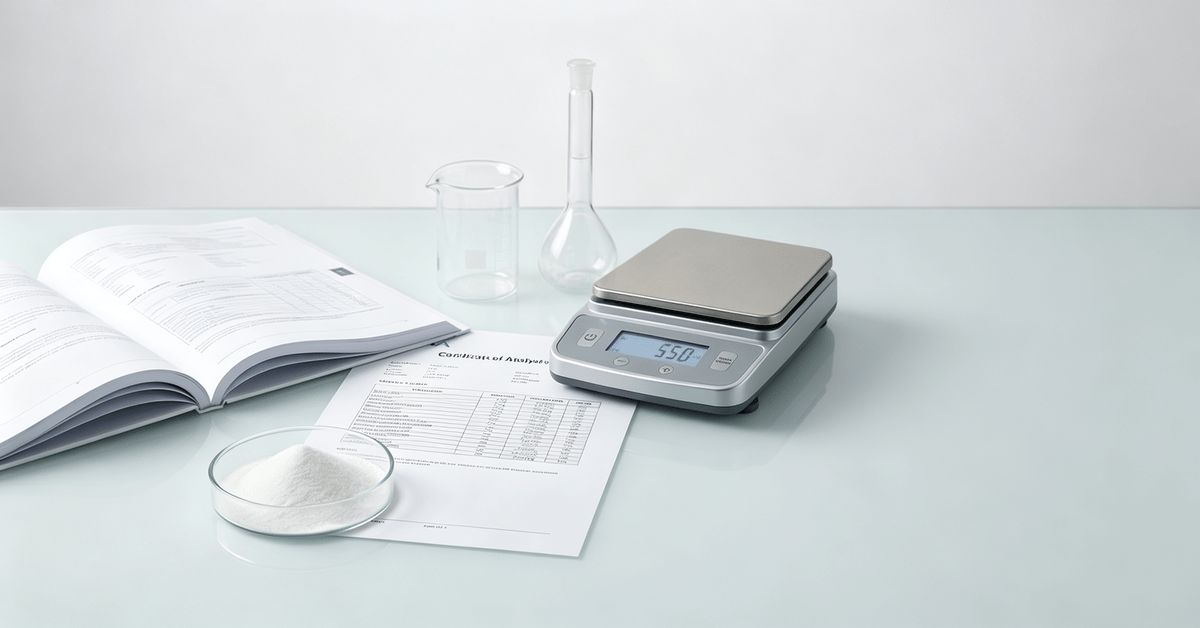
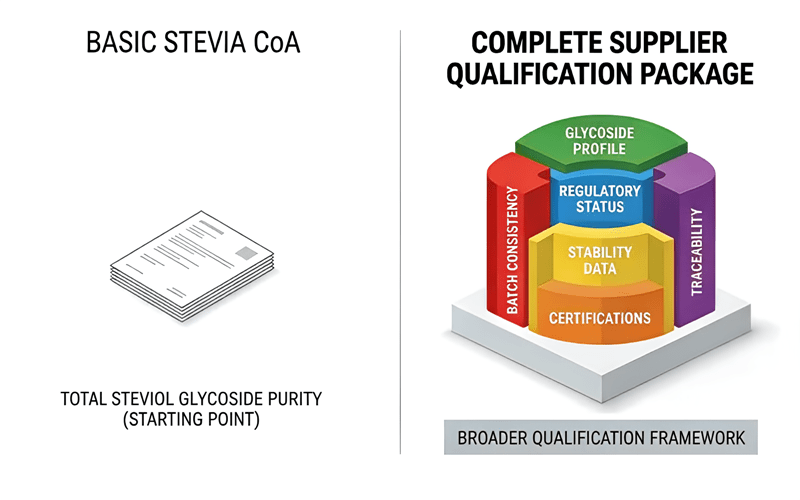
A basic CoA showing “total steviol glycosides ≥95%” is a starting point, not a complete qualification package.
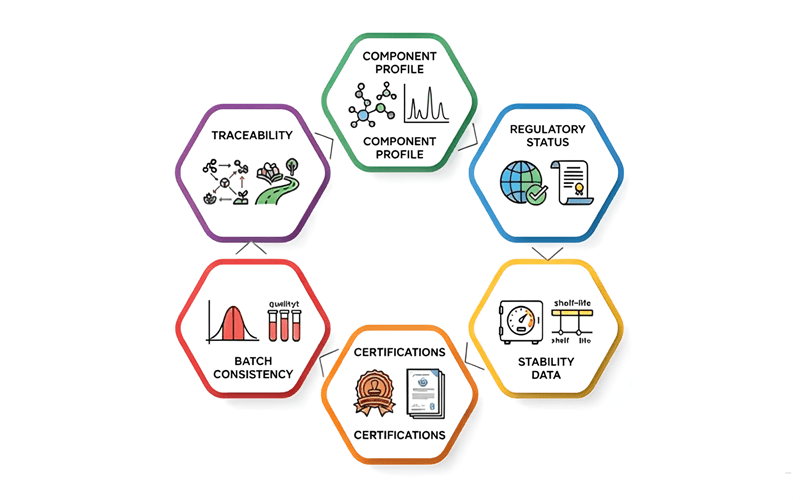
When sourcing stevia ingredients for commercial food and beverage applications, procurement and R&D teams need to look beyond total purity. Component profile, regulatory status, production method, application-specific stability, certifications, and batch consistency can all affect whether a stevia ingredient is suitable for the intended product and target market.
Component Breakdown, Not Just Total Purity
Total steviol glycoside content does not tell you the complete composition of the ingredient.
A product meeting a total purity specification may contain different proportions of stevioside, Rebaudioside A, Rebaudioside D, Rebaudioside M, and other steviol glycosides.
That composition matters because different steviol glycosides can have different sensory characteristics.
For example, a formulation based on a Reb A-dominant stevia may not perform exactly the same way as one based on a higher-purity Reb M product.
For this reason, a procurement specification should ideally include the relevant individual steviol glycoside profile rather than relying only on a total glycoside percentage.
For more background, see [Steviol Glycoside Components: Why Reb A, Reb D, and Reb M Taste Different].
Regulatory and Market-Specific Compliance
Steviol glycosides are regulated as food additives in many markets, but the applicable requirements depend on the jurisdiction, food category, permitted use, and sometimes the production method.
At the international level, JECFA has established specifications for steviol glycosides, including specifications for products containing at least 95% total steviol glycosides.
However, an international specification should not automatically be treated as a complete market-approval dossier.
For example, FSANZ regulates steviol glycosides under the Australia New Zealand Food Standards Code. Its current information covers different production routes, including extraction from stevia leaves, enzymatic conversion, and fermentation-based production.
This distinction becomes particularly important when sourcing newer steviol glycoside products such as Reb M or other glycosides produced through enzymatic or fermentation processes.
Therefore, when qualifying a source, confirm:
• Which steviol glycoside(s) are present
• How the ingredient is produced
• Which regulatory framework applies to the target market
• Whether the intended food category permits its use
• Whether any use-level or labeling requirements apply
Do not assume that one compliance statement automatically covers every target market or every type of steviol glycoside.
Stability and Shelf-Life Documentation
Steviol glycosides are generally considered suitable for use under a range of food-processing conditions, but stability should still be evaluated in the context of the finished application.
JECFA has reported that steviol glycosides such as stevioside and Rebaudioside A show reasonable thermal stability under food-processing conditions, while hydrolytic stability can become more relevant in acidic food systems.
This means dry-storage stability data should not automatically be treated as equivalent to stability in an aqueous beverage.
For beverage applications, relevant variables may include:
• pH
• Storage temperature
• Processing temperature
• Exposure time
• Steviol glycoside composition
• Final formulation matrix
When sourcing stevia ingredients for a specific application, ask whether available stability information reflects the intended format rather than relying only on a general product specification.
Certification Documentation
Regulatory compliance is only one part of supplier qualification.
Depending on the target market and customer requirements, additional documentation may include:
• Halal certification
• Kosher certification
• Non-GMO documentation
• Organic certification
• HACCP certification
• ISO 22000 or FSSC 22000 certification
• Allergen statement
• Residual solvent information
• Heavy metal specifications
• Microbiological specifications
Not every product needs every document.
The appropriate documentation depends on the finished product, target market, customer requirements, and claims being made.
The key is to establish the documentation requirements before final supplier qualification rather than discovering missing documents after the product has already been selected.
Consistency Across Batches
A supplier can meet a total steviol glycoside specification while still showing differences in individual glycoside composition between batches.
For applications where sensory performance is important, this can matter.
Ask whether the supplier monitors the individual steviol glycoside profile on a batch-by-batch basis or whether the profile is established only during initial product qualification.
Also compare actual batch CoAs rather than reviewing only a single representative CoA.
For a commercial formulation, consistency should be evaluated across multiple lots whenever possible.
A stable specification is more valuable than a strong result from a single sample.
A Practical Stevia Supplier Qualification Checklist
Before approving a stevia ingredient, a procurement or R&D team can work through the following checklist.
1. Product Identity
Confirm the exact product name, steviol glycoside type, grade, and intended application.
2. Composition
Request total steviol glycoside content together with the relevant individual glycoside profile.
3. Regulatory Status
Confirm suitability for the specific target market and intended food category.
4. Production Method
Understand whether the ingredient is produced through leaf extraction, enzymatic conversion, fermentation, or another process where relevant.
5. Quality Documentation
Review the current CoA, specification, microbiological limits, heavy metals, and other applicable quality parameters.
6. Stability
Request relevant stability information for the intended product format and processing conditions.
7. Certifications
Confirm the certifications and supporting documents required by the finished-product market or customer.
8. Batch Consistency
Review more than one production batch where possible and compare the analytical results.
9. Traceability
Confirm that the material can be traced to a specific production batch and that the corresponding quality documentation is available.
10. Commercial Qualification
Finally, evaluate the ingredient not only by price per kilogram but by sensory performance, required use level, documentation quality, supply consistency, and total formulation cost.
Practical Considerations
A standardized supplier-qualification checklist can make stevia sourcing much more consistent.
Instead of accepting whatever documents a supplier provides, define the minimum information required before a product enters technical evaluation.
A practical qualification package may include:
• Product specification
• Representative and/or batch-specific CoA
• Individual steviol glycoside profile
• Regulatory statement for the target market
• Production-method information where relevant
• Stability information
• Food safety and certification documents
• Allergen and GMO statements where applicable
• Packaging and storage information
For ongoing suppliers, documentation should also be reviewed periodically rather than treated as a one-time qualification exercise.
Regulations, production processes, specifications, and certifications can change, so current documentation matters.
Common Mistakes
Qualifying a Stevia Ingredient Based Only on Total Purity
A “≥95% total steviol glycosides” specification does not by itself tell you the complete sensory or compositional profile of the ingredient.
Assuming One Regulatory Dossier Covers Every Market
Regulatory requirements can differ by jurisdiction, food category, and production method. FSANZ, for example, distinguishes among different production routes for steviol glycosides.
Requesting Stability Data Without Considering the Final Application
Dry powder stability and stability in an acidic beverage are not necessarily the same qualification question.
Reviewing Only One CoA
A single CoA demonstrates one batch. It does not necessarily demonstrate long-term batch-to-batch consistency.
Focusing on Price Before Technical Qualification
A lower price per kilogram does not necessarily mean a lower formulation cost if the ingredient requires a higher use level or creates additional formulation challenges.
Key Takeaways
• Total steviol glycoside purity is only one part of stevia ingredient qualification.
• Individual glycoside composition can be important for sensory performance and formulation consistency.
• Regulatory suitability should be verified for the specific target market, food category, and production method.
• Stability information should be relevant to the intended application rather than assumed from dry-storage data.
• Batch-to-batch consistency should be evaluated when sensory performance is critical.
• A complete qualification package should cover composition, compliance, quality, stability, certification, and traceability.
Conclusion
Sourcing stevia ingredients effectively requires more than finding a product with a high total steviol glycoside percentage.
A qualified ingredient should have a clearly defined composition, appropriate regulatory status, relevant quality documentation, suitable stability information, and consistent performance across batches.
For procurement and R&D teams, the most reliable approach is to qualify the ingredient against the actual requirements of the finished product and target market rather than relying on a generic CoA or a single supplier statement.
Once the source has been qualified, the next practical question is which stevia grade best fits the formulation.
See [Choosing the Right Stevia Grade: A Decision Framework for R&D and Procurement Teams].
References
- Joint FAO/WHO Expert Committee on Food Additives (JECFA). Steviol Glycosides — Specifications and Safety Evaluations. WHO JECFA Database – Steviol Glycosides
- Food Standards Australia New Zealand (FSANZ). Steviol Glycosides (960) — Intense Sweetener (Stevia). FSANZ – Steviol Glycosides (960)
- Food and Agriculture Organization of the United Nations (FAO). General Specifications and Information on Steviol Glycosides. FAO/WHO JECFA Specifications for Steviol Glycosides
- Food Standards Australia New Zealand (FSANZ). Technical information on steviol glycoside specifications and composition. FSANZ Technical Assessment – Steviol Glycosides