
Why Low MOQ Ingredient Suppliers Matter for Supplement Manufacturers
For a supplement manufacturer, the cost of testing a new ingredient is not always the price of the ingredient itself.
Sometimes, the bigger cost is the inventory you have to purchase before you even know whether the ingredient will work.
A new formulation may need only 500 g, 1 kg, or a few kilograms for initial testing. But if the supplier requires 50 kg or 100 kg, the R&D team has to make a much larger commitment before the formula has even been validated.
This is why low MOQ ingredient suppliers can play an important role in supplement product development, particularly during the R&D and formulation stages.
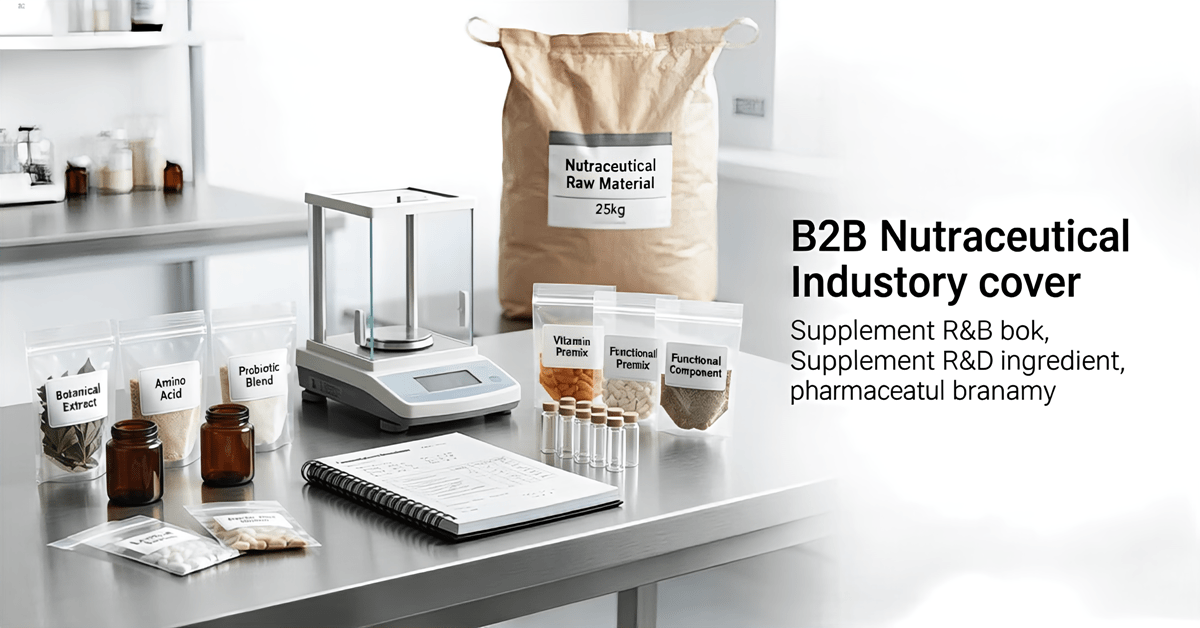
Why Low MOQ Ingredient Suppliers Matter During R&D
Consider a typical product development process.
The customer identifies a new product opportunity.
R&D develops an initial formulation.
Procurement begins sourcing the required ingredients.
Then one ingredient creates a problem:
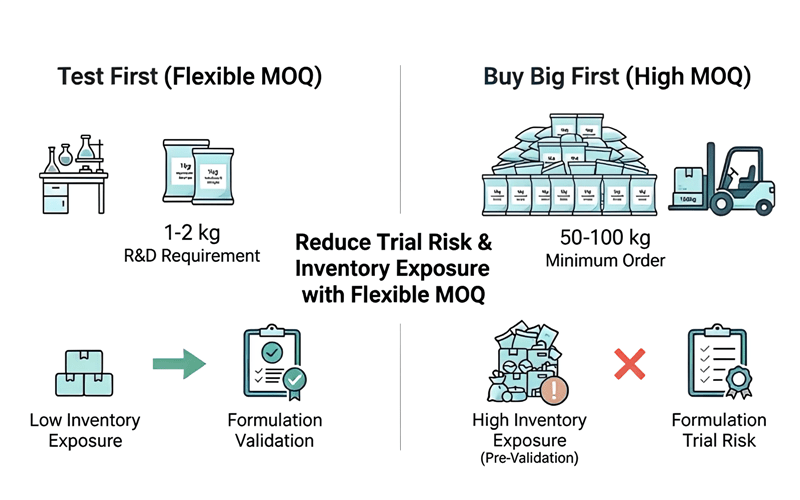
The required testing quantity is only 1–2 kg, but the supplier requires 50 kg or more.
At that point, the manufacturer usually has three choices:
- Purchase much more material than the project currently needs.
- Delay testing while looking for another source.
- Replace the ingredient with another option simply because it is easier to source.
None of these options is ideal.
The issue is not necessarily that a supplier’s MOQ is unreasonable. Large-scale production naturally favors larger orders.
The problem is that production purchasing logic does not always fit R&D-stage requirements.
R&D Purchasing and Production Purchasing Are Different
One of the most important distinctions in ingredient sourcing is the difference between development-stage purchasing and commercial production purchasing.
During R&D, the priorities are usually:
- Small quantities
- Fast sampling
- Flexible sourcing
- Low financial commitment
- Fast formulation iteration
Once a product enters commercial production, the priorities change:
- Stable supply
- Consistent specifications
- Larger volumes
- Predictable pricing
- Batch consistency
- Reliable documentation
These are different procurement requirements.
A supplier that is well suited to a 5-ton production order may not be the most convenient option when an R&D team needs 1 kg for an initial formulation test.
Likewise, a supplier that supports small quantities may not automatically be the best option for long-term bulk supply.
The stronger sourcing model is one that can support the transition from small-scale testing to pilot production and eventually commercial volume.
Low MOQ Can Reduce Formulation Trial Risk
Formulation development rarely follows a straight line.
An ingredient may look promising during the first trial but fail because of:
- Taste
- Solubility
- Stability
- Compatibility with other ingredients
- Processing behavior
- Consumer acceptance
- Cost at the final use level
This means the first sample is not necessarily the final ingredient.
If a manufacturer has already purchased 100 kg, every formulation change creates a potential inventory problem.
With a smaller initial purchase, the financial exposure is much lower.
The team can test the ingredient, evaluate the formulation, adjust the dosage or combination, and decide whether the project should move forward before committing to larger volumes.
In this sense, low MOQ is not simply a purchasing benefit. It can be a way to reduce formulation risk.
Small-Batch Sourcing Can Support Faster Product Development
Time is another important factor.
When an R&D team has to negotiate a large MOQ, obtain internal approval, arrange inventory, or search for an alternative supplier, a formulation project can lose valuable time before testing even begins.
A supplier able to provide small quantities quickly can shorten the path from:
Ingredient Selection → Sample Testing → Formula Validation → Pilot Production
This becomes particularly useful when manufacturers are developing several products simultaneously.
Instead of committing heavily to every new ingredient, the team can test several candidates first and scale only the ingredients that demonstrate technical and commercial potential.
Low MOQ Does Not Mean Buying Small Forever
There is an important distinction here.
The purpose of low-MOQ sourcing is not to keep commercial orders permanently small.
It is to match purchasing volume with the development stage of the product.
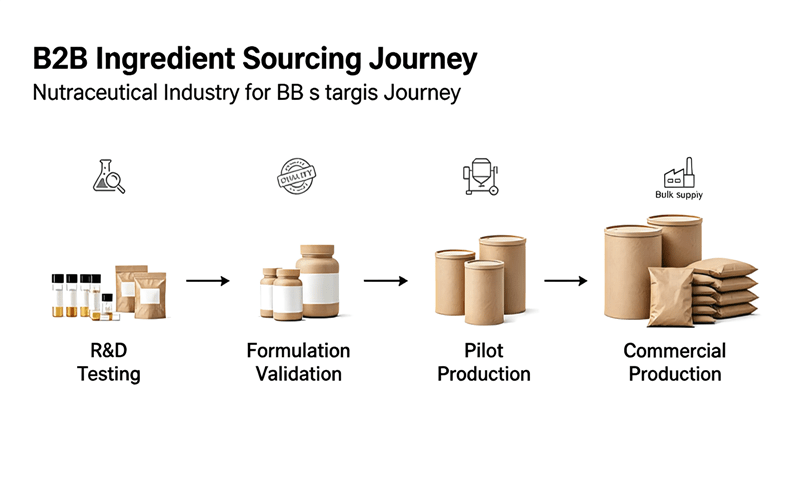
A practical sourcing process may look like:
R&D Stage
500 g–5 kg
↓
Formulation Validation
5–25 kg
↓
Pilot Production
25–100+ kg
↓
Commercial Production
Bulk volume based on demand
Actual quantities will vary by ingredient and application.
The principle is what matters:
Purchase what the project needs now, then scale when the product is validated.
Which Ingredients Can Benefit From Low-MOQ Sourcing?
Low-MOQ flexibility can be particularly useful when manufacturers are evaluating new or specialized ingredients, including:
- Botanical extracts
- Standardized plant extracts
- Amino acids
- Vitamins and minerals
- Probiotics and postbiotics
- Functional powders
- Specialty nutraceutical ingredients
- Longevity and cellular health ingredients
- Custom functional blends
This is especially relevant when the ingredient is new to the manufacturer’s formulation portfolio or when several potential ingredients are being evaluated at the same time.
What Should Procurement Teams Ask an Ingredient Supplier?
When evaluating low MOQ ingredient suppliers, procurement teams should look beyond the minimum order quantity itself.
When evaluating a supplier for an R&D project, procurement teams should also ask several practical questions.
Can You Supply the Quantity Needed for Initial Testing?
A supplier may advertise a low MOQ but have different minimum quantities for different ingredients.
Confirm the actual MOQ for the specific material being evaluated.
How Quickly Can Samples Be Provided?
A low MOQ has limited value if the sampling process is slow.
For time-sensitive formulation projects, sampling speed can be almost as important as order quantity.
Can the Same Material Be Scaled to Bulk?
Ideally, the material used for formulation testing should be representative of what can later be supplied commercially.
Ask about bulk availability, lead time, production capacity, and specification consistency.
What Documentation Is Available?
Ingredient qualification may require documents such as:
- CoA
- Specification sheet
- SDS/MSDS
- Microbiological specifications
- Heavy metal specifications
- Regulatory documentation
- Relevant certifications
The exact requirements depend on the ingredient, product, and target market.
For U.S. dietary supplement manufacturers, supplier qualification and component specifications are also part of the broader quality-control framework under FDA’s dietary supplement CGMP requirements. FDA specifically addresses component specifications, supplier qualification, CoAs, testing, and documentation in 21 CFR Part 111.
Low MOQ Should Be Part of a Larger Supplier Evaluation
Low MOQ is useful, but it should not become the only supplier-selection criterion.
A supplier offering a 1 kg MOQ is not necessarily the better supplier if the ingredient has inconsistent specifications, poor documentation, unreliable lead times, or limited bulk availability.
A stronger evaluation considers several factors together:
MOQ + Sampling Speed + Quality Documentation + Supply Reliability + Specification Consistency + Bulk Availability
The objective is not simply to find the supplier willing to sell the smallest quantity.
The objective is to find a supplier that can support the product through different stages of development.
A More Flexible Approach to Ingredient Sourcing
For supplement manufacturers, a practical sourcing strategy is to separate qualification risk from commercial purchasing.
A typical process can be:
- Obtain a manageable quantity.
- Test the ingredient in the formulation.
- Evaluate sensory and technical performance.
- Confirm the required documentation.
- Validate the formula.
- Conduct pilot production if needed.
- Move to larger-volume purchasing once the product is commercially justified.
This approach gives R&D teams more flexibility while helping procurement control unnecessary inventory exposure.
Common Mistakes
Buying Large Quantities Before the Formula Is Validated
A low ingredient price can become expensive if most of the material ends up sitting in inventory.
Choosing a Supplier Based Only on MOQ
MOQ should be evaluated together with quality, documentation, lead time, and long-term supply capability.
Treating Samples and Commercial Supply as Separate Problems
If the supplier cannot support the product after the testing stage, the team may need to repeat qualification with another source.
Ignoring the Cost of Failed Formulation Trials
The cost of an unsuccessful formulation includes more than unused ingredients. It can also involve R&D time, testing, procurement work, inventory, and delayed product development.
Key Takeaways
- Low MOQ can reduce the financial risk of testing new ingredients.
- R&D-stage purchasing and commercial production require different procurement priorities.
- Small initial orders allow manufacturers to validate formulation performance before committing to larger inventory.
- Sampling speed, documentation, quality consistency, and bulk availability should be evaluated alongside MOQ.
- A strong ingredient supplier should be able to support the transition from R&D → pilot → commercial production.
- Low MOQ is most valuable when it provides flexibility without sacrificing long-term supply reliability.
Conclusion
For supplement manufacturers, choosing low MOQ ingredient suppliers is not simply about finding the lowest minimum order quantity.
The more important question is whether the supplier can match the purchasing model to the development stage of the product.
During R&D, manufacturers need flexibility, manageable quantities, and fast testing. Once the formulation is validated, they need reliable supply, consistent specifications, and competitive commercial pricing.
A sourcing partner that can support both stages can help reduce inventory exposure while making new product development more flexible.
At Esubio, our sourcing model is built around Low MOQ | Fast Sampling | Reliable International Supply, with small-batch options starting from around 1 kg for selected ingredients. Our portfolio includes botanical extracts, amino acids, probiotics, functional blends, and other specialty nutraceutical ingredients.
The objective is simple:
Test first. Validate the formulation. Scale when the product is ready.
References
- U.S. Food & Drug Administration (FDA). Small Entity Compliance Guide: Current Good Manufacturing Practice in Manufacturing, Packaging, Labeling, or Holding Operations for Dietary Supplements. FDA – Dietary Supplement CGMP Compliance Guide
- U.S. Food & Drug Administration (FDA). Dietary Supplements Guidance Documents & Regulatory Information. FDA – Dietary Supplements Guidance & Regulatory Information
- U.S. Food & Drug Administration (FDA). Questions and Answers on Dietary Supplements. FDA – Questions and Answers on Dietary Supplements