
Fast Ingredient Sampling: 7 Ways Faster Samples Can Accelerate Supplement R&D
Your R&D team may not be short of ideas.
They may simply be waiting for the ingredients.
When a supplement development project is delayed, the cause is often attributed to formulation complexity, testing, or internal approval. But in many cases, the development timeline has already slowed down before formulation testing even begins — because the required ingredient samples have not arrived.
This is where fast ingredient sampling becomes more than a purchasing convenience.
For supplement manufacturers, the speed of ingredient sampling can directly affect how quickly an R&D team can start testing, compare alternatives, and move a promising formulation toward pilot production.
Why Fast Ingredient Sampling Matters During R&D
Consider a typical product development process.
The customer confirms a product concept.
R&D defines the initial formulation framework and identifies several ingredients that need to be evaluated.
Procurement contacts suppliers.
Then the project reaches a simple but frustrating point:
The formulation is ready to test, but the samples are not.
If the sample arrives one or two weeks later than expected, the delay does not necessarily end there.
The formulation test moves back.
Comparative testing may need to be rescheduled.
Stability testing may start later.
Pilot production can be pushed back.
The customer’s sampling date may also need to change.
A small delay at the ingredient-sourcing stage can therefore create a much larger delay across the development schedule.
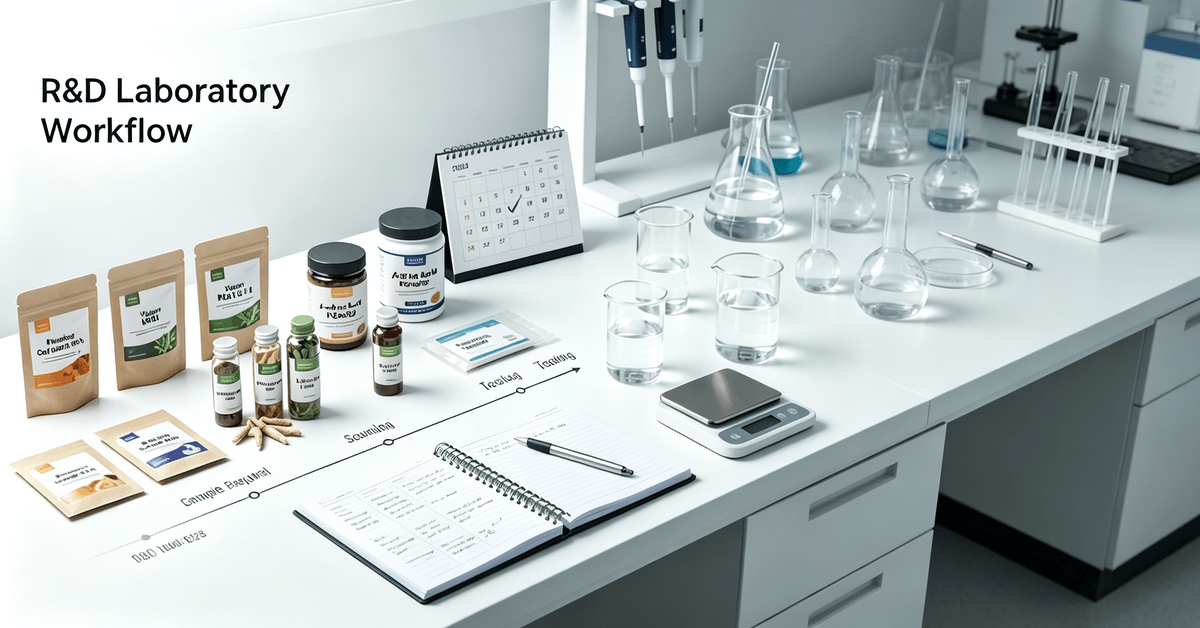
The Hidden Cost of Waiting for Ingredient Samples
The most obvious cost of a delayed sample is lost time.
But the less visible cost can be greater.
An R&D team may have already allocated laboratory resources, personnel, equipment, and testing slots for a project.
When the ingredient is unavailable, those resources may not be used as planned.
The team may also have to rearrange testing schedules around other projects.
For manufacturers working on several new products at the same time, these small delays can accumulate.
This is why fast ingredient sampling should be viewed as part of development efficiency rather than simply a logistics issue.
Why Ingredient Samples Can Take Longer Than Expected
Sample delays are not always caused by the ingredient itself.
Several steps may be involved before an R&D team receives a usable sample:
- Confirming the exact specification
- Checking available inventory
- Arranging a sample quantity
- Preparing packaging
- Preparing CoA or specification documents
- Coordinating shipment
- Confirming shipping information
When these steps are handled separately or require multiple rounds of communication, the process can become unnecessarily slow.
There is also another problem.
A sample may arrive physically, but the required documentation may be missing.
The R&D team then has the material but still cannot complete the qualification process.
For regulated products, documentation is not merely administrative. FDA’s dietary supplement CGMP framework requires manufacturers to establish specifications for components and to determine whether those specifications are met. FDA also addresses supplier qualification and the use of supplier Certificates of Analysis.
That means sample availability and sample documentation should ideally move together.
Fast Sampling Helps R&D Start Testing Earlier
The value of faster sampling is simple:
The earlier the sample arrives, the earlier testing can begin.
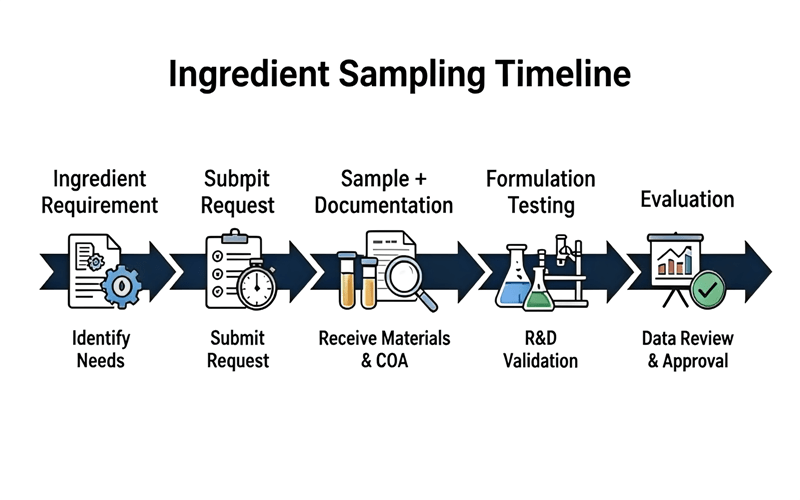
A more efficient sequence looks like:
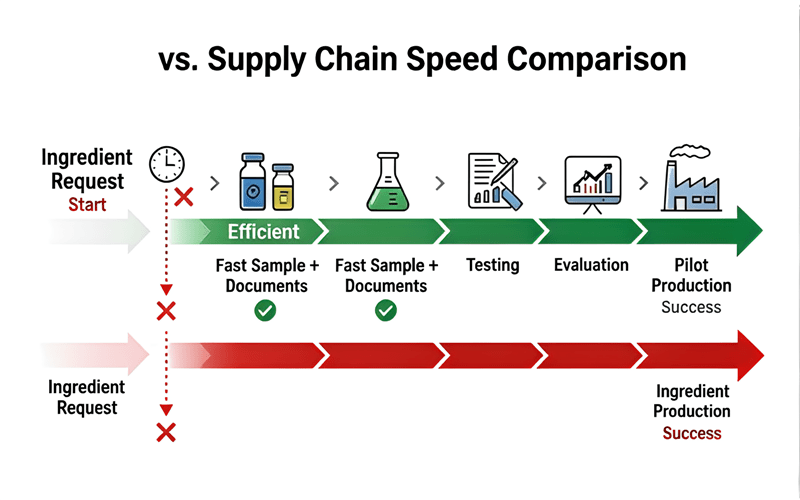
Ingredient Requirement → Sample Request → Sample + Documentation → Formulation Testing → Evaluation → Pilot Production
Instead of:
Ingredient Requirement → Sample Request → Waiting → Follow-up → Waiting → Sample → Missing Documents → Follow-up → Testing
The difference may look small at the procurement stage.
For the overall product development timeline, it can be significant.
Multiple Samples Can Make Ingredient Screening More Efficient
Fast sampling becomes even more useful when R&D teams are evaluating several candidate ingredients.
For example, a formulation may require comparison between:
- Different botanical extracts
- Different amino acid grades
- Different probiotic strains
- Different stevia grades
- Different functional ingredients
- Different premix options
Testing several candidates early can help the team identify the most suitable ingredient before committing to larger quantities.
This can reduce the risk of moving too quickly from one untested ingredient to bulk purchasing.
The objective is not simply to receive one sample quickly.
It is to shorten the time between ingredient selection and informed formulation decisions.
Documentation Should Arrive With the Sample
A fast sample without sufficient documentation does not necessarily mean fast qualification.
Depending on the ingredient and target market, R&D and procurement teams may need information such as:
- CoA
- Specification
- SDS/MSDS
- Microbiological specifications
- Heavy metal specifications
- Allergen information
- Regulatory documentation
- Relevant certifications
The exact requirements depend on the product and market.
For U.S. dietary supplement manufacturers, FDA’s guidance explains that suppliers may provide Certificates of Analysis for components and that manufacturers relying on supplier CoAs need appropriate supplier qualification procedures.
For this reason, a useful sample process should consider two questions together:
When can we receive the material?
and
Will we have enough information to evaluate it when it arrives?
What Procurement Teams Should Ask Suppliers
When sourcing ingredients for a new formulation, procurement teams can ask several practical questions before placing a sample request.
How Quickly Can You Arrange the Sample?
Ask for an expected sample preparation and delivery timeline rather than assuming that “sample available” means immediate shipment.
Is the Sample Representative of the Commercial Material?
The sample should ideally correspond to the specification and grade that can later be supplied commercially.
Otherwise, the team may have to repeat qualification after moving to bulk supply.
Can the Required Documents Be Provided With the Sample?
Confirm which documents will be available before testing begins.
This can prevent a situation where the physical sample arrives but qualification remains incomplete.
Can You Support Larger Quantities Later?
If the ingredient passes testing, the next question is whether the supplier can support pilot and commercial quantities with consistent specifications and reasonable lead times.
Fast Sampling Is Only Valuable When Supply Can Scale
There is an important distinction between fast sampling and reliable supply.
A supplier may send a sample quickly but struggle to provide the same material later in larger quantities.
That creates another qualification problem.
A stronger sourcing model connects the different stages:
Sample → R&D Testing → Pilot → Commercial Supply
This allows procurement teams to evaluate a supplier not only by how quickly the first sample arrives, but also by whether the supplier can support the product after validation.
Common Mistakes
Focusing Only on Sample Price
A free or inexpensive sample is not necessarily valuable if it takes weeks to arrive.
For R&D projects, time can be more important than the nominal cost of the sample.
Treating Sample Delivery and Documentation Separately
Receiving the material without the required specification or CoA can create another round of waiting.
Testing a Sample That Cannot Be Scaled
If the sample comes from a different grade or supply channel than the eventual commercial material, the formulation may need to be revalidated later.
Waiting for One Ingredient Before Evaluating Alternatives
When several ingredients are technically viable, requesting multiple samples at the beginning can sometimes reduce the overall development timeline.
7 Practical Ways to Improve Ingredient Sampling Speed
A more efficient sampling process can be built around seven simple principles:
- Define the exact specification before requesting samples.
- Confirm the available sample quantity and preparation time.
- Request the relevant documentation at the same time.
- Evaluate multiple candidate ingredients when appropriate.
- Confirm that the sample represents a commercially available grade.
- Check whether the supplier can support pilot and bulk quantities.
- Track sample lead time as part of supplier performance.
This turns sampling from an informal purchasing task into a measurable part of the R&D workflow.
Key Takeaways
- Fast ingredient sampling can help supplement manufacturers start formulation testing earlier.
- A delayed sample can affect formulation testing, stability studies, pilot production, and customer timelines.
- Sample availability and documentation should ideally be handled together.
- Procurement teams should evaluate not only sample speed but also specification consistency and commercial scalability.
- When several ingredients are being evaluated, faster multi-sample screening can help R&D make decisions earlier.
- The strongest ingredient sourcing model connects sample → R&D → pilot → commercial supply.
Conclusion
For supplement manufacturers, development speed is not determined by R&D alone.
The availability of the right ingredients at the right time is part of the development process too.
Fast ingredient sampling helps remove one of the earliest bottlenecks between formulation planning and laboratory testing.
But speed should not come at the expense of qualification.
The ideal process is simple:
Get the right sample quickly. Receive the relevant documentation. Test the ingredient. Validate the formulation. Then scale with confidence.
At Esubio, we focus on Low MOQ | Fast Sampling | Reliable International Supply. For selected ingredients, samples can typically be arranged within 3–5 days, with CoA, MSDS/SDS, and specification documents provided as applicable.
Our ingredient portfolio includes botanical extracts, amino acids, probiotics, functional blends, and other specialty nutraceutical ingredients.
The goal is straightforward:
Reduce waiting time so your R&D team can spend more time testing — and less time waiting for ingredients.
References
1. U.S. Food & Drug Administration (FDA)
Small Entity Compliance Guide: Current Good Manufacturing Practice in Manufacturing, Packaging, Labeling, or Holding Operations for Dietary Supplements.
FDA – Dietary Supplement CGMP Compliance Guide
2. U.S. Food & Drug Administration (FDA)
Dietary Supplements Guidance Documents & Regulatory Information.
FDA – Dietary Supplements Guidance & Regulatory Information