
Batch-to-Batch Consistency: 7 Critical Checks Before You Move from Sample to Bulk
A sample passes your evaluation.
The formulation works.
The customer approves it.
Then the bulk shipment arrives — and something is different.
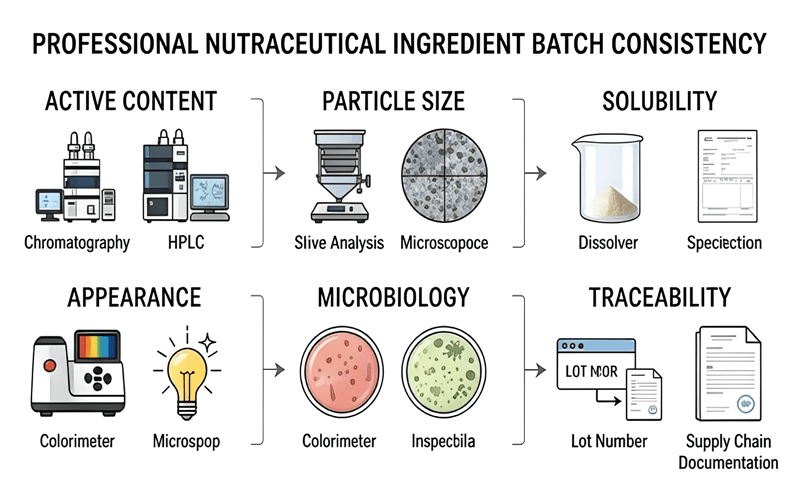
The active content is lower than expected. The particle size has changed. Solubility is no longer the same. Appearance is different. In some cases, microbiological results may also require additional investigation.
The formulation has not changed.
The raw material has.
This is one of the most frustrating situations for R&D, QA, and procurement teams because a successful sample evaluation does not automatically prove batch-to-batch consistency.
A sample demonstrates that one specific lot meets the required criteria.
Commercial supply requires something more: the ability to deliver material that remains within the agreed specification from one batch to the next.
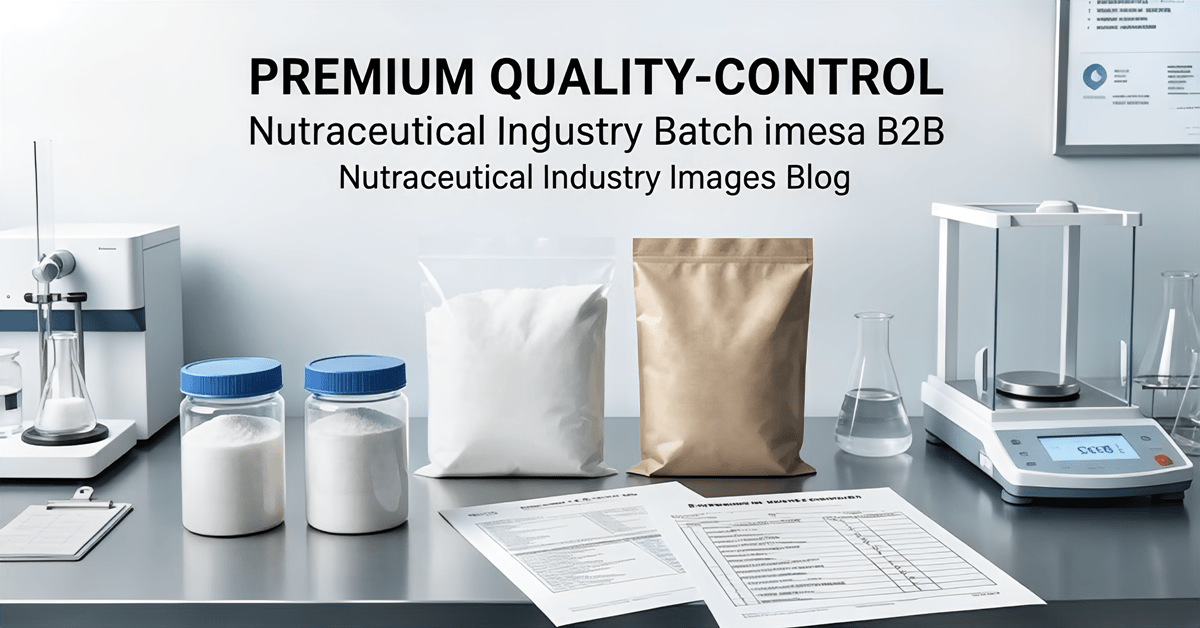
Why Batch-to-Batch Consistency Matters
During product development, R&D usually evaluates a specific sample or lot.
If the sample performs well, that material may become the basis for:
- Formulation development
- Sensory evaluation
- Stability testing
- Customer samples
- Pilot production
- Commercial specifications
The problem appears when the commercial material does not behave like the original sample.
A difference in active content may affect dosage.
A change in particle size may affect blending or flowability.
A difference in solubility may affect the manufacturing process.
Changes in appearance or odor may create additional quality concerns.
The resulting problem is not limited to the ingredient itself.
It can lead to retesting, reformulation, production delays, customer communication, and additional logistics costs.
That is why batch-to-batch consistency should be considered before the first bulk purchase, not after a problem appears.
A Passed Sample Does Not Prove Consistent Commercial Supply
There is an important distinction between two questions:
Does this sample meet our requirements?
and
Can this supplier consistently provide material that meets our requirements?
The first question is about sample qualification.
The second is about supplier qualification and ongoing quality control.
For dietary supplement manufacturers in the U.S., FDA’s CGMP framework requires manufacturers to establish component specifications and verify that those specifications are met. FDA also addresses supplier qualification when a manufacturer relies on supplier Certificates of Analysis.
In other words, supplier reliability is not simply a commercial preference. It can form part of a manufacturer’s quality system.
What Causes Batch-to-Batch Variation?
Batch variation can have different causes depending on the ingredient.
For botanical extracts, variation may be related to raw material source, extraction conditions, standardization, or processing.
For amino acids, vitamins, minerals, and other refined ingredients, differences may involve purity, physical properties, particle size, or manufacturing parameters.
For probiotics, viability and microbiological characteristics require particular attention.
Even when two batches carry the same product name, they should not automatically be assumed to perform identically.
This is why the agreed specification matters.
The specification creates an objective reference point against which incoming batches can be evaluated.
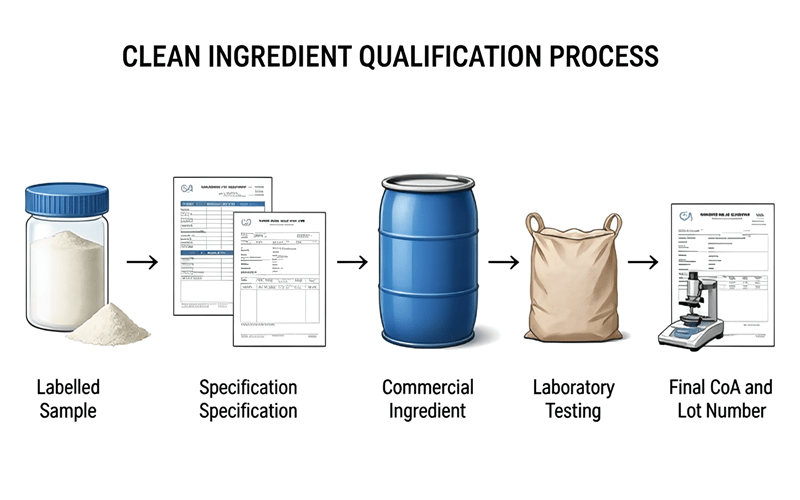
7 Critical Checks for Batch-to-Batch Consistency
1. Define the Critical Quality Attributes
Before purchasing in bulk, identify which characteristics actually matter to your formulation.
Depending on the ingredient, these may include:
- Active content or assay
- Marker compounds
- Particle size
- Solubility
- Appearance
- Moisture
- Microbiological limits
- Heavy metals
- Pesticide residues
- Other application-specific parameters
Not every parameter needs the same level of control.
The important point is to identify the critical quality attributes that can materially affect your product.
2. Establish Clear Specifications
A specification should define what is acceptable before the commercial order is placed.
For example, instead of simply specifying a product as “high purity,” define the relevant measurable range for the parameter that matters to your application.
FDA guidance for dietary supplement CGMPs specifically addresses component specifications covering identity, purity, strength, composition, and contamination limits.
Clear specifications make later batch comparison much more objective.
3. Check the Supplier’s Quality System
A supplier should be evaluated on more than whether it can provide one good sample.
Look at how the material is controlled during production.
Relevant questions may include:
- How is the raw material controlled?
- Are production processes standardized?
- Are in-process checks performed?
- Is the finished batch tested?
- How are deviations handled?
- How are batch records maintained?
- Is the supplier operating under an established quality system?
For supplement manufacturers, FDA inspections can include review of supplier qualification, incoming material CoAs, specifications, laboratory testing, and disposition decisions.
4. Compare Batch Documents, Not Just One CoA
A single CoA tells you about one batch.
For ongoing supply, reviewing multiple batch records or CoAs can provide a better picture of consistency.
Pay particular attention to critical parameters.
If the assay result, moisture, particle size, or other important characteristics fluctuate significantly between batches, that may warrant further investigation before committing to regular commercial supply.
The goal is not necessarily to demand identical numerical results from every batch.
The goal is to understand whether the variation remains within a predictable and acceptable range.
5. Confirm Traceability
When a quality issue occurs, the first question is often:
Which batch is affected?
A reliable supply system should allow the material to be traced through batch or lot information and supporting documentation.
Traceability helps connect the physical material to its production and quality records.
Without adequate traceability, investigating a deviation becomes much more difficult.
6. Define How Changes Are Communicated
Another overlooked issue is supplier change management.
A supplier may change a raw material source, manufacturing process, specification, facility, or other relevant part of the supply chain.
Not every change will affect product performance, but significant changes may require review or requalification.
Therefore, procurement and quality teams should understand how relevant changes are communicated and documented.
7. Validate the Transition from Sample to Bulk
The final step is simple but important.
Do not treat the first bulk shipment as completely disconnected from the sample that was approved.
The commercial material should be checked against the agreed specification and, where appropriate, compared with the qualified sample.
This creates a clear link:
Qualified Sample → Agreed Specification → Bulk Batch → Incoming QC → Ongoing Monitoring
That is a much stronger quality-control approach than simply assuming that the bulk material will be identical because the product name is the same.
What Procurement Should Ask Before Placing a Bulk Order
Before moving from sample evaluation to commercial purchasing, procurement teams can ask suppliers:
What are the critical quality parameters for this grade?
Can you provide the specification before we place the bulk order?
Is the sample representative of the commercial grade?
Can you provide batch-specific CoA documentation?
How is batch traceability maintained?
How are significant changes communicated?
Can you provide previous batch information where appropriate?
These questions do not guarantee zero variation.
They do, however, make the risk visible before the purchase becomes a production problem.
Common Mistakes
Assuming a Passed Sample Guarantees Bulk Consistency
A successful sample proves the sample passed your requirements.
It does not automatically establish long-term supplier capability.
Comparing Only the Assay Result
Two batches may have similar assay results but behave differently in particle size, solubility, moisture, appearance, or other application-critical properties.
Buying Before Agreeing on Specifications
If acceptance criteria are unclear before the order, disagreements can become much harder to resolve after the material arrives.
Treating CoA as the Entire Quality System
A CoA is important, but it is only one part of supplier quality management.
Supplier qualification, specifications, testing, traceability, and change control all contribute to a stronger system.
Ignoring the Difference Between Sample and Commercial Grade
The sample used for R&D should represent the material that can actually be supplied at commercial scale.
Otherwise, the formulation may effectively be validated against the wrong material.
Key Takeaways
- Batch-to-batch consistency starts before the first bulk order.
- A passed sample demonstrates the quality of one specific lot, not necessarily the capability of the entire supply chain.
- Critical quality attributes should be identified and agreed before commercial purchasing.
- Specifications, batch-specific CoAs, traceability, supplier qualification, and change control all contribute to consistent supply.
- Comparing multiple batches can provide a more realistic picture of supplier performance than evaluating one sample alone.
- The transition from sample to bulk should be treated as part of the qualification process, not as a completely separate purchasing step.
Conclusion
The real test of an ingredient supplier is not whether they can send you one good sample.
It is whether they can provide consistent material after the sample has been approved.
For R&D, that means the formulation developed with the sample has a better chance of behaving as expected during pilot and commercial production.
For procurement, it means fewer surprises after placing a bulk order.
For quality teams, it means having objective specifications, batch records, and traceability to support incoming material decisions.
At Esubio, we work with verified suppliers and focus on specification alignment, batch documentation, and traceable international supply. Our supplier network includes ISO- and HACCP-certified manufacturers, and applicable shipments are supported with CoA, MSDS/SDS, and specification documents.
The objective is straightforward:
Turn a successful sample into a predictable commercial supply — not a one-time success.
References
U.S. Food & Drug Administration — Current Good Manufacturing Practices for Dietary Supplements
FDA explains that dietary supplement manufacturers must establish component specifications and verify that those specifications are met. FDA also addresses supplier qualification and the conditions under which supplier Certificates of Analysis may be relied upon.
FDA — Current Good Manufacturing Practices for Dietary Supplements
FDA — Dietary Supplements: Foreign and Domestic Inspections, Sampling, and Imports
FDA inspection guidance includes review of supplier qualification, incoming CoAs, specifications, laboratory testing, and material disposition.
FDA — Dietary Supplements: Foreign and Domestic Inspections, Sampling, and Imports