
Raw Material Procurement Cost: Why the Lowest Price per Kg Can Be the Most Expensive Choice
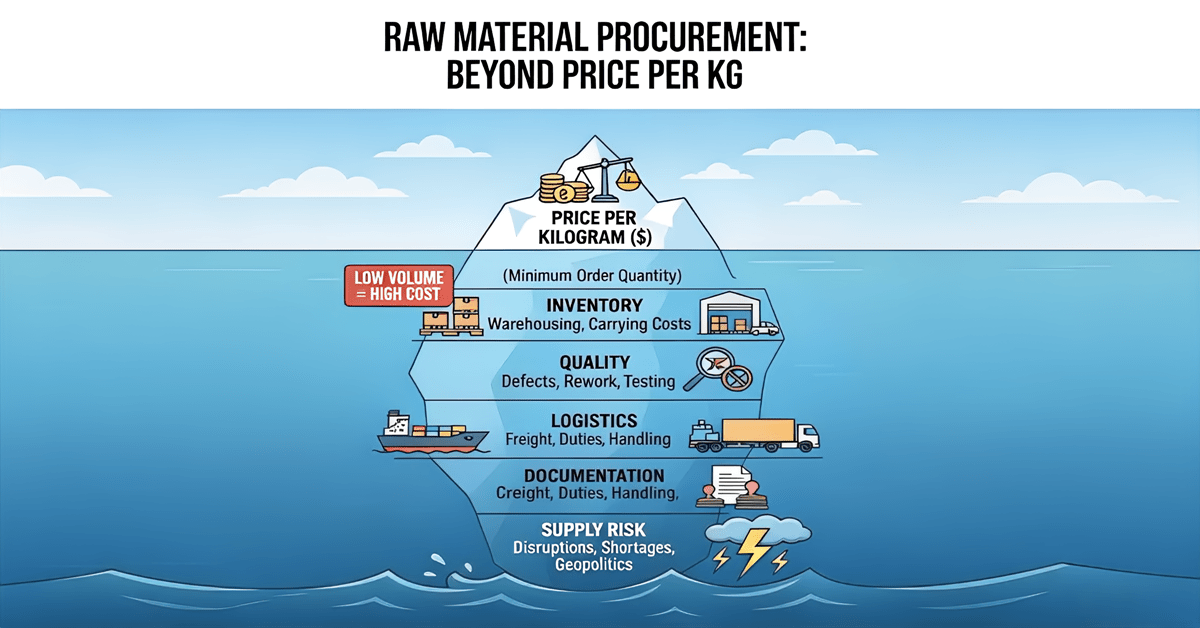
Raw material procurement cost is not the same as the price you see on a quotation.
A supplier offering the lowest price per kilogram may appear to be the obvious choice. But once MOQ, inventory, testing, quality issues, logistics, documentation, lead time, and supplier reliability are included, the actual cost of that raw material can be significantly higher.
This is why experienced procurement teams increasingly evaluate total cost of ownership (TCO) rather than looking at unit price alone.
For dietary supplement manufacturers, nutraceutical companies, food manufacturers, and OEM/ODM factories, the right sourcing question is not simply:
“Which supplier offers the lowest price per kg?”
It is:
“Which sourcing option gives us the lowest total cost while meeting our quality, delivery, and production requirements?”
Why Raw Material Procurement Cost Is More Than Price
A quotation normally shows only one visible number: the purchase price.
The actual cost of sourcing an ingredient can include much more:
- Purchase price
- MOQ and excess inventory
- Freight and customs
- Incoming quality inspection
- Additional laboratory testing
- Documentation and compliance work
- Quality failures and rejected batches
- Rework or production delays
- Emergency purchasing
- Formula adjustments
- Supplier qualification and requalification
- Inventory carrying costs
- Obsolescence or unused stock
The Chartered Institute of Procurement & Supply (CIPS) defines total cost of ownership as an end-to-end view that goes beyond purchase price and includes acquisition, usage, inventory, scrap, rework, logistics, and other associated costs.
For raw material sourcing, this means a cheaper quotation is not automatically a cheaper procurement decision.
1. Compare Total Cost of Ownership, Not Just Unit Price
Suppose two suppliers offer the same botanical extract:
Supplier A: USD 18/kg
Supplier B: USD 20/kg
At first glance, Supplier A appears to save USD 2/kg.
But imagine Supplier A requires a 500 kg MOQ, while Supplier B can supply 100 kg.
If your actual production requirement is only 100 kg, the additional 400 kg may become excess inventory.
The calculation changes immediately.
The same principle applies to logistics, testing, quality failures, and other indirect costs.
A useful procurement model is:
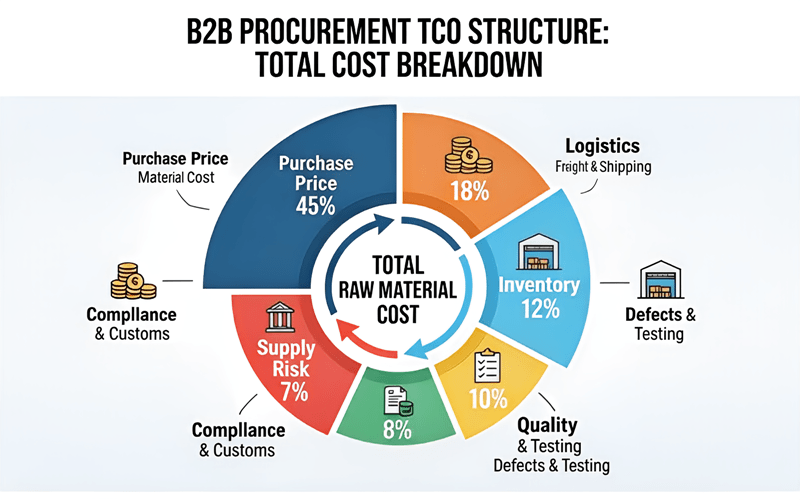
Total Procurement Cost = Purchase Cost + Logistics + Inventory + Quality + Compliance + Operational Risk
The exact calculation will vary by company, but the principle is consistent: evaluate the complete sourcing decision rather than one line on the quotation.
2. MOQ Can Change the Real Cost of an Ingredient
MOQ is often treated as a commercial term.
It should also be treated as a cost variable.
A high MOQ may reduce the supplier’s unit price, but it can increase:
- Inventory investment
- Warehouse requirements
- Working capital
- Obsolescence risk
- Expiration risk
- Internal inventory management
- Risk of unused material after a formulation change
This is particularly important during R&D, pilot production, and new product launches.
If a formulation requires only 5 kg for initial testing, buying 100 kg simply to obtain a lower unit price may not be economically efficient.
A lower MOQ can sometimes produce a higher price per kilogram but a lower overall procurement cost.
3. Quality Failures Can Destroy a Low-Cost Advantage
Quality is another hidden component of raw material procurement cost.
Consider a supplier that is USD 1/kg cheaper but has inconsistent batches.
A rejected batch may result in:
- Additional laboratory testing
- Production delays
- Rework
- Replacement shipments
- Additional freight
- Customer communication
- Production scheduling changes
The original price advantage can disappear very quickly.
ASCM notes that procurement performance involves more than price, including quality, supplier relationships, delivery, inventory, and supply risk.
For ingredient procurement, supplier quality should therefore be evaluated before the purchase decision rather than after a quality problem occurs.
4. Documentation Is Part of Procurement Value
A raw material is not fully procurement-ready simply because it meets the quoted specification.
For many supplement and food manufacturers, the supplier also needs to provide appropriate documentation such as:
- CoA
- Specification
- MSDS/SDS
- Allergen information
- Non-GMO documentation
- Halal or Kosher documentation where applicable
- Microbiological testing
- Heavy metal testing
- Pesticide testing where relevant
- Origin information
- Batch traceability
Missing documentation creates another form of procurement cost: internal time.
Quality teams may need to contact suppliers repeatedly, request additional reports, arrange third-party testing, or delay material approval.
The ingredient may be inexpensive, but the qualification process is not.
5. Lead Time Can Become a Production Cost
A low-priced ingredient does not create value if it arrives too late.
Long or unreliable lead times can force manufacturers to:
- Carry additional safety stock
- Place emergency orders
- Use more expensive transportation
- Reschedule production
- Delay customer deliveries
- Change production priorities
CIPS specifically recommends considering lead time, supplier performance, disruption risk, logistics, and inventory when evaluating total cost of ownership.
For critical ingredients, supplier reliability can therefore be worth more than a small difference in unit price.
6. Supplier Consistency Matters From Pilot to Bulk
Another important component of raw material procurement cost is consistency between sample, pilot, and commercial supply.
A sample may perform well in R&D, but if the bulk material has a different specification, particle size, active content, solubility, appearance, or sensory profile, the manufacturer may need to repeat validation.
That can create additional costs through:
- Re-testing
- Reformulation
- Production trials
- Quality investigation
- Customer approval
- Delayed commercialization
For this reason, procurement teams should ask not only:
“Can you provide a sample?”
but also:
“Can the same specification and quality standard be maintained when the order moves to commercial volume?”
A sourcing model that supports both pilot quantities and larger commercial orders can reduce this transition risk.
7. Evaluate the Supplier, Not Just the Product
The final mistake is evaluating an ingredient independently from the supplier behind it.
Two suppliers may offer technically similar products but provide very different levels of procurement support.
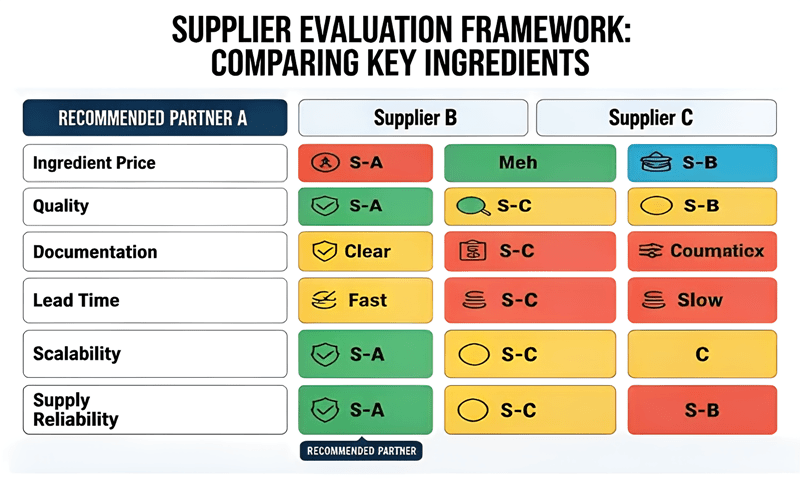
A more complete supplier evaluation can include:
| Evaluation Factor | Key Question |
|---|---|
| Price | What is the actual price per kg? |
| MOQ | How much material must we purchase? |
| Quality | Are specifications clearly defined and consistently met? |
| Documentation | Can required documents be provided promptly? |
| Lead Time | Can the supplier meet our production schedule? |
| Flexibility | Can the supplier support R&D and pilot quantities? |
| Scalability | Can supply increase when the product goes commercial? |
| Traceability | Can each batch be linked to appropriate documentation? |
| Logistics | What is the actual landed cost? |
| Reliability | Can the supplier maintain stable supply over time? |
This is closer to the real procurement decision than simply comparing two prices.
A Simple Framework for Comparing Ingredient Suppliers
Before selecting a supplier, procurement teams can divide the evaluation into five categories.
Purchase Cost
Start with the quoted price, but do not stop there.
Check:
- Price per kg
- MOQ
- Payment terms
- Packaging
- Price validity
Landed Cost
Calculate the actual cost of getting the material to your facility.
Consider:
- Freight
- Customs
- Duties and taxes where applicable
- Insurance
- Handling
- Local delivery
Quality Cost
Estimate the potential cost associated with quality management.
Consider:
- Incoming inspection
- Third-party testing
- Failed batches
- Rework
- Replacement
- Supplier investigation
Inventory Cost
Consider how much inventory the supplier’s MOQ and lead time force you to carry.
Include:
- Working capital
- Storage
- Expiration
- Obsolescence
- Excess inventory
Supply Risk
Finally, consider what happens if the supplier cannot deliver.
Ask:
- How stable is the supply?
- Can the supplier support higher volumes?
- How consistent are batches?
- How quickly can problems be resolved?
- Is there a backup sourcing option?
This approach turns supplier comparison from a simple price exercise into a structured procurement decision.
The Cheapest Supplier Is Not Always the Lowest-Cost Supplier
The difference between unit price and total cost of ownership is easy to overlook because unit price is visible.
Inventory costs are less visible.
Quality failures are often recorded by the quality department.
Production delays may appear in operations.
Documentation problems may consume time in regulatory or procurement teams.
Emergency freight may appear later as a logistics expense.
When these costs are separated across departments, the original sourcing decision can look cheaper than it actually was.
A TCO approach brings those costs back into the same decision.
ASCM also emphasizes that procurement should focus on value rather than price alone, including logistics, warehousing, quality, disruption risk, and other costs associated with sourcing.
How Esubio Approaches Raw Material Procurement Cost
At Esubio, we believe ingredient sourcing should be evaluated around the complete supply requirement rather than price per kilogram alone.
Our sourcing model is designed to support manufacturers from initial sampling and pilot orders through commercial supply.
Depending on the product and supplier availability, we can support:
- Flexible MOQ for selected ingredients
- Small-batch sampling
- CoA, MSDS/SDS and specification documents
- Verified supplier sourcing
- Batch documentation
- Ingredient sourcing across multiple categories
- Transition from pilot orders to bulk shipments
The objective is straightforward: help customers reduce unnecessary inventory, qualification delays, documentation gaps, and supply-chain friction while maintaining the required quality and delivery standards.
For procurement teams, the best supplier is not necessarily the one with the lowest quotation.
It is the supplier that provides the best overall value for the actual production requirement.
Key Takeaways
- Raw material procurement cost is more than the price per kilogram.
- Total cost of ownership should include purchasing, logistics, inventory, quality, documentation, and supply risk.
- A higher MOQ can create additional inventory and working-capital costs.
- Quality failures and inconsistent batches can quickly eliminate a unit-price advantage.
- Missing documentation can create hidden qualification costs and delays.
- Lead time and supplier reliability should be included in procurement decisions.
- The best supplier should support the complete path from sample and pilot to commercial supply.
- Procurement should optimize for total value, not simply the lowest quotation.
Conclusion
The cheapest raw material is not necessarily the cheapest raw material to buy.
A supplier offering a lower price per kilogram may create higher costs through MOQ, excess inventory, quality problems, documentation gaps, long lead times, or supply disruption.
A more effective approach is to evaluate raw material procurement cost through a total cost of ownership framework.
For dietary supplement manufacturers, nutraceutical companies, food manufacturers, and OEM/ODM factories, this means looking beyond the quotation and asking a more important question:
What will this sourcing decision really cost us from the first sample to commercial production?
That is where procurement moves from price negotiation to strategic sourcing.
References
CIPS — Total Cost of Ownership CIPS — Total Cost of Ownership
CIPS — Whole-Life Costing CIPS — Whole-Life Costing
ASCM — Prioritize Value Over Cost for Procurement Success ASCM — Prioritize Value Over Cost for Procurement Success
ASCM — Procurement ASCM — Procurement and Supply Chain