
7 Powerful Multi-Ingredient Sourcing Strategies to Simplify Procurement
Multi-Ingredient Sourcing becomes significantly more complicated when a supplement or functional food formula requires several different functional ingredients.
One ingredient may be relatively easy to manage.
Five ingredients can create an entirely different procurement problem.
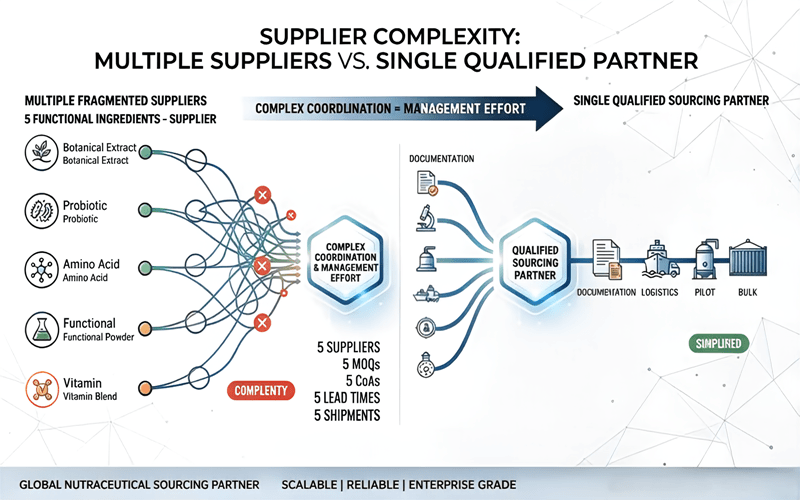
Each additional ingredient can introduce another supplier, MOQ, specification, CoA, MSDS, lead time, shipment, batch requirement, and quality review.
For R&D and procurement teams, the challenge is therefore not simply finding five ingredients.
The challenge is keeping all five moving on the same timeline.
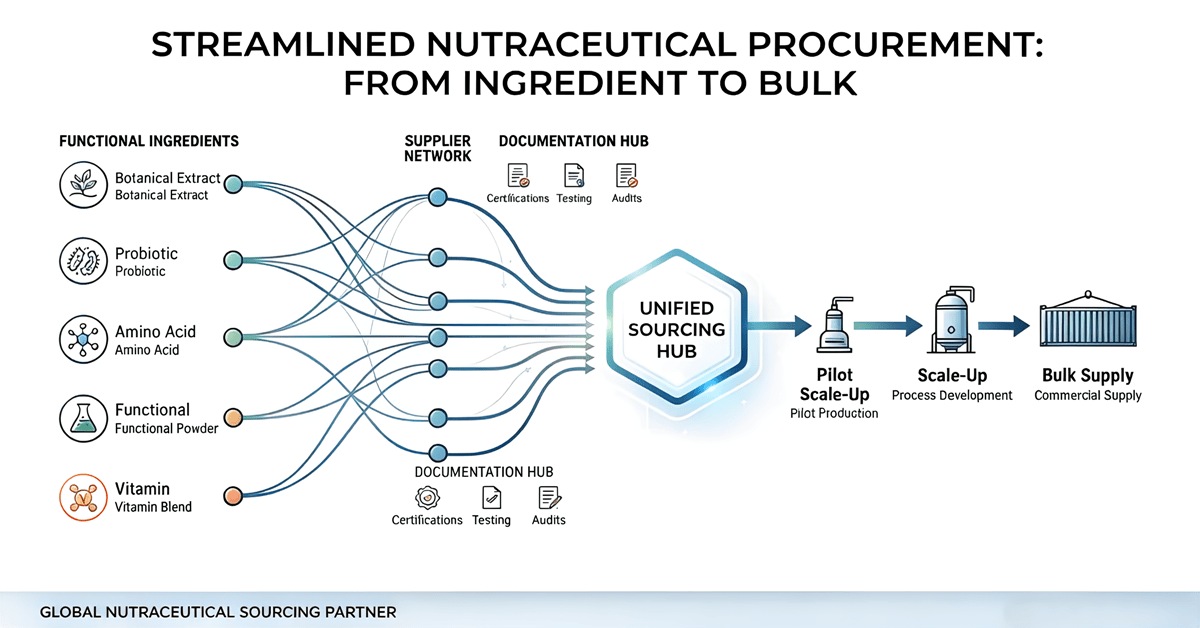
Why Multi-Ingredient Sourcing Becomes Complex So Quickly
Consider a supplement formula containing probiotics, botanical extracts, amino acids, and two additional functional ingredients.
The formulation itself may be straightforward.
The procurement process is not.
The purchasing team may need to coordinate:
- Multiple suppliers
- Different MOQs
- Different lead times
- Separate quotations
- Different specification formats
- Individual CoAs and MSDS
- Multiple sample shipments
- Separate quality approvals
- Different payment and shipping arrangements
If four suppliers deliver on time but the fifth supplier needs another three weeks, the entire formulation project may be delayed.
This is why Multi-Ingredient Sourcing should be viewed as a coordination problem, not simply a purchasing problem.
Supplier management research also highlights supplier consolidation and supplier relationship management as important levers for improving procurement efficiency and total cost.
1. Reduce the Number of Supplier Interfaces
One of the simplest ways to make Multi-Ingredient Sourcing easier is to reduce the number of supplier interfaces.
This does not mean putting every ingredient into one supplier regardless of capability.
Instead, it means identifying categories that can reasonably be sourced through the same qualified supply partner.
For example, a supplement manufacturer may need:
- Botanical extracts
- Amino acids
- Probiotics
- Functional powders
- Specialty ingredients
Instead of communicating with five separate suppliers, procurement may be able to consolidate several categories through one sourcing partner.
The benefit is not only fewer purchase orders.
It can also mean fewer emails, fewer document packages, fewer shipment arrangements, and fewer delivery dates to track.
Supplier consolidation can be particularly valuable when the ingredients are complementary rather than highly specialized.
2. Standardize Documentation Early
Documentation is another hidden source of complexity.
When every supplier uses a different specification format, procurement and quality teams may spend significant time comparing documents that should be straightforward to review.
A more efficient Multi-Ingredient Sourcing process starts by defining the required documentation before supplier selection.
Depending on the ingredient and target market, this may include:
- CoA
- Specification
- MSDS/SDS
- Microbiological specifications
- Heavy metal testing
- Residual solvent information
- Pesticide testing
- Allergen information
- Non-GMO documentation
- Halal or Kosher documentation
- Origin information
- Batch traceability
The exact requirements depend on the product, market, ingredient, and customer specifications.
For dietary supplements sold in the United States, manufacturers also need to consider applicable FDA requirements and dietary supplement CGMP obligations.
The key point is simple:
Do not wait until the order is ready to discover that the documentation is incomplete.
3. Align Lead Times Across Ingredients
A formulation can only move as quickly as its slowest critical ingredient.
Imagine a five-ingredient formula:
- Ingredient A: 5 days
- Ingredient B: 7 days
- Ingredient C: 10 days
- Ingredient D: 14 days
- Ingredient E: 30 days
The first four ingredients arriving early does not necessarily allow production to start.
Ingredient E may determine the actual project timeline.
This makes lead-time coordination an important part of Multi-Ingredient Sourcing.
Instead of asking only:
“What is the lead time for this ingredient?”
procurement should ask:
“Can all critical ingredients arrive within the required production window?”
This small change in perspective can reveal supply-chain bottlenecks much earlier.
4. Evaluate Suppliers Beyond Price Per Kilogram
When several ingredients are involved, the cheapest quotation is not necessarily the most efficient sourcing option.
Procurement should also consider:
- MOQ
- Sampling speed
- Documentation availability
- Batch consistency
- Lead time
- Shipping flexibility
- Communication efficiency
- Scale-up capability
- Quality requirements
A supplier offering a slightly higher ingredient price may create lower overall procurement costs if it reduces administrative work, minimizes shipment fragmentation, and provides more flexible order quantities.
A total-cost perspective is generally more useful than evaluating purchasing decisions only by short-term price.
5. Consider Functional Blends Where Appropriate
Another approach to Multi-Ingredient Sourcing is using a Functional Blend when several ingredients need to work together in a defined formulation.
Instead of purchasing several individual ingredients and managing each separately, a pre-formulated blend can sometimes consolidate multiple components into one sourcing and production process.
This can potentially reduce:
- Number of individual purchase orders
- Number of supplier interfaces
- Document fragmentation
- Weighing and batching steps
- Formulation complexity
However, Functional Blends are not automatically better.
The blend still needs to meet the customer’s formulation, specification, labeling, regulatory, and quality requirements.
For U.S. dietary supplements, FDA labeling requirements can also affect how blends and their constituent ingredients are declared, so the final labeling approach should be reviewed for the specific product.
The right question is therefore not:
“Can these ingredients be blended?”
It is:
“Would a blend make this formulation easier to source, manufacture, document, and scale?”
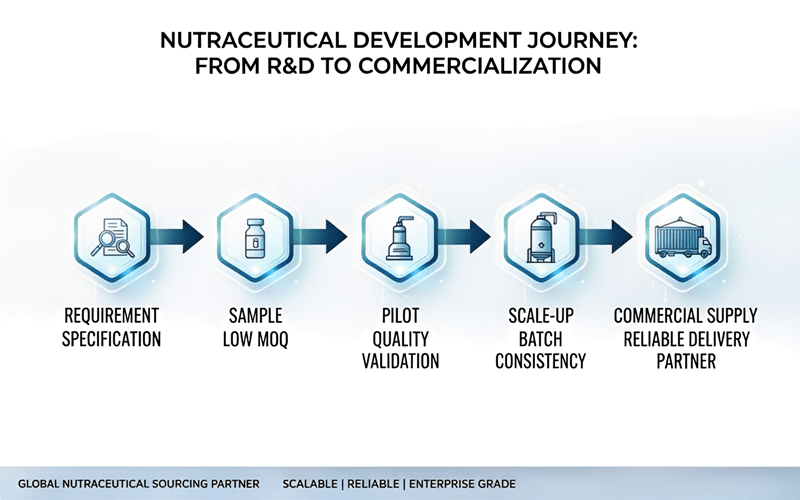
6. Keep Pilot and Bulk Supply Connected
One of the biggest problems in ingredient sourcing occurs when the supplier used for R&D cannot support commercial volumes.
The development process then becomes:
Sample → Supplier A
Pilot → Supplier B
Commercial Production → Supplier C
Every supplier change introduces another qualification step.
The specification may need to be reviewed again.
The batch characteristics may need to be compared.
The quality team may need additional testing.
The procurement team may need to renegotiate pricing and lead times.
A more efficient Multi-Ingredient Sourcing strategy considers scale-up capability from the beginning.
The supplier does not necessarily need to provide the largest production volume immediately.
But the supply chain should have a realistic path from:
Sample → Pilot → Scale-Up → Bulk
That continuity can reduce unnecessary requalification later.
7. Build a Sourcing System Instead of Managing Individual Orders
The most mature approach to Multi-Ingredient Sourcing is to stop treating every ingredient as an isolated purchasing task.
Instead, create a repeatable sourcing framework.
For each ingredient, evaluate:
Technical Fit
Does the ingredient meet the formulation requirement?
Quality Fit
Can the supplier provide the required specification and batch documentation?
Commercial Fit
Are MOQ, pricing, and payment terms workable?
Supply Fit
Can the supplier support the required lead time and commercial volume?
Compliance Fit
Can the documentation support the intended market and application?
This creates a more structured supplier evaluation process.
It also makes future projects easier because procurement teams can reuse qualified suppliers and documentation standards rather than starting from zero each time.
When Should You Consolidate Ingredient Sourcing?
Not every ingredient should be consolidated.
A highly specialized ingredient may require a dedicated supplier because of technology, certification, origin, or production capability.
However, consolidation can make sense when several ingredients:
- Are used in the same product
- Have similar documentation requirements
- Are purchased regularly
- Come from the same sourcing region
- Do not require highly specialized production
- Can be supplied under compatible quality standards
The objective is not to have the fewest suppliers possible.
The objective is to have the right number of qualified suppliers.
Too many suppliers increase coordination.
Too few suppliers can increase dependency and supply risk.
The right sourcing structure balances efficiency with resilience.
Common Mistakes in Multi-Ingredient Sourcing
Managing Every Ingredient Separately
Treating every ingredient as an independent purchasing project creates unnecessary administrative work.
Look at the entire formulation before deciding how the supply base should be structured.
Comparing Only Ingredient Prices
A lower price per kilogram does not necessarily mean lower procurement cost.
MOQ, logistics, documentation, testing, lead time, and requalification can all affect the real cost.
Choosing Suppliers Without Considering Scale-Up
A supplier may be excellent for a 1 kg sample but unsuitable for a 500 kg or 2 MT commercial order.
Scale-up capability should be considered before qualification is complete.
Waiting Until Production to Standardize Documentation
If every supplier provides different documentation, quality review can become a bottleneck.
Define the required documentation early.
Key Takeaways
Multi-Ingredient Sourcing is not simply about finding more ingredients. It is about managing the complexity created by multiple ingredients.
A more efficient sourcing strategy can:
- Reduce the number of supplier interfaces
- Standardize documentation
- Align ingredient lead times
- Improve supplier management
- Reduce procurement fragmentation
- Simplify pilot-to-bulk scale-up
- Make Functional Blends easier to evaluate
The goal is not to eliminate every supplier.
The goal is to build a sourcing structure that allows R&D, procurement, quality, and production to move together.
Conclusion
As supplement and functional food formulations become more sophisticated, Multi-Ingredient Sourcing becomes an increasingly important procurement capability.
Five functional ingredients do not necessarily require five completely independent sourcing processes.
With the right supplier structure, documentation standards, lead-time planning, and Functional Blend strategy, procurement teams can reduce unnecessary complexity while maintaining quality and supply flexibility.
For manufacturers developing products with multiple functional ingredients, the better question is no longer:
“Who can supply this ingredient?”
It is:
“How can we build the simplest reliable supply system for the entire formulation?”
That shift—from individual ingredient purchasing to coordinated ingredient sourcing—can make R&D, procurement, quality review, and commercial scale-up significantly easier.
References
- McKinsey & Company — Digital MRO procurement: New solutions for capturing and sustaining more value
- Deloitte — Global CPO Survey
- Deloitte — Sourcing and Procurement
- U.S. FDA — Dietary Supplements: Information for Industry
- U.S. FDA — Dietary Supplement CGMP