
Probiotic Ingredient Procurement: 7 Powerful Checks for Better Quality Decisions
Probiotic Ingredient Procurement is often reduced to one number: CFU. But comparing probiotic raw materials by CFU alone can lead to poor purchasing decisions.
CFU, or colony-forming units, is an important measure of viable microorganisms. However, it is only one part of a probiotic ingredient specification. Strain identity, purity, water activity, stability, carrier system, storage conditions, documentation, and batch consistency can all affect whether an ingredient performs as expected throughout storage and formulation.
For procurement teams, the better question is not simply “How many CFU does this ingredient have?”
It is:
“Will this probiotic ingredient remain suitable for my formulation, storage conditions, and target shelf life?”
This article focuses on probiotic ingredient sourcing and formulation considerations. It does not discuss disease treatment or health claims.
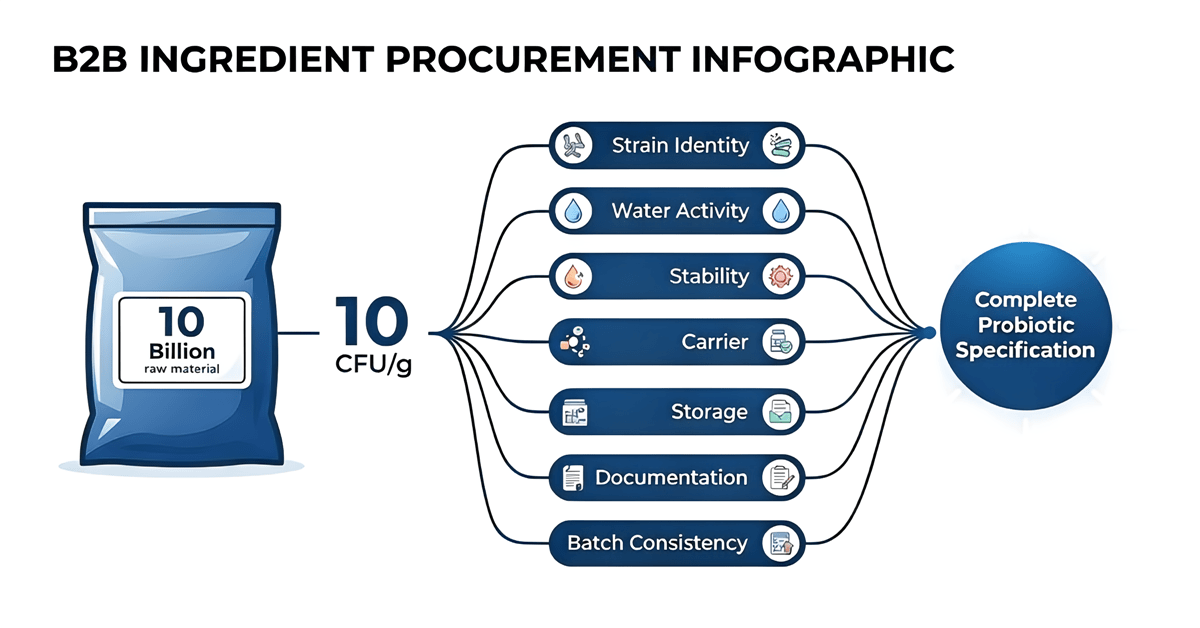
Why Probiotic Ingredient Procurement Should Not Start With CFU Alone
CFU tells you about the number of viable microorganisms under the specified test conditions. That makes it an important quality and potency parameter.
But CFU does not tell you everything about the ingredient.
Two probiotic ingredients may have similar CFU specifications while differing significantly in:
- Strain identity
- Stability during storage
- Water activity
- Moisture content
- Carrier composition
- Oxygen sensitivity
- Recommended storage conditions
- Processing tolerance
- Documentation
- Batch-to-batch consistency
The World Gastroenterology Organisation highlights viability through shelf life, purity, and accurate genus, species, subspecies, and strain identification as important aspects of probiotic product quality. WGO Global Guidelines on Probiotics and Prebiotics
In other words, CFU is important—but it should be evaluated as part of the complete specification.
1. Check the Probiotic Strain, Not Just the Species
One of the first questions in Probiotic Ingredient Procurement should be:
“What exactly is the strain?”
A specification that only says “Lactobacillus” or “Bifidobacterium” may not provide enough information for technical evaluation.
A more complete identification normally includes:
- Genus
- Species
- Subspecies, where applicable
- Strain designation
Strain-level information matters because probiotic characteristics can be strain-specific. Different strains of the same species can have different technological properties and stability profiles.
For procurement teams, the strain designation should therefore be traceable and consistent across the product specification, CoA, technical documentation, and commercial supply.
2. Evaluate CFU Together With the Testing Method
CFU is not simply a number printed on a specification sheet. The test method and testing conditions also matter.
When comparing probiotic suppliers, ask:
- Is CFU reported per gram, per serving, or per dose?
- Is the value a minimum specification or a typical result?
- At what stage is the CFU measured?
- What enumeration method is used?
- Is the reported value representative of the specific batch?
- Is there an overage strategy?
- Is the specification intended to apply at manufacture or through shelf life?
Different enumeration approaches can measure different aspects of microbial populations. For example, ISO 19344 describes a flow-cytometry method for quantifying active and/or total lactic acid bacteria in specified probiotic applications, while also noting that the method does not provide taxonomic differentiation. ISO 19344 Probiotic Quantification Standard
This is why a CFU number should always be interpreted together with the method and specification behind it.
3. Look at Water Activity and Moisture
For dry probiotic ingredients, water activity can be one of the most important stability parameters.
Probiotics are living microorganisms, so their viability can be affected by environmental conditions during storage. Research reviews identify water activity, temperature, oxygen, formulation composition, and storage time as important factors affecting probiotic stability.
This creates a common procurement mistake.
A buyer may select Ingredient A because it provides a higher CFU at a lower price, but Ingredient B may have a more suitable water-activity profile and storage system for the intended application.
That difference can become important during:
- Long-term storage
- Transportation
- Humid environments
- Powder blending
- Tablet compression
- Sachet filling
- Final product storage
For this reason, Probiotic Ingredient Procurement should review water activity and moisture alongside CFU rather than treating them as separate quality topics.
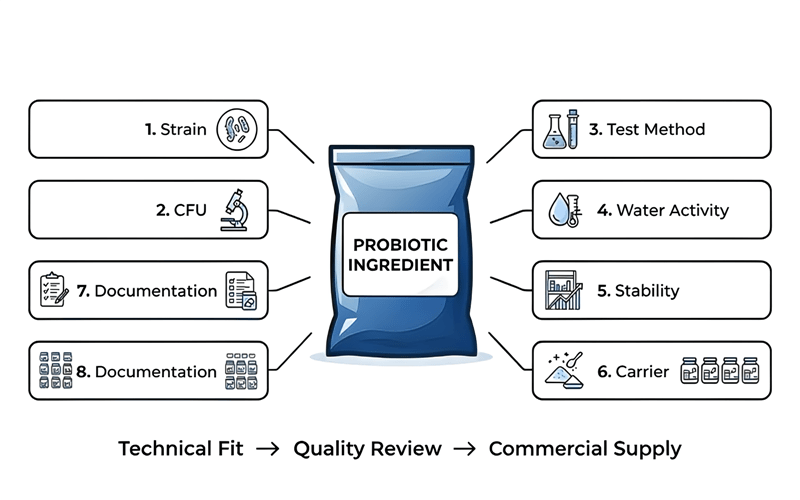
4. Check Stability Under the Intended Storage Conditions
A probiotic ingredient is not evaluated only at the moment it arrives at your warehouse.
The more relevant question is how well the ingredient maintains viability under its expected storage and handling conditions.
Important parameters may include:
- Storage temperature
- Relative humidity
- Water activity
- Oxygen exposure
- Packaging
- Storage duration
- Transportation conditions
A review of probiotic production and delivery notes that maintaining the required cell count through shelf life requires careful control of formulation, processing, storage, and packaging. It also identifies water activity and storage temperature as major factors affecting probiotic stability.
Therefore, procurement should ask suppliers for clear storage recommendations rather than relying only on a CFU specification.
5. Understand the Carrier and Formulation Compatibility
The probiotic microorganism is only one part of many commercial probiotic preparations.
The carrier or matrix surrounding the microorganism can affect handling, stability, processing, and compatibility with the final formulation.
Depending on the product, carriers or protective materials may include substances such as:
- Maltodextrin
- Starch-based materials
- Dairy-derived materials
- Fibers
- Prebiotic materials
- Encapsulation systems
- Other protective excipients
The important procurement question is not whether a carrier is “good” or “bad.”
It is whether the carrier is appropriate for the customer’s application.
For example, the formulation team may need to consider:
- Allergen requirements
- Vegan requirements
- Dairy-free requirements
- Solubility
- Flowability
- Compression behavior
- Moisture sensitivity
- Regulatory requirements
- Compatibility with other active ingredients
Recent research also emphasizes that probiotic stability can depend on the interaction between the strain, protective system, carrier, and surrounding formulation environment.
6. Review the Complete Probiotic Ingredient Specification
A professional Probiotic Ingredient Procurement process should not stop after checking CFU.
A complete technical review may include:
| Parameter | Why It Matters |
|---|---|
| Genus / Species / Strain | Confirms identity |
| CFU | Indicates viable microbial count |
| Test Method | Defines how potency is measured |
| Water Activity | Helps evaluate storage stability |
| Moisture | Important for dry-form stability |
| Carrier | Determines formulation compatibility |
| Appearance | Supports incoming QC |
| Microbiological Limits | Supports purity and safety evaluation |
| Heavy Metals | Supports raw-material qualification where applicable |
| Storage Conditions | Defines handling requirements |
| Shelf Life | Supports inventory planning |
| Packaging | Helps control moisture and oxygen exposure |
| Batch / Lot Number | Enables traceability |
| CoA | Provides batch-specific quality information |
The exact specification should always be adapted to the strain, ingredient format, intended application, and target market.
7. Check Documentation and Batch Consistency Before Buying
Documentation is often underestimated during Probiotic Ingredient Procurement.
A supplier may provide an attractive CFU specification, but the ingredient can still create problems if the technical documentation is incomplete or difficult to verify.
Before approval, procurement and quality teams may want to review:
- Current product specification
- Batch-specific CoA
- Test methods
- Storage requirements
- Shelf-life information
- Packaging details
- Allergen statement
- Non-GMO statement, where applicable
- Halal or Kosher documentation, where applicable
- Other market-specific documentation
- Batch traceability information
Batch consistency is equally important.
A supplier should be able to provide documentation that allows the buyer to compare actual batch results against the agreed specification.
This is especially important when moving from sample evaluation to commercial purchasing.
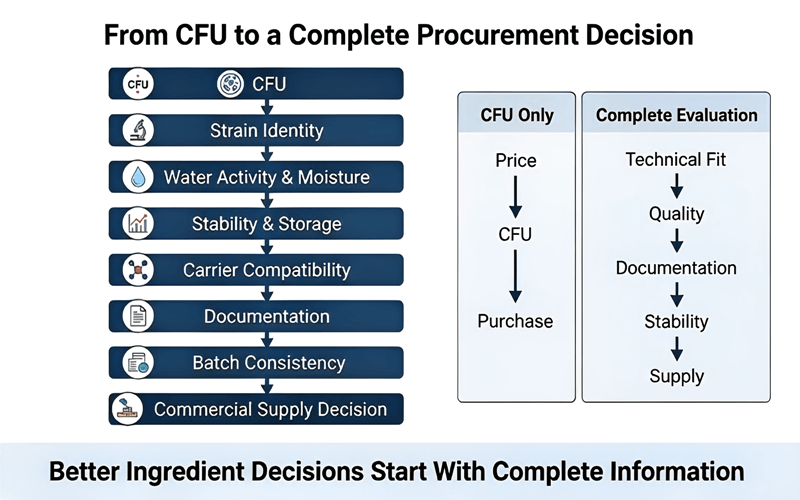
Probiotic Ingredient Procurement: A Better Decision Framework
Instead of using a simple:
CFU → Price → Purchase
model, procurement teams can use a broader:
Strain → CFU → Test Method → Water Activity → Stability → Carrier → Documentation → Batch Consistency → Price
framework.
This approach does not mean that price becomes unimportant.
It means that price is evaluated after technical suitability has been established.
A lower-cost probiotic ingredient is not necessarily the lower-cost choice if it creates additional testing, reformulation, storage, inventory, or quality-control problems later.
What Should Procurement Ask a Probiotic Supplier?
Before approving a new probiotic raw material, a practical supplier questionnaire can include:
- What is the complete strain designation?
- What is the minimum CFU specification?
- How is CFU tested?
- Is the CFU specification based on the manufacturing date or another point in time?
- What is the water activity specification?
- What are the recommended storage conditions?
- What carrier or protective system is used?
- What is the shelf life?
- Can you provide a batch-specific CoA?
- Can you provide the complete product specification?
- What documentation is available for the target market?
- How is batch-to-batch consistency controlled?
These questions give procurement teams a much clearer picture than CFU alone.
How Esubio Approaches Probiotic Ingredient Procurement
At Esubio, Probiotic Ingredient Procurement is approached around complete specifications and transparent documentation rather than a single CFU number.
For probiotic raw materials, we can provide available technical documentation such as:
- Batch-specific CoA
- Product specification
- MSDS/SDS where applicable
- Storage information
- Technical documentation
- Market-specific documents where available
For customers serving different markets, documentation requirements can vary. Depending on the ingredient and market, additional documents such as Halal certification or local specification documents may be available.
The goal is simple: give procurement, R&D, and quality teams enough technical information to evaluate an ingredient before moving from sample testing to commercial supply.
Key Takeaways
CFU remains an important parameter when evaluating probiotic ingredients, but it should not be the only purchasing criterion.
A stronger Probiotic Ingredient Procurement process looks at:
- Strain identity
- CFU and test method
- Water activity and moisture
- Storage stability
- Carrier compatibility
- Complete specifications
- Documentation
- Batch consistency
- Total purchasing risk
The best probiotic ingredient is not necessarily the one with the highest CFU or the lowest price.
It is the one that fits the intended formulation, storage conditions, quality requirements, documentation requirements, and commercial supply plan.
For probiotic procurement, the better question is not simply “How many CFU?”
It is “What does the complete specification tell us about this ingredient?”
References
- World Gastroenterology Organisation. Global Guidelines on Probiotics and Prebiotics.
WGO Global Guidelines - ISO. ISO 19344:2015 — Milk and milk products — Starter cultures, probiotics and fermented products — Quantification of lactic acid bacteria by flow cytometry.
ISO 19344:2015 - Ouwehand et al. The Production and Delivery of Probiotics: A Review of a Practical Approach.
PMC — Probiotic Production and Delivery Review - United States Pharmacopeia. General Chapter <64> Probiotic Tests.
USP — Probiotic Tests - FDA. Draft Guidance for Industry: Policy Regarding Quantitative Labeling of Dietary Supplements Containing Live Microbials.
FDA — Live Microbial Labeling Guidance