
Nutraceutical Dosage Form Defects: 3 Root Causes Explained
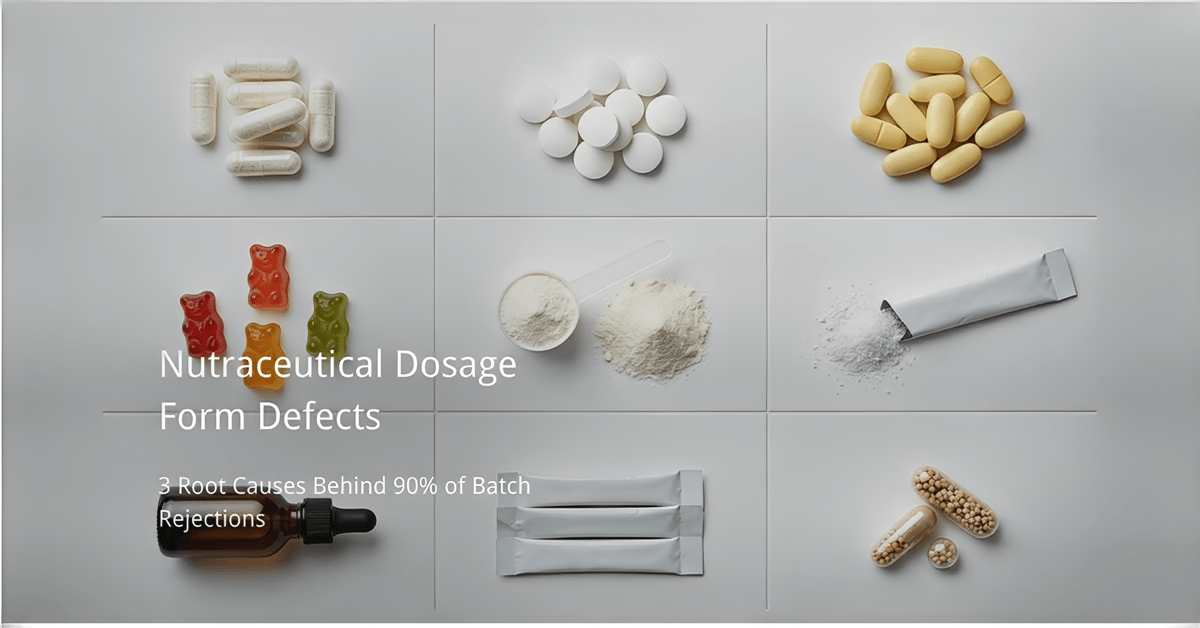
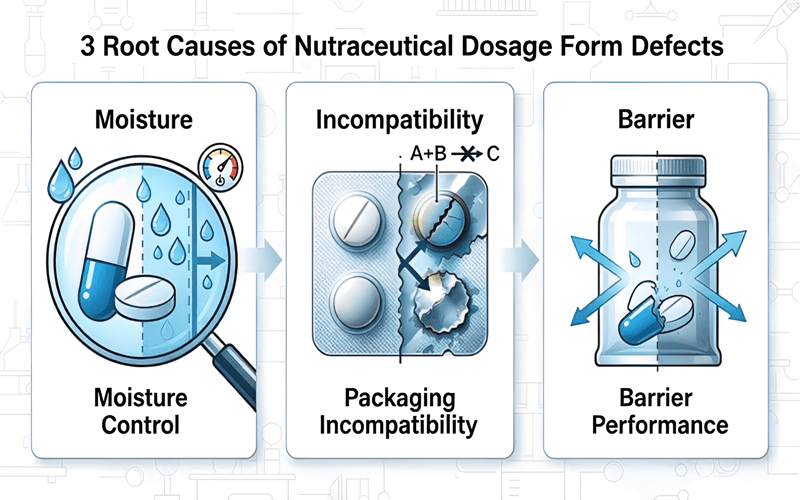
Nutraceutical dosage form defects are almost never bad luck, and they are rarely confined to a single batch. A recent industry-wide technical review covering nine dosage forms — powder drink mixes, hard capsules, soft gels, tablets, gummies, oil drops, stick-pack liquids, glass-bottled liquids, and granulation — found that more than 90 percent of nutraceutical dosage form defects trace back to just three root causes: loss of control over moisture or water activity, incompatibility between raw material and packaging or shell, and inadequate packaging barrier performance. For procurement and R&D leaders sourcing across global markets, that finding matters more than it first appears, because it means most nutraceutical dosage form defects are predictable and preventable, not random variation.
Why Nutraceutical Dosage Form Defects Are Rising Alongside Growth
The global dietary supplement and functional food market surpassed 240 billion dollars in 2025, and non-traditional formats — gummies, liquids, powder drink mixes — are growing faster than 10 percent per year, well ahead of legacy tablets and capsules. Growth has a shadow side. A single batch rejection from caking, leakage, or a seal failure typically costs three to eight times the value of the original production batch once raw-material loss, rework, logistics, and the cost of rebuilding customer trust are factored in. Every one of these failure modes is best caught at the trial-batch stage, not after full-scale production runs, which is the single biggest lever procurement and R&D teams have for controlling quality-related cost.
The Three Root Causes Behind Most Nutraceutical Dosage Form Defects
Moisture and water-activity management is the common thread underlying nearly every one of these nutraceutical dosage form defects across all nine formats — powder-mix caking, gummy graining and mold, hard-capsule brittleness or softening, soft-gel cross-linking, and case-hardened granules all ultimately trace back to a failure to balance moisture among the raw material, the environment, and the packaging. Industry data increasingly points toward water-activity monitoring, not simple moisture-content testing, as the metric that actually predicts both microbial growth and chemical-reaction risk. Raw-material and packaging incompatibility is the second driver, showing up as glass delamination in high-pH liquid formulas, shell cracking when plant-based capsules are qualified against gelatin specifications, or coating cracks when a hygroscopic tablet core is paired with the wrong film. Packaging barrier performance is the third, and it now sits in direct tension with sustainability pressure — de-layering a foil-plastic laminate to improve recyclability reduces its oxygen and moisture-vapor barrier, and lightweighting glass trades away impact resistance, so any packaging-material switch needs formal pre-change validation through accelerated stability testing before it goes into production.
Two Trends Making the Problem Harder to Manage
Plant-based raw materials — plant proteins, non-gelatin gums, algae oils — have scaled rapidly over the past three years, but as agricultural products they carry far more batch-to-batch variability than synthesized ingredients, with protein content, particle size, color, and odor all shifting with origin and season. When qualifying a new plant-based supplier, batch-to-batch consistency data across multiple lots matters more than a single certificate of analysis. Clean-label formulation is the second complicating trend: reducing or removing traditional anti-caking agents, preservatives, emulsifiers, and colorants pushes manufacturers to give up some of the exact tools historically used to solve dosage-form defects, and clean-label formulations typically require 30 to 50 percent more R&D time to validate process stability than conventional ones.
Where Regulatory Frameworks Add Another Layer
Quality defects are ultimately judged against the regulatory framework of the target market, and those frameworks are not interchangeable. US dietary supplements operate under 21 CFR Part 111, emphasizing raw-material identity testing and batch traceability. EU food supplements require Novel Food authorization for novel ingredients and increasingly tight packaging-sustainability rules that directly affect stick-pack and laminate material choices. China runs a dual registration-and-filing system where cross-category misclassification, particularly for powder drinks and compressed-candy formats, is a common compliance pitfall. Halal certification has become a de facto market-entry requirement across the Middle East and Southeast Asia, directly shaping capsule shell and gummy gelling-system choices — a decision that is far cheaper to build into formulation design early than to retrofit just before launch.

A Practical Way to Audit for Dosage Form Defects Before They Happen
The most useful diagnostic tool for procurement teams is a short list of specific, hard-to-fake questions for any supplier. Can they provide batch-by-batch moisture or water-activity data, not just periodic type-testing reports? For plant-based ingredients, do they have consistency data across multiple consecutive batches rather than a single COA? Do they have documented history of packaging-material changes along with the corresponding stability re-validation records? Have packaging materials — glass, capsule shell, laminate film — been specifically tested for compatibility with your formulation, not just certified as generically food-grade? A supplier who answers these questions readily, with data rather than assurances, is signaling exactly the kind of process discipline that prevents nutraceutical dosage form defects before they reach your production line.
Where esubio Fits Into This Picture
Most nutraceutical dosage form defects originate upstream of the finished product — in raw-material moisture control, in shell-and-fill compatibility, or in the granulation step that feeds into tablets, powders, and capsule fills. esubio supplies botanical extracts, probiotics, and amino acids with batch-level documentation, alongside a full range of capsule shells and a granulation service that works directly with your raw material order, so the upstream variables that most often cause downstream defects are controlled before your formulation ever reaches full-scale production. If you would like the full technical breakdown behind this article — including the complete supplier evaluation checklist and quality-agreement clauses referenced above — reach out and we will share the full report.
References
Grand View Research. Dietary Supplements Market Size & Share Report, 2026-2033. https://www.grandviewresearch.com/industry-analysis/dietary-supplements-market-report
U.S. Food and Drug Administration. 21 CFR Part 111 — Current Good Manufacturing Practice for Dietary Supplements. https://www.ecfr.gov/current/title-21/chapter-I/subchapter-B/part-111
European Commission. Food Supplements Directive 2002/46/EC. https://food.ec.europa.eu/food-safety/labelling-and-nutrition/food-supplements_en