
Customs Clearance Documents: 7 Powerful Ways to Prevent Costly Delays
Many ingredient buyers think delivery time is mainly determined by production.
Until a shipment is sitting at the port.
The goods may already be produced, packed, and ready for delivery. But if a required document is missing, incomplete, inconsistent, or needs additional verification, the shipment may not move as planned.
This is where Customs Clearance Documents become more than paperwork. They can directly affect the timing of your raw material supply chain.
For dietary supplement manufacturers, OEM factories, and ingredient buyers, a few days of delay can mean a delayed production schedule, postponed customer delivery, or additional storage and logistics costs.
Why Customs Clearance Documents Can Affect Delivery
International ingredient shipments involve more than the physical movement of goods.
Depending on the product, destination market, importer, intended use, and applicable regulations, the shipment may require different types of commercial, technical, quality, or regulatory documentation.
Common examples may include:
- Commercial Invoice
- Packing List
- Bill of Lading or Air Waybill
- Certificate of Analysis (CoA)
- Product Specification
- Safety Data Sheet (SDS/MSDS), where applicable
- Certificate of Origin
- Product or ingredient declarations
- Testing reports
- Market- or product-specific certificates or supporting documents
Not every shipment requires every document.
That is exactly why documentation needs to be checked before shipment rather than handled as a last-minute task.
For example, the U.S. FDA notes that incomplete or inaccurate entry information can result in additional review, and importers may need to provide supporting documentation depending on the product and entry.
In Australia, importers are expected to check the specific requirements applicable to their goods, including documentation requirements, before arrival. The BICON system is used to determine applicable import conditions and supporting documentation.
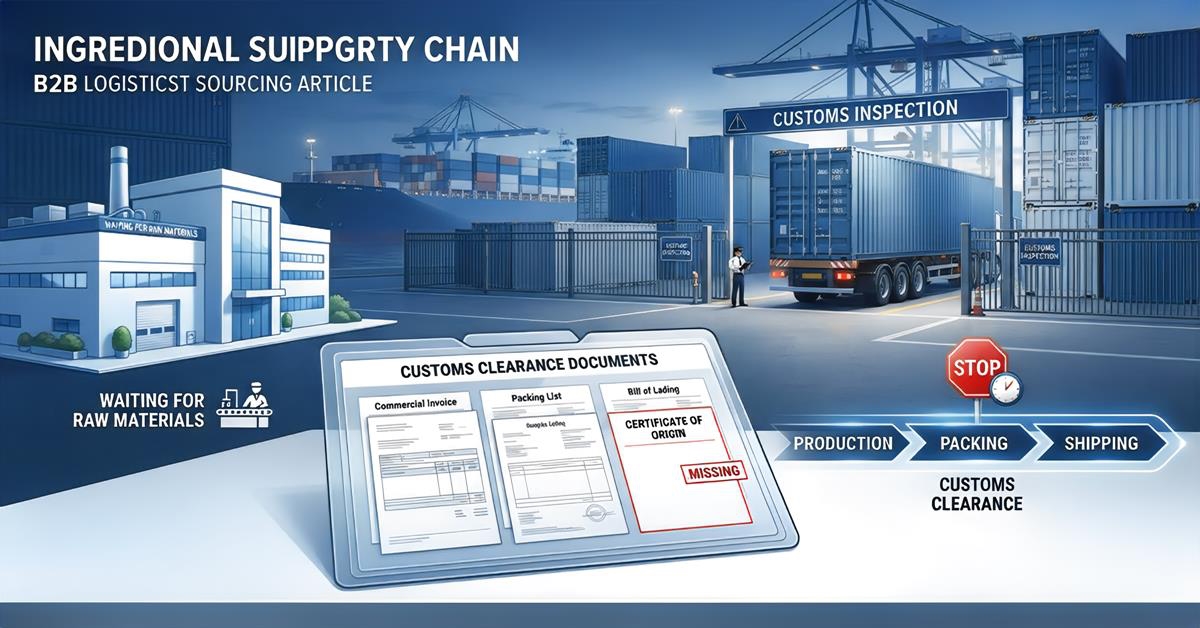
The lesson is simple:
The right documents should be identified before the goods leave the country of export.
1. Start With the Destination Market, Not the Supplier
One common mistake is to ask the supplier:
“Which documents do you normally provide?”
That is useful, but it is not enough.
The better question is:
“What documents will this shipment require in the destination market?”
The supplier’s standard document package may not match the importer’s actual requirements.
A buyer may need a specific testing report, declaration, certificate, label information, manufacturer information, or other supporting document depending on the product and market.
For this reason, documentation requirements should be reviewed during the sourcing stage.
The destination market should be part of the purchasing specification—not something checked after the goods are already on the water.
2. Confirm Documentation Before Placing the Order
The easiest time to solve a documentation problem is before production starts.
Before confirming an order, buyers should ideally check:
- Product specification
- Required testing parameters
- CoA requirements
- Packaging and labeling information
- Manufacturer information
- Origin information
- Required certificates
- Testing reports
- Importer or customs broker requirements
This does not mean preparing every possible document for every shipment.
It means identifying the documents that could become a condition for release, inspection, customer approval, or internal quality acceptance.
A five-minute documentation check before ordering can be much cheaper than solving a documentation problem after arrival.
3. Make the CoA Part of the Shipment Plan
For many functional ingredients, the CoA is one of the most important quality documents.
It connects the physical batch with its test results and specifications.
However, buyers should not assume that any CoA is automatically sufficient.
The required parameters may differ between products and customers. Some buyers may require additional testing for contaminants, microbiology, heavy metals, pesticides, allergens, or other product-specific parameters.
The key question is not simply:
“Do you have a CoA?”
It is:
“Does the CoA contain the information required for this specific shipment and approval process?”
This distinction can prevent unnecessary document revisions after production.
4. Check Whether Additional Testing Is Needed
A standard CoA may not cover every requirement.
Depending on the ingredient and destination market, buyers may request additional analytical reports or supporting documents.
For example, an importer may have internal specifications that require testing beyond the supplier’s routine release specification.
If an additional report is discovered only after shipment, the buyer may need to wait for the supplier or laboratory to provide it.
That can create an avoidable bottleneck.
The better approach is to identify additional testing requirements before production or shipment and determine whether the testing will be completed by the manufacturer, an independent laboratory, or another qualified party.
5. Keep Commercial and Technical Documents Consistent
Another common problem is inconsistency between documents.
For example:
The product name on the invoice is different from the name on the CoA.
The manufacturer shown on one document is different from the manufacturer information provided elsewhere.
The batch number does not match.
The quantity or packaging description is inconsistent.
The origin information is unclear.
Each issue may look small, but together they can create questions for the importer, customs broker, quality team, or regulatory reviewer.
A simple pre-shipment document check should therefore compare key information across the document set:
Product → Manufacturer → Batch → Quantity → Origin → Packaging → Specification
Consistency is often as important as completeness.
6. Prepare Market-Specific Documents Before Shipment
Different markets can have different documentation and compliance expectations.
For example, Australian food importers are required to comply with applicable biosecurity and food safety requirements, and the Australian authorities specifically advise importers to check applicable documentation before goods arrive.
In Europe, traceability requirements can also be relevant to food and ingredient supply chains. EU rules require food and feed operators to be able to identify their suppliers and the businesses to which products have been supplied.
This does not mean every European ingredient shipment requires the same documents, or that every Asia-Pacific shipment requires Halal documentation.
The practical point is different:
Documentation should be matched to the actual product, destination, and customer requirement.
A good sourcing partner should therefore ask about the destination market early instead of simply sending the same standard document package to every customer.
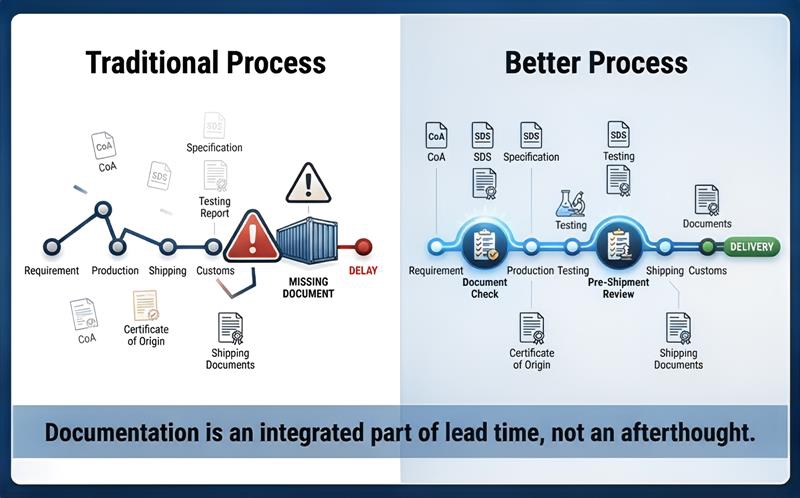
7. Treat Documentation as Part of Lead Time
This is perhaps the most important point.
When calculating delivery time, buyers often think in terms of:
Production → Packing → Shipping → Arrival
A more realistic international sourcing process is:
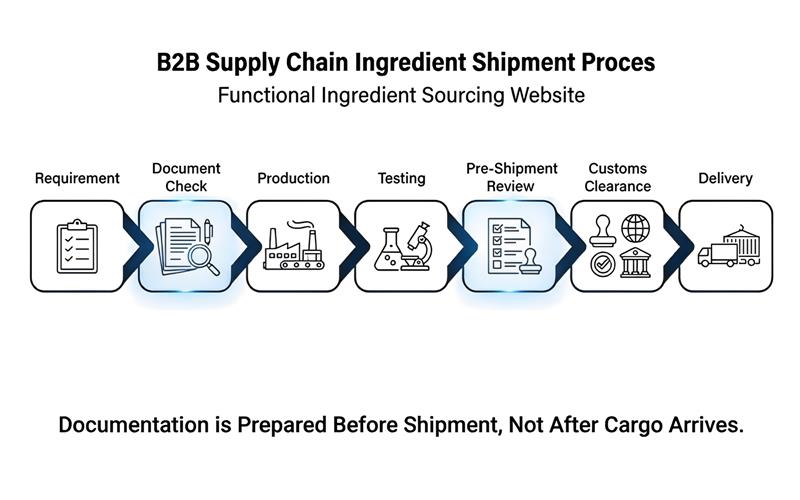
Requirement → Supplier Confirmation → Production → Testing → Documentation → Shipping → Customs Clearance → Delivery
Documentation is therefore part of the supply chain timeline.
If a required report takes several days to prepare, that time should be considered before shipment.
If a certificate needs verification, that should also be considered.
If the importer needs documents before the cargo arrives, they should be sent in advance.
The objective is not to eliminate every possible customs inspection or regulatory delay. Those are not always under the supplier’s control.
The objective is to eliminate delays caused by documentation that could have been prepared earlier.
A Better Approach: Build a Pre-Shipment Document Checklist
For recurring ingredient purchases, a simple document checklist can significantly improve communication between procurement, quality, logistics, and suppliers.
A practical checklist can include:
1. Commercial documents
Invoice, packing list, shipping documents and origin information.
2. Quality documents
CoA, specification and applicable testing reports.
3. Safety documents
SDS/MSDS and other applicable safety information.
4. Regulatory documents
Market- or product-specific declarations and certificates where required.
5. Traceability information
Manufacturer, batch/lot number, production information and relevant supply-chain records.
6. Customer-specific requirements
Any additional documents requested by the buyer, OEM, importer, or quality team.
The exact checklist should always be confirmed for the specific product and destination.
From “Document Supplier” to “Supply Chain Support”
For ingredient buyers, documentation should not be treated as something added to the shipment at the last minute.
It is part of the supply process.
At Esubio, we support ingredient sourcing for markets including the US, EU, Asia-Pacific, Australia & New Zealand, and the Middle East.
Depending on the product and customer requirements, shipment documentation may include CoA, SDS/MSDS, specifications, testing reports, origin information, and other applicable supporting documents.
For market-specific requirements, we confirm availability and applicability before shipment rather than assuming that one document package works for every market.
Our goal is straightforward:
Have the right documents ready before the goods arrive—not start looking for them after the shipment is already at the port.
What a More Reliable Ingredient Supply Process Looks Like
A reliable cross-border ingredient supply chain is not only about production capacity or freight rates.
It also depends on how early potential problems are identified.
A stronger process looks like this:
Requirement → Supplier Qualification → Documentation Check → Production → Testing → Pre-Shipment Review → Shipment → Customs Clearance → Delivery
When documentation is built into the sourcing process from the beginning, procurement teams have better visibility, suppliers have clearer requirements, and logistics teams have fewer last-minute issues to resolve.
In international ingredient sourcing, a shipment can be physically ready and still not be operationally ready.
That is why Customs Clearance Documents deserve attention before the cargo leaves the country of origin.
The goal is not simply to ship faster.
It is to make the entire supply process more predictable.
References
- U.S. FDA — FDA Import Process
FDA Import Process - U.S. FDA — Documents Required Status
FDA Documents Required Status - Australian Department of Agriculture — How to import food into Australia
Australia Food Import Guide - Australian Department of Agriculture — Documentary requirements
Australian Documentary Requirements - European Commission — Traceability and Labelling