
Functional Ingredient Sourcing: 7 Powerful Steps for Faster OEM Projects
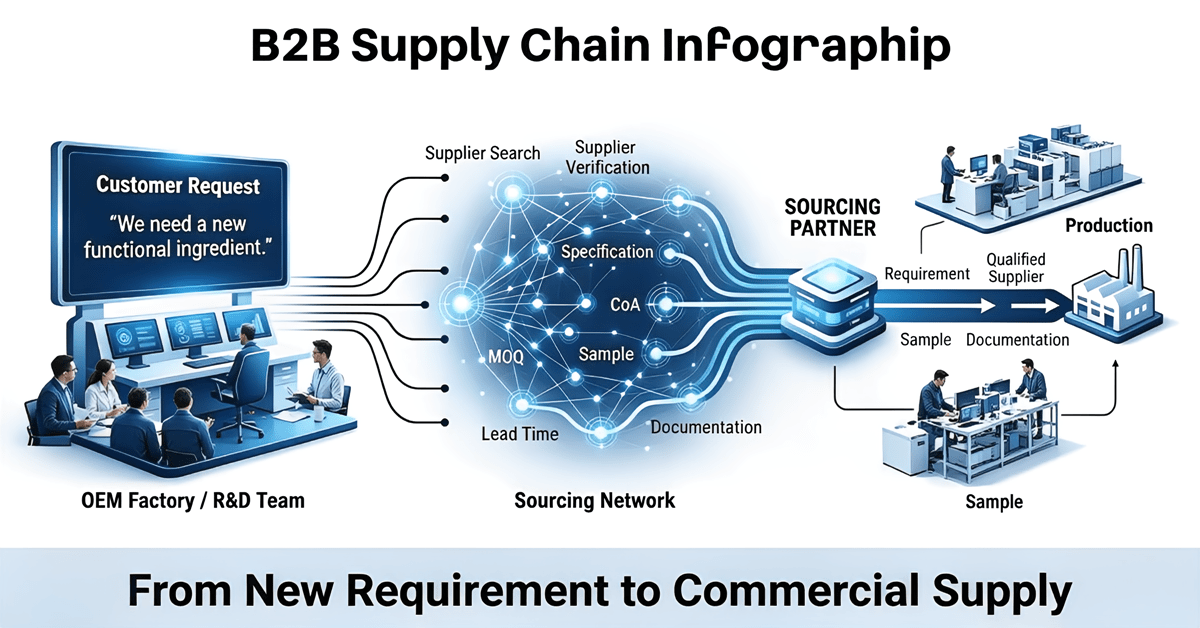
Functional Ingredient Sourcing becomes especially important when an OEM customer suddenly requests an ingredient your factory has never purchased before.
The request may sound simple:
“We want to add a new functional ingredient to the formula.”
But behind that request is a complete sourcing and qualification process.
You need to identify potential suppliers, verify their capabilities, review specifications and documentation, arrange samples, support formulation testing, complete supplier qualification, and eventually connect the approved ingredient to commercial production.
If any step is delayed, the entire project can move backward.
And from the customer’s perspective, they usually remember only one thing: when they submitted the request.
Why Functional Ingredient Sourcing Becomes Difficult With New Ingredients
For an OEM factory, an established supplier network makes familiar ingredients relatively easy to purchase.
The situation changes when a customer requests something outside the factory’s existing supply network.
The procurement team may suddenly need to:
- Search for new suppliers
- Compare different specifications
- Confirm the actual manufacturer or source
- Verify supplier qualifications
- Request CoA and technical documents
- Check MOQ and lead time
- Arrange samples
- Support R&D testing
- Coordinate quality review
- Confirm commercial supply capability
The problem is not simply finding a supplier.
The problem is finding a supplier that can meet the technical, quality, documentation, commercial, and delivery requirements of the project.
This is why Functional Ingredient Sourcing should be treated as a structured process rather than a simple online search.
1. Start With the Requirement, Not the Supplier
One of the most common mistakes in new ingredient sourcing is searching for suppliers before clearly defining the requirement.
Before contacting suppliers, the OEM team should clarify:
- Ingredient name
- Botanical or scientific name, where applicable
- Desired specification
- Active or marker compounds
- Form and grade
- Intended dosage
- Application
- Required certifications
- Target market
- MOQ
- Expected annual or initial volume
- Required delivery timeline
For example, “Ashwagandha extract” is not a complete sourcing requirement.
The procurement team may need to know the extract ratio, withanolide specification, plant part, extraction method, carrier, testing requirements, and intended application before meaningful supplier comparisons can begin.
A clear requirement makes supplier qualification much faster.
2. Build a Supplier Shortlist Before Comparing Prices
Once the requirement is clear, the next step is to identify suitable sources.
A long list of online quotations does not necessarily represent a strong supplier shortlist.
A better Functional Ingredient Sourcing process filters potential suppliers according to basic criteria such as:
- Relevant product experience
- Manufacturing or sourcing capability
- Product specification
- Quality system
- Certifications
- Documentation availability
- MOQ
- Lead time
- Export experience
- Target-market suitability
The goal is not to find the supplier with the lowest initial quotation.
The goal is to identify suppliers that are technically and commercially capable of supporting the project.
ASCM describes strategic sourcing as an approach that goes beyond transactional buying and focuses on supplier evaluation, performance, cost, risk, and long-term value. ASCM Supply Chain Procurement
3. Qualify the Supplier Before Moving Too Far
A new supplier should not automatically become an approved supplier simply because the first quotation looks attractive.
Supplier qualification may involve reviewing:
- Company information
- Manufacturing or supply capability
- Quality certifications
- Product specifications
- CoA examples
- Testing methods
- Traceability
- Production capacity
- Quality-control procedures
- Export documentation
- Previous supply experience
For OEM factories producing dietary supplements, supplier qualification is also closely connected with component specifications and quality control.
FDA’s dietary supplement CGMP guidance explains that manufacturers must establish specifications for components and that, when relying on a supplier’s CoA, the supplier must first be qualified and the reliability of the CoA established and periodically reconfirmed.
This is an important distinction:
A supplier can provide a CoA.
That does not automatically mean the supplier has been qualified.
4. Get the Sample and Documents Moving Together
Another common bottleneck is treating sampling and documentation as two separate processes.
The sample arrives.
Then the procurement team starts asking for the specification.
Then quality asks for the CoA.
Then R&D requests additional technical information.
Then another document is needed.
Each additional request can add another round of emails and another delay.
A more efficient Functional Ingredient Sourcing process is to request the basic technical package together with the sample whenever possible.
Depending on the ingredient and target market, this may include:
- Product specification
- Batch-specific CoA
- MSDS/SDS, where applicable
- Technical data
- Storage conditions
- Shelf-life information
- Allergen statement
- Non-GMO statement, where applicable
- Halal or Kosher documentation, where applicable
- Other market-specific documents
This allows R&D, procurement, and quality teams to evaluate the ingredient from the beginning rather than waiting for documents later.
5. Check MOQ, Lead Time, and Commercial Supply Early
A sample that passes laboratory testing does not automatically mean the ingredient is ready for production.
The next questions are commercial:
Can the supplier provide the required quantity?
What is the MOQ?
How long does production take?
Can the same specification be supplied consistently?
Is the supplier able to support repeat orders?
Can the required packaging and documentation be provided?
These questions should be considered before the formulation is finalized.
Otherwise, an OEM factory may successfully complete formulation testing and then discover that the approved ingredient has a commercial MOQ that is too high, a lead time that is too long, or supply conditions that do not fit the customer’s launch schedule.
Procurement decisions should therefore consider more than unit price.
CIPS defines Total Cost of Ownership as an end-to-end view that can include procurement, acquisition, inventory, conversion, scrap/rework, and other costs beyond the purchase price. CIPS Total Cost of Ownership
For a new ingredient, supply risk and project delay can become part of the real cost.
6. Keep Sampling, Qualification, and Production Connected
One of the biggest problems in ingredient sourcing is the disconnect between the supplier used for R&D and the supplier used for commercial production.
The process may look like this:
Requirement → Sample → Testing → Approved Formula → New Supplier Search → Bulk Supply
This creates unnecessary risk.
A better approach is:
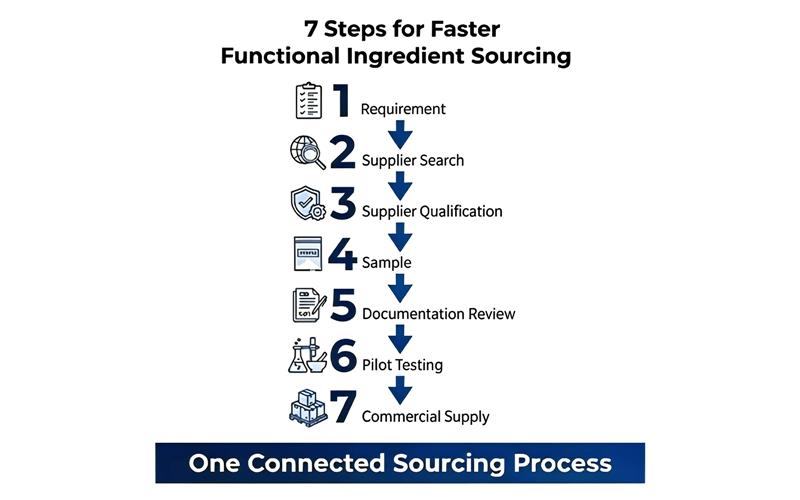
Requirement → Sourcing → Supplier Qualification → Sample → Documentation Review → Pilot → Scale-Up → Commercial Supply
The same sourcing process should consider both the initial sample and the potential commercial supply route.
This is particularly important for OEM factories because a customer may start with a small formulation trial and later move directly into a much larger production order.
The sourcing strategy should be able to grow with the project.
McKinsey’s work on procurement operating models also emphasizes the need to integrate sourcing, supplier capabilities, risk management, logistics, and business requirements rather than treating procurement as an isolated purchasing activity. McKinsey Procurement Operating Model
7. Use a Sourcing Partner When the Ingredient Is Outside Your Network
OEM factories do not need to maintain direct supplier relationships for every possible functional ingredient on the market.
That would create another problem: too many supplier interfaces to manage.
Instead, when a new requirement falls outside the existing supplier network, working with an experienced ingredient sourcing partner can provide an additional sourcing channel.
A capable sourcing partner should be able to help with:
Requirement clarification
Supplier identification
Preliminary supplier screening
Specification matching
Sample coordination
Documentation collection
MOQ and lead-time checks
Commercial supply coordination
The value is not simply another quotation.
The value is reducing the amount of time the OEM team spends starting from zero.
What Should an OEM Factory Ask When Sourcing a New Ingredient?
When a customer requests an unfamiliar functional ingredient, the following checklist can help procurement teams move faster:
- What exactly is the ingredient and specification?
- What application will it be used for?
- What active or marker compounds are required?
- What certifications or documents are needed?
- What target market will the finished product enter?
- Can the supplier provide a batch-specific CoA?
- Can the supplier provide a complete specification?
- What are the MOQ and lead time?
- Can the same specification be supplied for commercial production?
- Can the supplier support repeat orders?
- Can the sample, documentation, and commercial quotation be coordinated together?
- Has the supplier been appropriately qualified for the intended use?
This checklist helps turn a vague sourcing request into a structured procurement project.
Functional Ingredient Sourcing Should Reduce the Work Behind the Project
When an OEM factory receives a request for an ingredient it has never purchased before, the real challenge is not simply finding a product online.
The challenge is connecting:
Requirement → Supplier → Qualification → Sample → Documentation → Testing → Pilot → Production
If the procurement team has to rebuild this entire chain every time a customer requests a new ingredient, valuable time is spent on supplier discovery and verification instead of project execution.
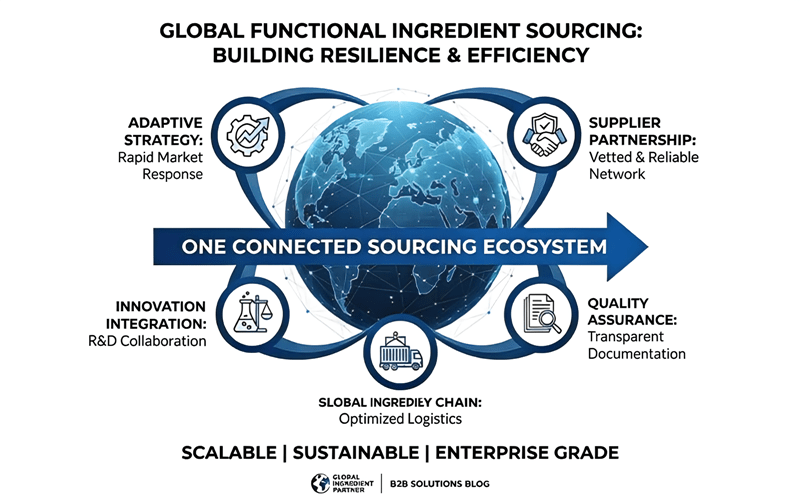
A more efficient sourcing model is to use qualified sourcing channels that can connect new requirements with suitable suppliers, technical documentation, samples, and commercial supply.
How Esubio Supports Functional Ingredient Sourcing
Esubio works as a sourcing partner for functional ingredients used in dietary supplements, functional foods, nutraceuticals, and related applications.
Our sourcing scope covers multiple categories, including:
- Botanical Extracts
- Amino Acids
- Probiotics
- Functional Blends
- Longevity & Cellular Health Ingredients
- Other functional ingredients based on project requirements
When an OEM customer requests an ingredient outside its existing supply network, the objective is to shorten the distance between the requirement and a qualified sourcing option.
Depending on the ingredient and availability, Esubio can support:
- Supplier sourcing
- Preliminary supplier verification
- Sample arrangement
- Product specification
- CoA
- MSDS/SDS where applicable
- MOQ and quotation
- Lead-time information
- Market-specific documentation where available
Samples are typically arranged within 3–5 days, depending on ingredient availability and project requirements.
The goal is not to replace the OEM’s procurement or quality team.
It is to give them a more efficient sourcing interface when a new ingredient requirement appears.
From a New Ingredient Request to Commercial Supply
A new ingredient request does not have to mean starting from a blank search page.
With a structured Functional Ingredient Sourcing process, the project can move through a clearer sequence:
Requirement→Sourcing→Supplier Qualification→Sample→Documentation Review→Formulation Testing→Pilot→Commercial Supply
For OEM factories, this can turn an unfamiliar ingredient request from a sourcing problem into a manageable project.
Key Takeaways
When an OEM customer suddenly requests an ingredient that the factory has never purchased before, the fastest response is not necessarily to search for the cheapest supplier.
A better approach is to:
- Define the requirement clearly
- Build a qualified supplier shortlist
- Verify supplier capabilities
- Request samples and documents together
- Check MOQ and lead time early
- Connect sampling with commercial supply
- Use a sourcing partner when the requirement falls outside the existing supplier network
Functional Ingredient Sourcing is ultimately about reducing uncertainty between the customer’s requirement and the final production order.
The goal is simple:
Find the right ingredient, from a suitable source, with the right documentation, at the right time—without making the OEM team rebuild the entire sourcing process from zero.
References
- U.S. Food & Drug Administration (FDA). Small Entity Compliance Guide: Current Good Manufacturing Practice in Manufacturing, Packaging, Labeling, or Holding Operations for Dietary Supplements.
FDA Dietary Supplement CGMP Guide - Association for Supply Chain Management (ASCM). Supply Chain Procurement Certificate and Strategic Sourcing Resources.
ASCM Procurement Resources - Chartered Institute of Procurement & Supply (CIPS). Total Cost of Ownership in Procurement and Supply.
CIPS Total Cost of Ownership - McKinsey & Company. A Next-Generation Operating Model for Source-to-Pay.
McKinsey Source-to-Pay Procurement Model