
Ingredient Sourcing System: 7 Powerful Ways to Build a Better Supply Chain
Ingredient Sourcing System is becoming increasingly important for overseas dietary supplement manufacturers and OEM factories.
When ingredient sourcing becomes difficult, the first reaction is often simple: find more suppliers.
But more suppliers do not always mean a better supply chain.
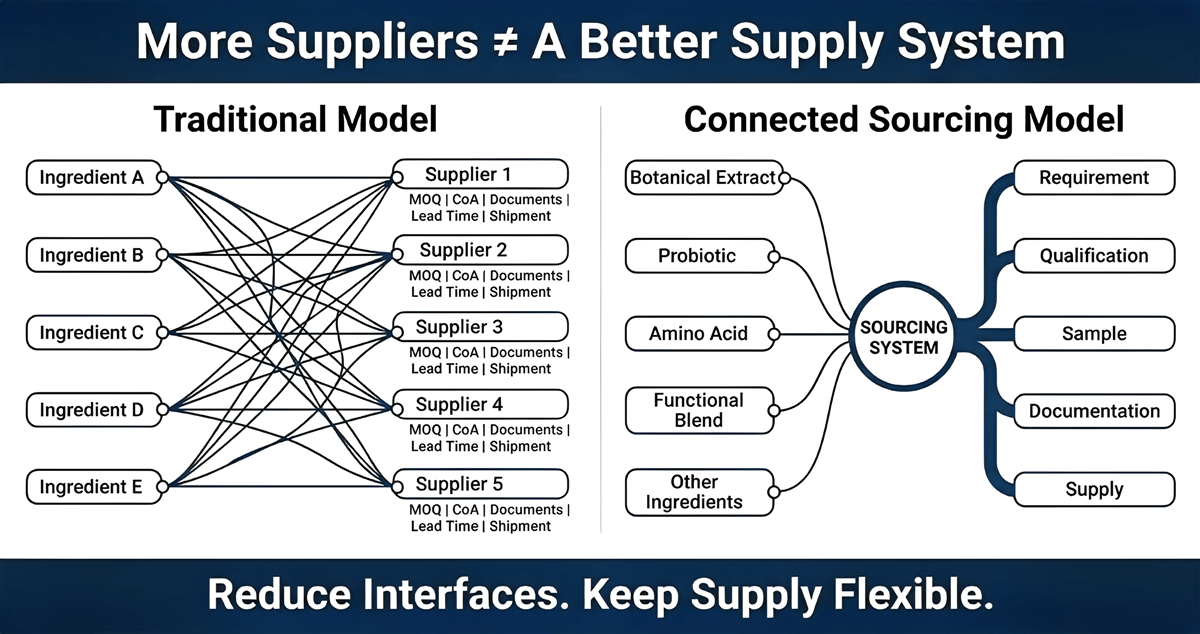
In many cases, every additional supplier creates another interface to manage: another MOQ, another specification, another CoA, another lead time, another shipment, another quality review, and another communication channel.
The result can be more work rather than more flexibility.
The real question is therefore not:
“How many suppliers do we have?”
It is:
“How efficiently can we move from an ingredient requirement to a qualified and reliable supply?”
Why an Ingredient Sourcing System Matters
Many of the procurement problems faced by supplement manufacturers appear to be separate issues.
MOQ is too high.
Samples take too long.
The sample and commercial batch are different.
The CoA is not enough for quality approval.
The supplier used for R&D cannot support commercial volume.
The lowest unit price creates higher total costs.
Five ingredients require five different suppliers.
A new ingredient request forces the procurement team to start searching from zero.
These problems look different on the surface, but they often point to the same underlying issue: the sourcing process is fragmented.
A modern procurement function needs to connect sourcing, supplier evaluation, purchasing, supplier management, and business requirements rather than treating each activity as an isolated transaction. McKinsey describes this as an end-to-end procurement operating model that coordinates multiple capabilities across the source-to-pay lifecycle.
That is the role an Ingredient Sourcing System can play.
Instead of managing every ingredient as a separate purchasing task, the company manages a connected sourcing process.
1. Move From “More Suppliers” to “Better Supplier Coverage”
Having multiple suppliers is not necessarily a problem.
In fact, supplier diversification can be important for supply continuity and risk management.
The problem is uncontrolled supplier proliferation.
For example, imagine an OEM factory buying five functional ingredients from five separate suppliers.
The procurement team may need to manage:
- 5 supplier relationships
- 5 MOQs
- 5 specifications
- 5 sets of technical documents
- 5 lead times
- 5 shipment arrangements
- 5 quality communication channels
If the number of ingredients increases, the administrative interfaces can grow quickly.
A better approach is to build supplier coverage around categories, applications, and sourcing capabilities.
The objective is not to reduce the number of suppliers at any cost.
It is to make sure every supplier relationship has a clear purpose.
Some suppliers may be strategic sources for high-volume materials.
Others may specialize in specific botanical extracts, probiotics, amino acids, or functional blends.
The key is to manage the supplier network as a system rather than as a collection of unrelated contacts.
2. Standardize the Requirement Before Starting the Search
A sourcing system becomes much more efficient when requirements are clearly defined before suppliers are contacted.
For a new ingredient, the procurement team should establish the basic requirement first.
This may include:
- Ingredient name
- Botanical or scientific name
- Active compound or marker
- Grade
- Purity
- Form
- Application
- Target market
- Required certifications
- Documentation requirements
- MOQ
- Initial quantity
- Expected commercial volume
- Required delivery date
Without a clear requirement, procurement may receive ten quotations that are not actually comparable.
One supplier may quote a standardized extract.
Another may quote a simple powder.
Another may use a different active-compound specification.
Another may offer a different grade or origin.
The problem then becomes not “Which supplier is cheaper?”
It becomes “Are we even comparing the same product?”
Standardized requirements make supplier comparison faster and reduce unnecessary communication.
3. Connect Supplier Qualification With Sourcing
Finding a supplier and qualifying a supplier are two different activities.
A supplier may have an attractive price and still fail to meet the project’s technical or quality requirements.
An effective Ingredient Sourcing System should therefore connect supplier discovery with preliminary qualification.
Depending on the ingredient and application, qualification may consider:
- Product specification
- Company information
- Manufacturing or supply capability
- Quality certifications
- CoA
- Test methods
- Traceability
- Production capacity
- Storage conditions
- Export experience
- Market-specific documentation
This is particularly relevant for dietary supplement manufacturers.
FDA’s dietary supplement CGMP guidance states that manufacturers must establish specifications for components and, when relying on supplier CoAs, must qualify suppliers and establish the reliability of the CoA.
The practical lesson is simple:
A supplier list is not the same as a qualified supplier network.
4. Connect Sampling With Commercial Supply
One common sourcing problem is the separation between the supplier used for R&D and the supplier used for production.
The process may look like this:
Sample Supplier → R&D Testing → Formula Approved → Search Again → Bulk Supplier
This creates unnecessary work.
The sample may pass.
The formula may be approved.
Then procurement discovers that the sample source has:
- A high commercial MOQ
- Long production lead times
- Limited production capacity
- Different commercial specifications
- Unstable batch availability
The team has to start the sourcing process again.
A better Ingredient Sourcing System considers commercial supply potential at the sampling stage.
The preferred flow is:
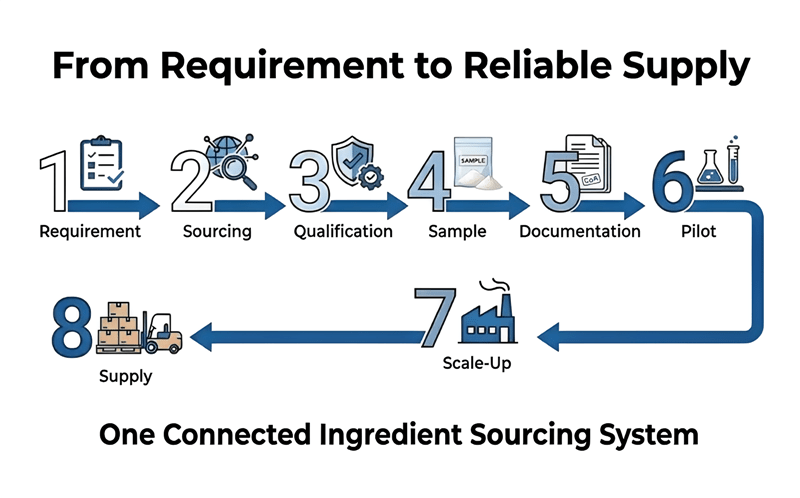
Requirement → Sourcing → Qualification → Sample → Documentation → Pilot → Scale-Up → Commercial Supply
This does not mean the same supplier must always be used.
It means commercial feasibility should be considered before the project reaches the final stage.
5. Treat Documentation as Part of Sourcing
Documentation should not be treated as an administrative task that happens after the supplier has already been selected.
For many functional ingredients, technical documentation is part of the qualification decision.
Depending on the ingredient and target market, procurement and quality teams may need:
- Product specification
- Batch-specific CoA
- MSDS/SDS where applicable
- Technical data
- Storage conditions
- Shelf-life information
- Allergen statement
- Non-GMO documentation where applicable
- Halal or Kosher documentation where applicable
- Other market-specific documents
If documentation is collected only after the supplier has been selected, the project may encounter avoidable delays.
A stronger process is:
Requirement → Supplier Screening → Documentation Review → Sample → Technical Evaluation
This allows quality, R&D, and procurement to work with the same information.
6. Measure Total Cost, Not Just Supplier Price
Supplier price is important.
But it is not the same as total procurement cost.
A supplier offering the lowest price per kilogram may create additional costs through:
- High MOQ
- Excess inventory
- Slow sampling
- Long lead times
- Additional testing
- Failed batches
- Rework
- Reformulation
- Emergency purchasing
- Additional logistics
- Supplier management time
CIPS defines Total Cost of Ownership as an end-to-end view that can include purchase and acquisition costs as well as inventory, conversion, scrap, rework, and other costs.
This is particularly important for functional ingredients.
A difference of USD 1/kg may look significant on a quotation.
But if a supplier requires an unnecessarily large MOQ, creates long inventory holding periods, or causes project delays, the apparent saving may disappear.
A strong sourcing system therefore evaluates:
Price + Quality + MOQ + Lead Time + Documentation + Reliability + Supply Risk
rather than price alone.
7. Build One Connected Sourcing Process
The biggest improvement does not necessarily come from finding one more supplier.
It comes from connecting the activities that already exist.
A more integrated Ingredient Sourcing System can follow:
Requirement
↓
Sourcing
↓
Supplier Qualification
↓
Sample
↓
Documentation
↓
Pilot
↓
Scale-Up
↓
Commercial Supply
Each stage should connect to the next one.
The information collected during sourcing should support qualification.
The qualification process should support sampling.
The sample supplier should have a path toward commercial supply.
Documentation collected during qualification should remain available for quality review and future orders.
Commercial performance should then feed back into supplier evaluation.
This is the difference between managing individual purchases and managing a sourcing system.
McKinsey’s procurement research similarly emphasizes integrated processes, supplier management, governance, data, and analytics as components of a stronger procurement operating model.
Supplier Consolidation Does Not Mean Supplier Dependence
There is an important distinction here.
Building a more efficient sourcing system does not mean putting every ingredient with one supplier.
That can create concentration risk.
The objective is not:
“Use fewer suppliers no matter what.”
The objective is:
“Reduce unnecessary supplier interfaces while maintaining appropriate supply options.”
For critical ingredients, companies may still want qualified alternative sources.
For less critical or highly fragmented categories, a sourcing partner may help consolidate multiple requirements through one procurement interface.
This balance between efficiency and resilience is becoming increasingly important as procurement teams manage supply disruptions, price volatility, and changing global sourcing conditions.
From Ingredient Supplier to Ingredient Sourcing Partner
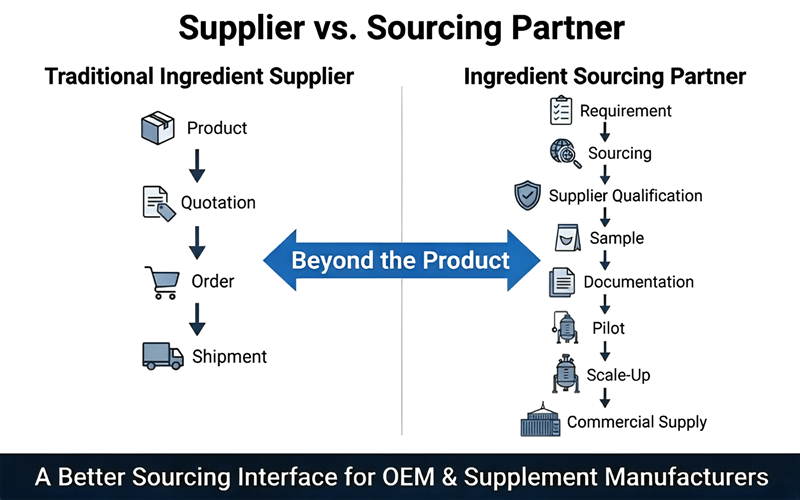
This is where the difference between a traditional ingredient supplier and a sourcing partner becomes clearer.
A traditional supplier generally answers:
“What ingredient can we sell you?”
A sourcing partner should help answer:
“What ingredient do you need, what source fits the requirement, what documentation is available, how quickly can we sample it, and can the supply scale with the project?”
The second model is particularly useful when an OEM factory has:
- A new ingredient requirement
- Multiple ingredients to source
- Small R&D quantities
- New market requirements
- Supplier qualification work
- Documentation challenges
- Pilot-to-bulk supply requirements
The value is not simply another quotation.
The value is reducing the number of sourcing problems the procurement team has to solve independently.
How Esubio Supports an Ingredient Sourcing System
Esubio works as an ingredient sourcing partner for overseas nutrition, supplement, nutraceutical, and functional food companies.
Our sourcing scope covers multiple functional ingredient categories, including:
- Botanical Extracts
- Amino Acids
- Probiotics
- Functional Blends
- Longevity & Cellular Health Ingredients
- Other functional ingredients based on project requirements
Our approach is built around:
Low MOQ | Fast Sampling | Reliable International Supply
Depending on the ingredient and availability, Esubio can support:
- Requirement clarification
- Supplier sourcing
- Supplier verification
- Sample arrangement
- Product specifications
- CoA
- MSDS/SDS where applicable
- MOQ and quotation
- Lead-time information
- Market-specific documentation where available
- Pilot-to-bulk supply coordination
Samples are typically arranged within 3–5 days, depending on ingredient availability and project requirements.
The objective is not simply to add another supplier to a customer’s supplier list.
It is to provide a more efficient sourcing interface when customers need new ingredients, small R&D quantities, technical documentation, or a path from pilot testing to commercial supply.
What a More Efficient Ingredient Sourcing System Looks Like
The traditional model is:
One Ingredient → One Supplier → One MOQ → One Document Set → One Lead Time
A more connected model is:
Requirement → Sourcing → Qualification → Sample → Documentation → Pilot → Scale-Up → Supply
The second model does not eliminate suppliers.
It makes the relationships, information, and processes around those suppliers easier to manage.
For an OEM factory, this can mean less time spent searching, comparing, following up, requesting documents, and coordinating multiple sourcing interfaces.
It allows procurement teams to spend more time on evaluation and decision-making rather than repeatedly rebuilding the sourcing process.
Key Takeaways
Overseas supplement manufacturers may not need more and more suppliers.
They may need a better Ingredient Sourcing System.
The goal is not to eliminate supplier diversity.
It is to reduce unnecessary complexity while maintaining qualified supply options.
A strong sourcing system should connect:
Requirement → Sourcing → Qualification → Sample → Documentation → Pilot → Scale-Up → Supply
It should also evaluate suppliers beyond price by considering MOQ, quality, documentation, lead time, reliability, and total cost.
For OEM factories, the real value of a sourcing partner is therefore not simply another product catalogue.
It is the ability to connect fragmented sourcing activities into a more manageable supply process.
When new ingredients, small-batch development, supplier qualification, documentation, cross-border procurement, and commercial scale-up all become part of the same workflow, ingredient sourcing becomes easier to manage—and easier to scale.
References
- McKinsey & Company, “A Next-Generation Operating Model for Source-to-Pay.”
- ASCM, “What Is Procurement?”
- CIPS, “Total Cost of Ownership.”
- McKinsey & Company, “Where Procurement Is Going Next.”
- U.S. Food & Drug Administration, Dietary Supplement CGMP guidance.