
Fermentable Fiber Satiety Ingredients: The Colon’s Role in Long-Duration Fullness
By four to six hours after a meal, digestion in the small intestine is essentially finished. What arrives in the colon at this point is whatever wasn’t digested upstream — and fermentable fiber satiety ingredients are specifically chosen to still have material available at this stage, for gut bacteria to ferment.
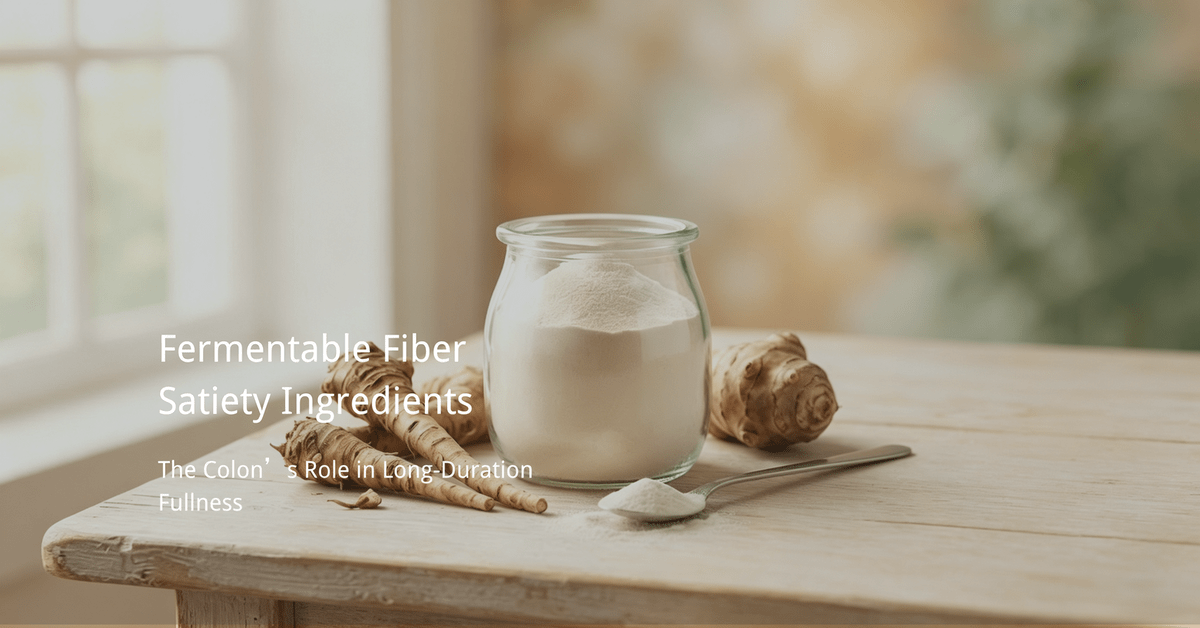
Why the colon matters for satiety timing
GLP-1-producing L-cells are present along the length of the intestine but are found in their highest density in the distal ileum and colon. Fermentation of dietary fiber by colonic bacteria produces short-chain fatty acids (SCFAs) — acetate, propionate, and butyrate — and these SCFAs are understood to interact with the same enteroendocrine signaling pathways active earlier in digestion, extending the general timeline of gut-hormone activity well beyond what small-intestinal mechanisms alone would produce.
Inulin and resistant starch as fermentation substrates
Inulin is among the most extensively studied fermentable fiber satiety ingredients for this stage, largely because of how well its fermentation profile in the colon has been characterized. Resistant starch that survives the small intestine — following on from the mechanism discussed in Resistant Starch Satiety Ingredients: Extending Fullness to the Two-Hour Mark — also becomes a fermentation substrate at this stage, giving formulators two structurally different but functionally complementary options for this phase.
Arabinogalactan, pectin, and other fermentable fibers
Beyond inulin and resistant starch, arabinogalactan and pectin are both fermented by colonic bacteria at different rates, giving formulators additional levers for tuning how a fiber blend’s fermentation — and by extension its functional activity — is distributed across the colonic phase rather than concentrated in one narrow window.
Polyphenols in the colonic phase
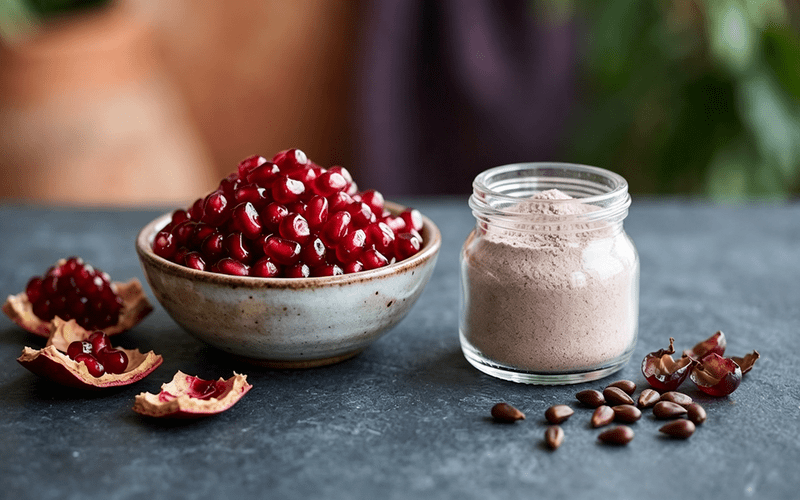
Pomegranate peel and grape seed polyphenols are frequently paired with fermentable fiber in this phase. Much of the polyphenol content in these sources isn’t absorbed until it reaches the colon, where bacterial metabolism converts it into more bioavailable compounds — meaning these polyphenols’ functional activity is itself tied to colonic timing, similar to fermentable fiber.
Formulation considerations
Fermentation rate — not just fiber content — is the property that actually determines how a fermentable fiber satiety ingredient behaves across this window. A fast-fermenting fiber is largely used up early in the colonic phase, while a slower-fermenting one extends activity further into the 6+ hour range. Blending fibers with different fermentation rates is a common strategy for spreading activity across the full window rather than concentrating it early.

Sourcing considerations
Degree of polymerization is a useful data point to request for inulin specifically, since shorter-chain inulin ferments faster than longer-chain material, directly affecting where in the colonic window it’s active. For defined prebiotic blends marketed for “targeted fermentation,” ask for the actual fermentation rate data behind that claim rather than accepting the framing at face value — this is a category where marketing language sometimes outpaces the underlying documentation.
We source inulin, resistant starch, arabinogalactan, and polyphenol ingredients suited to this formulation window, with fermentation and purity data available on request. Reach out with your target fermentation profile for current options.
References
- Nutrient detection by incretin hormone secreting cells — PMC — https://www.ncbi.nlm.nih.gov/pmc/articles/PMC3361765/
- Effects of GLP-1 and Incretin-Based Therapies on Gastrointestinal Motor Function — PMC — https://pmc.ncbi.nlm.nih.gov/articles/PMC3124003/