
The Stevia Taste Curve: Understanding Onset, Peak, and Lingering Sweetness
“Stevia has an aftertaste” is one of the most common complaints formulators hear. But “aftertaste” is only part of the problem.
A more useful way to understand stevia is to look at its taste curve over time: how quickly sweetness appears, when it reaches peak intensity, how it declines, and whether sweetness or bitterness remains after the initial taste has faded.
This time-intensity profile can vary significantly between different steviol glycosides. For formulators, understanding the curve—not just the sweetness intensity—can make it easier to select the right stevia and design a better-tasting system.
Sucrose Sets the Reference Curve
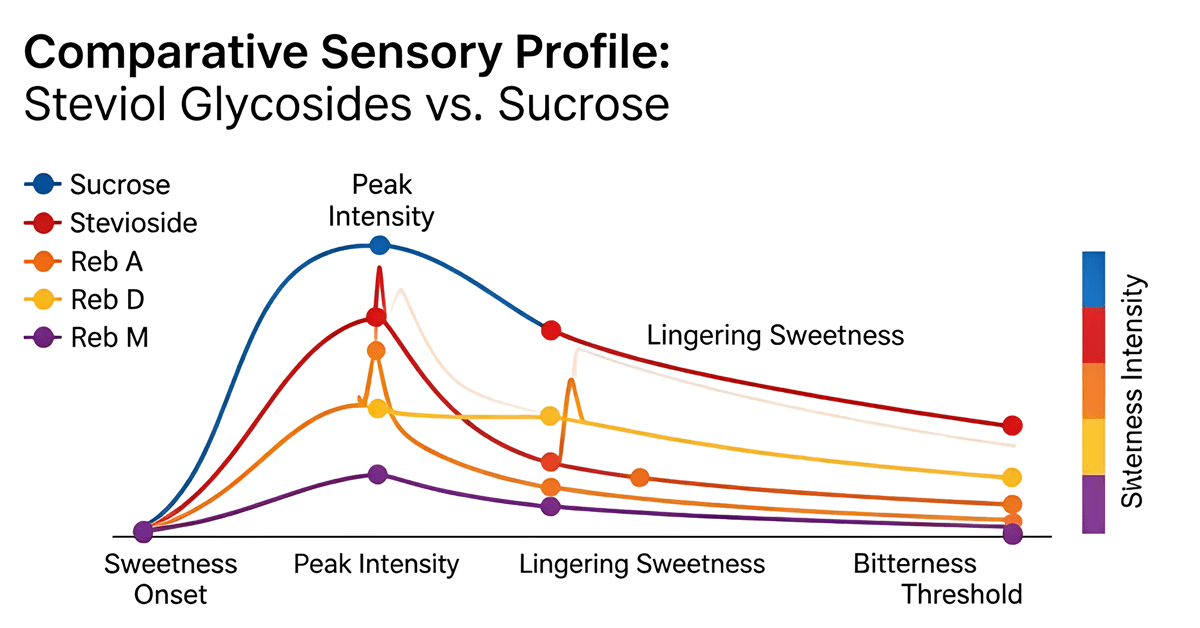
Sucrose provides the sensory reference that most consumers implicitly expect from sweetness.
Its sweetness appears relatively quickly, reaches its peak, and then declines relatively rapidly. This creates a relatively clean sweetness profile with limited lingering compared with many steviol glycosides.
That difference matters because sugar reduction is not simply a question of matching sweetness intensity. A sweetener can deliver similar peak sweetness while producing a noticeably different sensory experience over time.
This is why two sweeteners with similar sweetness ratings can behave very differently in a finished product.
Where the Stevia Taste Curve Diverges
Steviol glycosides do not all follow the same time-intensity profile.
Compared with sucrose, many steviol glycosides can show a slower onset and a longer persistence of sweetness. Depending on the glycoside, bitterness may also become more noticeable during the later part of the taste experience.
This is particularly relevant for stevioside and Reb A, which are more commonly associated with lingering bitterness and aftertaste.
The important point is that the sensory gap is not simply:
“Stevia is sweet but bitter.”
It is a difference in the shape of the sweetness and bitterness curves over time.
A formulation may therefore have the right sweetness intensity at the peak but still feel less natural because the sweetness or bitterness remains after the expected sucrose-like sweetness has already declined.
Why the Curve Varies by Steviol Glycoside
The taste curve is strongly influenced by the specific steviol glycoside composition.
Research comparing Reb A, Reb D, Reb M, and sucrose has shown meaningful differences in sweetness, bitterness, onset, and lingering characteristics.
Reb A tends to produce a more noticeable bitter and lingering profile than Reb D and Reb M. Reb D and Reb M can provide a cleaner sensory experience, although their sweetness can still persist longer than sucrose.
This means that simply specifying “stevia” is not enough when evaluating sensory performance.
Two products with similar stated purity may behave differently if their steviol glycoside profiles are different.
For formulators, component selection is therefore the first lever for managing the taste curve—before changing the blend ratio or adding masking ingredients.
For a deeper comparison, see Steviol Glycoside Components: Why Reb A, Reb D, and Reb M Taste Different.
How Blending Addresses the Curve
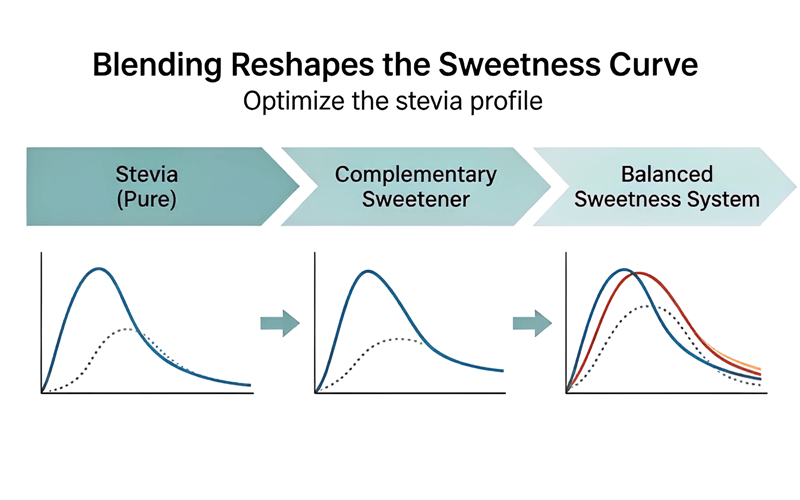
Once the taste curve is understood, blending becomes more than a way to reduce cost or increase sweetness.
It becomes a way to reshape the sensory profile.
A faster-onset sweetener can help fill the early sweetness gap, while another sweetener with a shorter lingering phase can help reduce the long tail.
Depending on the application, formulators may combine steviol glycosides with sweeteners such as erythritol, allulose, xylitol, or other complementary sweetening systems.
The objective is not necessarily to make stevia taste identical to sucrose. Instead, the goal is to create a combined sweetness curve that feels more balanced in the finished product.
The optimal ratio will depend on the steviol glycoside used, target sweetness, product matrix, pH, flavor system, and regulatory requirements.
For practical examples, see Stevia Blending Strategies: How Formulators Balance Taste, Cost, and Shelf Life.
Practical Considerations for Formulators
When qualifying a new stevia source, a single sweetness score is rarely enough.
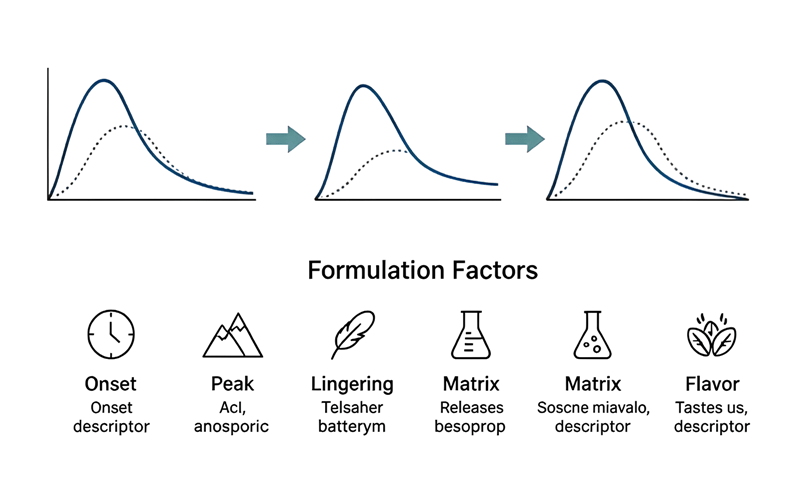
Consider using a time-intensity sensory evaluation that records:
- Sweetness onset
- Time to peak
- sweetness
- Peak sweetness
- intensity
- Sweetness decay
- Lingering sweetness
- Lingering bitterness
This can reveal differences that a conventional “How sweet is it?” test may miss.
The product matrix also matters.
Acidic and fruit-forward systems may help mask certain lingering notes more effectively than relatively neutral matrices such as water-based or dairy applications. Flavor interactions, pH, dosage, and other ingredients can all change the perceived sensory profile.
Most importantly, reassess the taste curve when changing either the steviol glycoside composition or supplier.
A formulation ratio that works well with one Reb A product, for example, should not automatically be transferred to a Reb M or Reb D system.
Common Mistakes
1. Evaluating only peak sweetness
A sample can achieve the desired sweetness intensity but still have an unacceptable lingering profile.
2. Treating all stevia products as equivalent
“Stevia” describes a family of steviol glycosides and preparations, not one uniform sensory profile.
3. Transferring blending ratios between glycosides
A ratio optimized for Reb A may not perform the same way with Reb D or Reb M because their sensory profiles differ.
4. Testing outside the final product matrix
Sweetener performance in water does not necessarily predict performance in a finished beverage, dairy product, gummy, powder, or other formulation.
Key Takeaways
- The stevia taste curve is defined by more than sweetness intensity—it includes onset, peak, decay, and lingering sweetness or bitterness.
- Sucrose provides a useful sensory reference because of its relatively fast and clean sweetness profile.
- Steviol glycoside composition matters. Reb A, Reb D, Reb M, and stevioside can produce noticeably different sensory curves.
- Component selection and blending are two important tools for improving the overall sweetness profile.
- Time-intensity testing can provide more useful formulation information than a single-point sweetness score.
Conclusion
The “stevia aftertaste” problem is better understood as a sensory curve problem.
Instead of asking only, “How sweet is this stevia?”, formulators can ask a more useful set of questions:
How quickly does the sweetness appear? When does it peak? How quickly does it decline? What remains after the sweetness fades?
That shift in perspective makes stevia selection and blending more systematic.
By understanding the specific steviol glycoside profile and how it interacts with the product matrix, formulators can design sweetness systems that deliver a cleaner and more balanced sensory experience.
The next article in this series looks at the practical side of this process: Stevia Blending Strategies: How Formulators Balance Taste, Cost, and Shelf Life.
References
- Tian, X., Zhong, F., & Xia, Y. (2022). Dynamic characteristics of sweetness and bitterness and their correlation with chemical structures for six steviol glycosides. Food Research International, 151, 110848. DOI: 10.1016/j.foodres.2021.110848. PubMed
- Tao, R., & Cho, S. (2020). Consumer-Based Sensory Characterization of Steviol Glycosides (Rebaudioside A, D, and M). Foods, 9(8), 1026. DOI: 10.3390/foods9081026. MDPI — Foods
- Development of Next Generation Stevia Sweetener: Rebaudioside M. PubMed Central
- The Effect of Steviol Glycosides on Sensory Properties and Acceptability of Ice Cream. Foods, 11(12), 1745. MDPI — Foods
I really enjoyed The Stevia Taste Curve: Understanding Onset, Peak,
and Lingering Sweetness – esubio, especially the part about lawyer for dui legal Defense charges.