
Stevia Blending Strategies: How Formulators Balance Taste, Cost, and Shelf Life
In commercial sugar-reduction formulations, stevia is rarely used completely on its own.
Instead, stevia blending strategies combine steviol glycosides with other sweeteners or functional ingredients to address specific formulation challenges — including taste profile, mouthfeel, cost, processing behavior, and formulation stability.
The goal is not simply to make a product sweeter. The goal is to build a sweetening system that performs consistently in the final formulation.
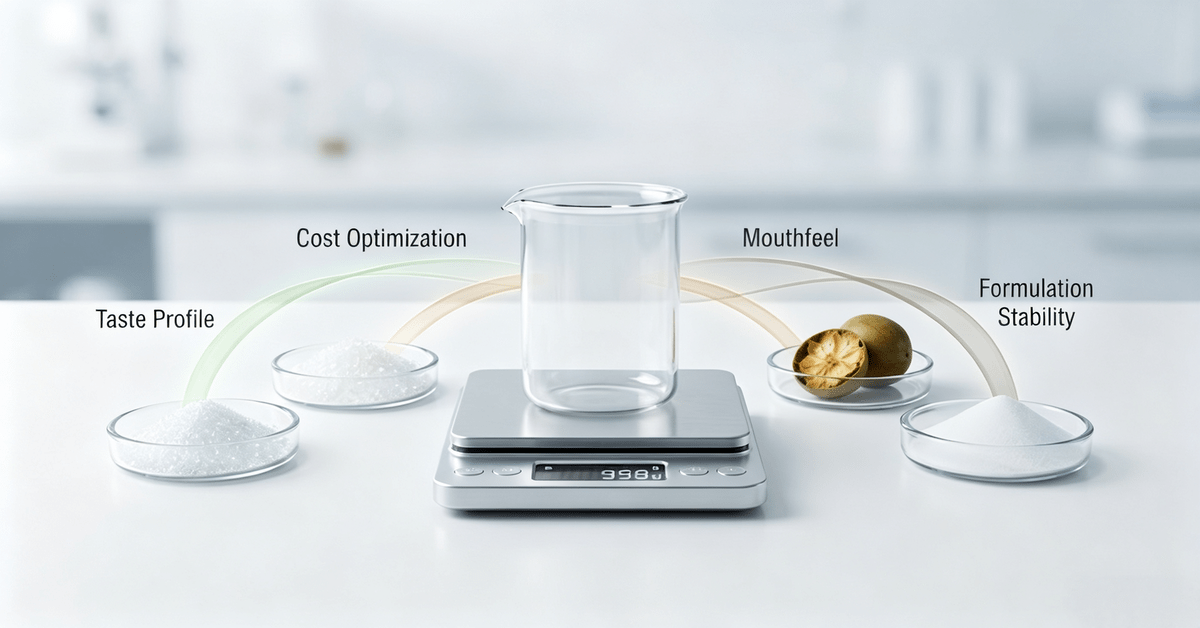
Why Blending Is the Default, Not the Exception
Single-sweetener formulations are relatively uncommon in commercial sugar-reduction products because no single high-intensity sweetener fully reproduces the sensory profile of sucrose.
Sucrose contributes more than sweetness. It affects sweetness onset, sweetness duration, body, mouthfeel, solids, and overall formulation balance.
Steviol glycosides, by contrast, provide intense sweetness at very low use levels and therefore contribute little bulk or body. Some steviol glycoside profiles can also produce bitterness, astringency, or a lingering aftertaste.
These characteristics are well documented in the scientific literature, particularly for stevioside and some Reb A-dominant systems.
This is where stevia blending strategies become useful.
Instead of asking, “What is the best stevia ratio?”, formulators should ask:
What formulation gap are we trying to solve?
The answer may be taste, bulk, mouthfeel, cost, or processing performance.
Stevia and Other High-Intensity Sweeteners
One approach is to combine stevia with another high-intensity sweetener.
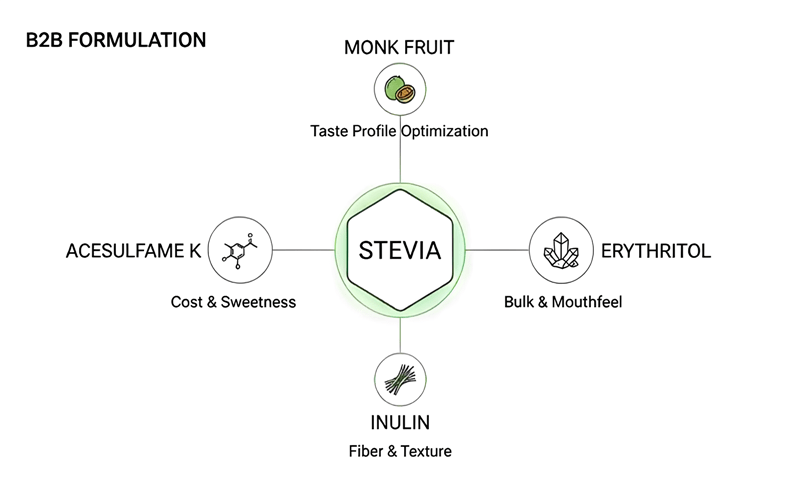
Monk fruit extract containing mogrosides is one example when an all-natural or plant-based positioning is important.
The purpose of this type of blend is primarily sensory.
Different sweeteners can produce different sweetness onset, peak, and lingering characteristics. Combining them can help create a more balanced sweetness profile and reduce the sensory impact of individual components.
Steviol glycoside composition itself also matters. Reb A, Reb D, and Reb M do not have identical sensory profiles, and recent research has shown that blending different rebaudiosides can reduce perceived bitterness and improve consumer acceptance in food applications.
This means that “stevia” should not always be treated as a single sensory ingredient.
A formulation using a high-Reb A stevia may require a different approach from one based on a higher-purity Reb M or a mixed steviol glycoside profile.
Stevia and Functional Bulking Sweeteners
A different formulation challenge appears when stevia is combined with a bulk sweetener such as erythritol.
Stevia provides very high sweetness intensity but contributes essentially no bulk at typical use levels. Erythritol can therefore provide solids and a different mouthfeel while allowing stevia to provide the primary sweetness intensity.
This approach is particularly relevant to:
- Powdered drink mixes
- Tabletop sweeteners
- Nutrition powders
- Reduced-sugar confectionery
- Dairy and frozen dessert applications
- Some bakery formulations
The important point is that erythritol should not simply be treated as a “stevia taste masker.”
The two ingredients perform different formulation functions.
Stevia supplies high-intensity sweetness, while erythritol contributes bulk, solids, cooling sensation, and mouthfeel.
Sensory research has also evaluated formulations combining steviol glycosides with erythritol and other sweeteners, showing that the interaction between sweetener type and final food matrix can materially affect sensory perception.
For this reason, a ratio that performs well in a beverage may not transfer directly to a powder, confectionery system, or dairy application.
Stevia with Functional Fiber
Stevia can also be paired with functional fibers such as inulin.
This strategy addresses a different set of formulation requirements.
Inulin and similar fibers can contribute solids, body, and mouthfeel while supporting a formulation positioned around fiber content or prebiotic functionality.
This can be useful when the product needs to achieve more than sweetness reduction.
For example, a powdered nutrition product may need:
- Reduced sugar
- Added fiber
- Improved mouthfeel
- Better powder handling
- A clean-label positioning
In such cases, stevia and fiber can be designed as complementary components rather than simply as two sweeteners competing for the same function.
Research has also investigated the use of inulin and other carriers in steviol glycoside systems to improve sensory characteristics, including reduction of undesirable aftertaste.
Stevia with Other Approved Intense Sweeteners
Where an all-natural positioning is not required, stevia may also be combined with other approved high-intensity sweeteners such as sucralose or acesulfame potassium.
The primary advantages can include sensory optimization and cost control.
Different high-intensity sweeteners have different sweetness curves and sensory characteristics. Combining them can allow formulators to reduce reliance on a single sweetener while targeting a more familiar sweetness profile.
Cost can also become an important consideration.
A formulation should therefore be evaluated not only by the price per kilogram of each ingredient, but by the cost per unit of sweetness delivered in the finished product.
This distinction becomes increasingly important at commercial production volumes.
Research on mixed systems containing sucralose, steviol glycosides, and erythritol has demonstrated that certain combinations can achieve sensory characteristics closer to sucrose than individual sweeteners used alone.
How Blending Can Affect Formulation Stability
Taste is only one part of the equation.
A stevia blend also needs to remain appropriate for the product’s processing and storage conditions.
Steviol glycosides are generally considered reasonably stable under normal food-processing conditions, but their stability can depend on factors such as pH, temperature, exposure time, and formulation environment. FDA documentation summarizing available stability data notes that steviol glycoside stability is influenced by both temperature and pH.
This matters when moving a sweetener blend from a laboratory prototype to commercial production.
A blend optimized in a dry powder may behave differently after dissolution.
Likewise, a blend developed for a neutral-pH beverage may require additional validation in an acidic beverage or heat-processed application.
Therefore, shelf-life validation should consider the complete formulation rather than evaluating stevia in isolation.
Practical Considerations for Stevia Blending
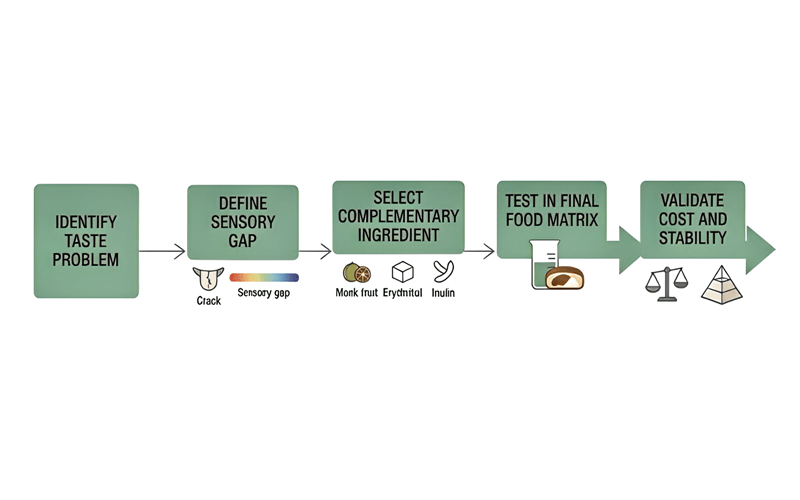
A more reliable development process starts with the formulation problem rather than a predefined ratio.
1. Identify the sensory gap
Is the problem:
- Delayed sweetness?
- Excessive lingering sweetness?
- Bitterness?
- Astringency?
- Lack of body?
- Cooling sensation?
- Insufficient sweetness intensity?
The answer determines which blending direction makes sense.
For a deeper look at sweetness timing, see The Stevia Taste Curve: Understanding Onset, Peak, and Lingering Sweetness.
2. Define the product positioning
An all-natural formulation will have different sweetener options from a cost-driven mainstream food product.
Before sensory testing, establish whether the formulation needs to meet requirements such as:
- Natural positioning
- Sugar-free or reduced-sugar positioning
- Clean-label requirements
- Added-fiber claims
- Specific regulatory requirements
3. Evaluate cost on a sweetness basis
Ingredient price alone can be misleading.
The relevant commercial question is not:
“Which sweetener has the lowest price per kilogram?”
It is:
“What is the cost of achieving the required sweetness level in the finished product?”
This is particularly important when comparing different steviol glycoside grades or blends containing Reb A, Reb D, or Reb M.
4. Revalidate when changing grades or suppliers
A stevia ratio should not automatically be transferred from one supplier to another.
Two products sold under the same general name may have materially different steviol glycoside compositions, purity levels, or sensory profiles.
This is particularly relevant when moving between Reb A-dominant products and higher-purity minor glycoside products.
Common Mistakes
Copying a published ratio without testing the final formulation
A blend ratio that performs well in a beverage, dairy product, or confectionery system may not perform the same way in your formulation.
The surrounding ingredients matter.
Acidity, flavor system, minerals, proteins, fibers, hydrocolloids, and other sweeteners can all influence the final sensory result.
Optimizing taste without considering cost
A sensory improvement may come from increasing the proportion of a more expensive sweetener.
That may be acceptable at laboratory scale but commercially unattractive at production scale.
Evaluate both sensory performance and cost per unit of sweetness before selecting the final ratio.
Treating “stevia” as one standardized ingredient
Stevia products can differ significantly in steviol glycoside composition.
The sensory profile of a Reb A-focused product should not automatically be assumed to match a Reb M-rich or mixed-glycoside product.
Ignoring the final food matrix
Sweetener performance should be tested in the actual application whenever possible.
A blend that tastes excellent in water is not necessarily the best solution for a protein powder, acidic beverage, gummy, dairy product, or baked application.
Key Takeaways
- Stevia blending strategies are a formulation tool, not a workaround for a poor ingredient.
- Different blend partners address different gaps: taste profile, bulk, mouthfeel, functionality, or cost.
- Reb A, Reb D, Reb M, and other steviol glycoside profiles can behave differently in sensory testing.
- Erythritol and functional fibers can provide bulk and mouthfeel that high-intensity stevia cannot provide alone.
- Blend ratios should be evaluated in the actual food matrix rather than copied from a generic reference.
- Supplier or grade changes should trigger sensory and formulation revalidation.
- Shelf-life and processing stability should be evaluated at the finished-product level, especially when pH and heat exposure are significant variables.
Conclusion
The most effective stevia blending strategies start with a clear formulation objective.
If the problem is aftertaste, the solution may involve a different steviol glycoside profile or another complementary sweetener. If the problem is mouthfeel, a bulk sweetener or functional fiber may be more appropriate. If cost is the primary constraint, the formulation should be optimized around cost per delivered sweetness rather than ingredient price alone.
In other words, there is no universal “best” stevia ratio.
The right blend is the one that fits the taste profile, product matrix, regulatory positioning, processing conditions, and commercial cost target of the finished product.
For applications involving heat processing specifically, blending decisions also intersect with additional processing considerations, covered in Formulating Stevia for Bakery and High-Heat Applications.
References
- Moazzem et al. (2025), International Journal of Gastronomy and Food Science
Taste profiles of steviol glycoside blends and their application in ice cream
ScienceDirect – Taste profiles of steviol glycoside blends - Stevia Glycosides: Chemical and Enzymatic Modifications of Their Carbohydrate Moieties to Improve the Sweet-Tasting Quality
ScienceDirect – Stevia Glycosides and Sweet-Tasting Quality - Properties, extraction and purification technologies of Stevia rebaudiana steviol glycosides: A review
ScienceDirect – Steviol Glycosides Review - Ice cream with sucralose, stevioside, and erythritol as sugar substitutes
PubMed – Ice Cream with Sucralose, Stevioside and Erythritol - FDA GRAS Notice 745 – Steviol Glycosides Primarily Rebaudioside M
FDA – GRAS Notice 745