
Glucosylated Steviol Glycosides: What Formulators Need to Know About GSG
Glucosylated steviol glycosides (GSG), sometimes referred to as enzyme-modified stevia, are often discussed alongside standard steviol glycosides. However, they are not simply another form of stevia extract.
GSG is produced through an additional enzymatic modification step, which can change its sensory profile, technical characteristics, and regulatory status.
For formulators, understanding these differences is important before selecting GSG for a new product.
How GSG Is Produced
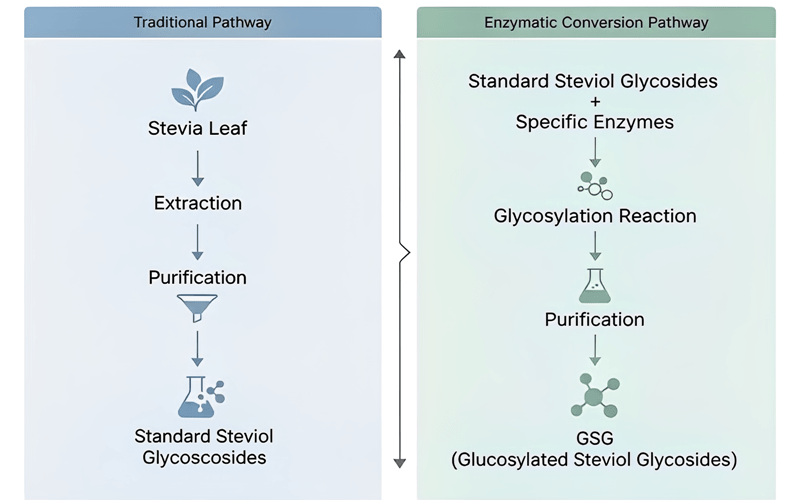
Standard steviol glycosides are extracted and purified from the stevia plant.
Glucosylated steviol glycosides start with steviol glycosides and undergo an additional enzymatic transglucosylation process, in which glucose units are transferred onto the steviol glycoside structure.
This modification can change the sweetness curve and sensory profile.
Depending on the specific GSG and application, formulators may experience a smoother sweetness profile, reduced lingering notes, or improved overall taste balance compared with certain conventional steviol glycoside systems.
However, these effects should be confirmed through application-specific sensory testing rather than assumed for every GSG product.
Why the Regulatory Status Matters
GSG should not automatically be treated as equivalent to standard steviol glycosides for regulatory purposes.
The regulatory status, permitted uses, specifications, and labeling requirements can vary by market and by the specific GSG preparation.
For example, the U.S. FDA has published GRAS notices covering specific glucosylated steviol glycoside preparations, with their intended uses and specifications defined in the individual notices.
This means formulators should evaluate the specific ingredient and target market, rather than relying only on the general term “GSG” or “enzyme-modified stevia.”
GSG as a Sweetness and Taste-Modulation Tool
One reason formulators consider GSG is its potential to influence the overall sweetness experience rather than simply increase sweetness intensity.
Depending on the application, GSG may be used as part of a broader sweetening system to help improve sweetness quality, reduce undesirable aftertaste, or balance the sensory profile of a formulation.
Importantly, GSG should not automatically be described as a “natural flavor” or assumed to have the same labeling treatment in every market.
Whether a specific GSG preparation is used or declared as a sweetener, flavor modifier, or under another permitted category depends on the applicable regulatory framework and the specific product.
Where GSG Fits in a Stevia Formulation Strategy
GSG is not necessarily a replacement for individual steviol glycosides such as Reb A, Reb D, or Reb M.
Instead, it can be viewed as another formulation tool.
A formulator may evaluate GSG alongside conventional steviol glycosides or other sweeteners depending on:
- sweetness intensity
- sweetness onset and decay
- bitterness and lingering notes
- target cost
- application format
- regulatory requirements
This makes GSG particularly relevant when the formulation challenge is not simply “How much sweetness do we need?”, but rather “How do we achieve a better overall sweetness experience?”

Practical Considerations
Before selecting a GSG ingredient, formulators should confirm:
1. Production process
Understand how the GSG was produced and what enzymatic modification was used.
2. Product specification
Review purity, steviol glycoside composition, carrier materials, and other relevant specifications.
3. Regulatory status
Check the status and permitted use of the specific GSG preparation in the target market.
4. Sensory performance
Evaluate sweetness profile, aftertaste, onset, and compatibility with the complete formulation.
5. Labeling requirements
Confirm the appropriate ingredient declaration with the relevant regulatory requirements before commercialization.
Common Mistakes
Mistake 1: Treating GSG as identical to standard steviol glycosides.
The production process and resulting ingredient characteristics are different.
Mistake 2: Assuming every GSG has the same sensory performance.
Different products and formulations can behave differently.
Mistake 3: Assuming “enzyme-modified” automatically means better.
GSG may solve certain taste challenges, but application-specific testing is still necessary.
Mistake 4: Assuming the same regulatory treatment worldwide.
Regulatory status and labeling requirements need to be checked market by market.
Key Takeaways
- GSG is produced through enzymatic modification of steviol glycosides rather than direct extraction alone.
- The modification can change the sweetness curve and sensory profile.
- GSG should not automatically be treated as regulatory-equivalent to standard steviol glycosides.
- Its permitted use and labeling depend on the specific product and target market.
- Sensory testing remains essential when evaluating GSG in a finished formulation.
Conclusion
Glucosylated steviol glycosides give formulators another tool for managing sweetness quality and taste balance.
But GSG is not simply “better stevia,” nor is it automatically interchangeable with standard steviol glycosides.
The better approach is to evaluate process, specification, regulatory status, and sensory performance together.
For formulators working with stevia systems, the next question is often how to combine different steviol glycosides and complementary sweeteners to balance taste, cost, and formulation performance.
References
U.S. Food and Drug Administration (FDA), GRAS Notice No. 662 — Glucosylated Steviol Glycosides (minimum purity 95%).