
Raw Material Stability: Why a Passing Sample Is Not Enough for Shelf Life
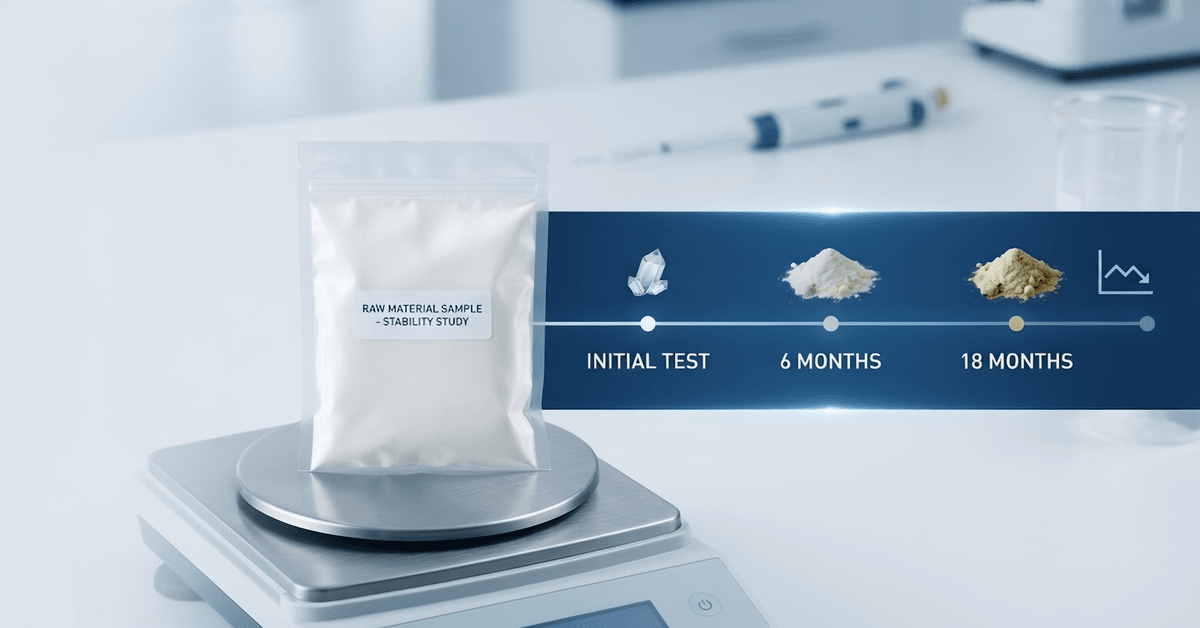
A sample that passes testing today does not automatically mean the same ingredient will perform well throughout an 18-month shelf life.
This is one of the easiest things to overlook during raw material qualification. A sample arrives, the COA looks good, the specification is met, the formulation works, and the project moves forward.
But a laboratory result is only a snapshot in time.
Raw material stability is a longer-term question. Temperature, humidity, light, oxygen, moisture exchange, processing conditions and packaging can all affect how an ingredient performs over time.
For supplement manufacturers, the real question is not simply:
“Does this sample meet specification?”
It is:
“How likely is this material to remain suitable under the conditions in which it will actually be stored, processed and used?”
Why Raw Material Stability Matters After the Initial Test
Consider a typical development process.
A manufacturer receives a botanical extract or probiotic ingredient. The initial sample meets the specification. The formulation performs as expected, and the finished product moves toward commercialization.
Several months later, stability samples are tested.
The active marker has declined. The powder has changed color. The material has started to cake. Moisture has increased. Or, in the case of sensitive biological ingredients, potency has decreased.
The problem may not have been the original sample.
The problem may have been time.
Stability is a dynamic process. An ingredient can meet every specification at the time of release while still being sensitive to environmental conditions during storage.
This is why raw material stability should be considered before commercial production, not only after a finished product shows a stability issue.
7 Practical Checks for Raw Material Stability
1. Look Beyond the Initial COA
A COA tells you whether a particular batch met defined specifications when it was tested.
It does not, by itself, tell you how the material will behave over an extended storage period.
When evaluating a new ingredient, look beyond assay and microbiological results. Depending on the ingredient, useful information may include moisture, water activity, particle characteristics, physical appearance, active-marker stability, recommended storage conditions and packaging requirements.
The objective is not to collect unnecessary data.
It is to identify the quality attributes most likely to change during storage.
2. Ask About Water Activity, Not Just Moisture
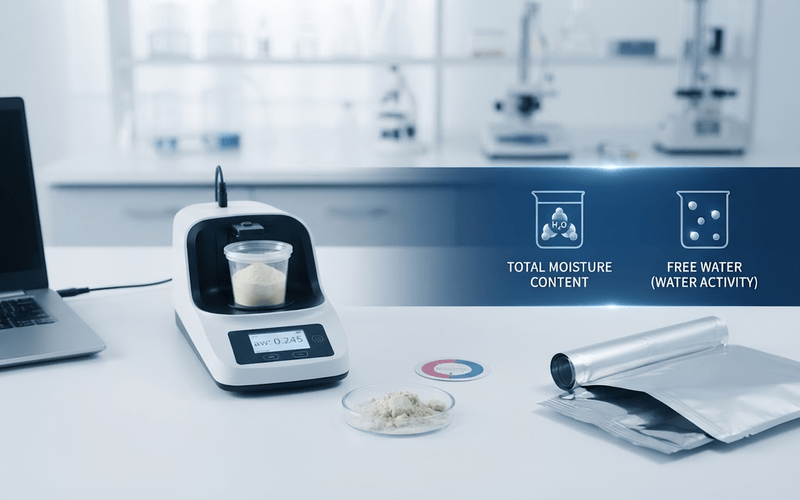
Moisture content and water activity are related, but they are not the same measurement.
Water activity, or aw, describes the availability of water within a material rather than simply the total amount of water present. USP General Chapter <922> explains that some water may be tightly bound, while other water is more available for chemical, biochemical or microbiological processes.
This distinction can matter for hygroscopic powders, probiotics, botanical extracts and other moisture-sensitive ingredients.
A material may have an acceptable moisture result while still requiring careful control of its water activity and exposure to ambient humidity.
For certain products, asking for water activity data can therefore provide useful information that moisture percentage alone cannot.
3. Understand the Recommended Storage Conditions
“Store in a cool, dry place” is often not enough information for a meaningful stability assessment.
Ask for the actual recommended storage conditions whenever available.
Temperature, humidity and light exposure can affect ingredient quality over time. FDA guidance for dietary supplement operations also emphasizes holding components under appropriate temperature, humidity and light conditions to prevent deterioration.
For moisture-sensitive ingredients, the difference between controlled storage and repeated exposure to humid air can become significant.
Storage conditions should therefore be treated as part of the raw material specification, not as an afterthought.
4. Evaluate the Packaging as Part of the Ingredient
The ingredient itself is only one part of the stability equation.
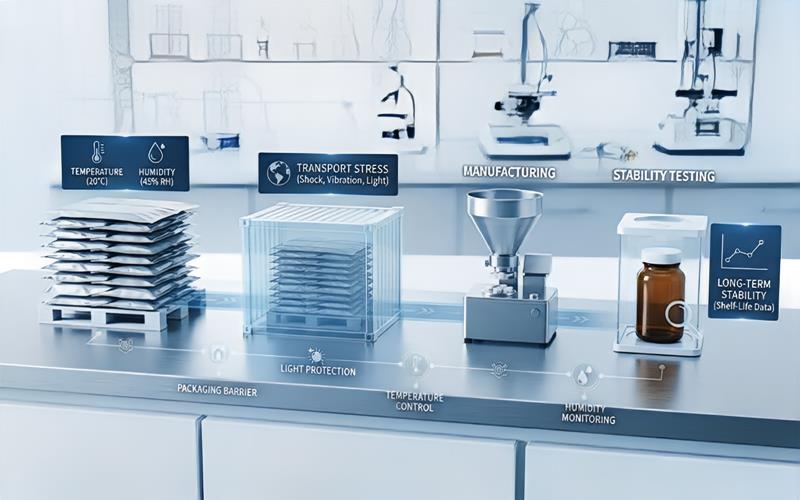
Packaging determines how much protection the material has against moisture, oxygen and light during transportation and storage.
For example, a moisture-sensitive powder may require a more protective inner liner or sealed barrier packaging than a relatively stable dry ingredient.
This is particularly relevant when material is shipped internationally and may experience changes in temperature and humidity during transportation.
The right question is not simply:
“What packaging do you use?”
It is:
“Is the packaging appropriate for the ingredient’s known stability risks?”
5. Identify Ingredients That Need More Attention
Not every ingredient requires the same level of stability assessment.
Some categories deserve closer attention because their quality can be more sensitive to environmental conditions.
Examples include:
- Probiotics and other biological ingredients
- Hygroscopic amino acids and powders
- Botanical extracts with defined active markers
- Ingredients sensitive to oxidation or light
- Materials with relatively high moisture sensitivity
- Ingredients whose physical properties affect processing or dosing
For biological products in particular, environmental factors can have a significant impact on biological activity. FDA’s stability guidance for biological products notes sensitivity to factors such as temperature, oxidation, light and other environmental stresses.
The appropriate evaluation therefore depends on the ingredient rather than following one checklist for every raw material.
6. Consider Stability Under Real Storage Conditions
Stability data becomes much more useful when it reflects the conditions the material is actually expected to experience.
Formal stability programs commonly evaluate how quality changes over time under defined environmental conditions. ICH Q1A, for example, addresses the role of temperature, humidity, packaging and storage conditions in stability evaluation.
The same principle is useful when qualifying nutritional ingredients:
What happens to this material under realistic storage conditions?
A supplier may not have a complete stability study for every ingredient and every application. That does not automatically make the material unsuitable.
But the absence of useful stability information should be recognized as a risk rather than ignored.
7. Connect Raw Material Stability to the Finished Product
One important boundary needs to be clear:
Raw material stability data does not replace finished-product stability testing.
Once an ingredient enters a formulation, its stability can be affected by other ingredients, processing conditions, water activity, pH, packaging, oxygen exposure and the final dosage form.
The final product therefore needs its own stability assessment.
However, better raw material information can make that assessment more efficient.
If you already know that an ingredient is moisture-sensitive, for example, you can consider packaging, manufacturing controls and storage conditions accordingly instead of discovering the issue months later.
A Better Question for Ingredient Qualification
Instead of asking only:
“Does the sample pass?”
A stronger qualification process asks:
- What are the critical quality attributes?
- Which attributes are likely to change during storage?
- Is the ingredient moisture-sensitive?
- What is the water activity?
- What storage conditions are recommended?
- What packaging is used?
- Is there relevant stability information?
- Are there known sensitivities to heat, humidity, oxygen or light?
- How might processing affect the ingredient?
- What additional controls should be considered in the finished product?
These questions do not guarantee a successful shelf life.
They help identify risks earlier.
What a Responsible Ingredient Supplier Should Provide
A supplier cannot guarantee the shelf life of your finished product because the final formulation, packaging and manufacturing process are outside the supplier’s control.
But a good supplier should make the available raw material information clear enough for your technical and quality teams to make informed decisions.
At Esubio, we provide COA, MSDS and product specification documents with shipments and can discuss application-related parameters such as recommended storage conditions, moisture sensitivity and water activity where relevant.
Our ingredient portfolio includes probiotics, botanical extracts, amino acids and functional ingredients used in areas such as Longevity & Cellular Health.
The goal is not to promise that every ingredient will remain unchanged for 18 months.
The goal is simpler:
Give R&D and QA teams better information before the stability risk becomes a finished-product problem.
A passing sample tells you where the ingredient stands today.
Raw material stability helps you think about where it may be tomorrow.
References
FDA / ICH Q1A(R2) Stability Testing