
Amino Acid Quality: 7 Powerful Checks Beyond 99% Purity
Amino Acid Quality is often reduced to one number: 99%, 99.5%, or 98%.
For procurement teams, purity is an important starting point. It tells you something about the amount of the intended substance relative to specified impurities or other components.
But it does not tell you everything you need to know about how an amino acid will behave in a real formulation.
Two amino acid powders can both meet a high-purity specification and still have differences in particle size, solubility, bulk density, physical form, odor, or manufacturing route.
Those differences may not be obvious when reviewing a basic specification sheet.
They can become much more obvious during formulation, processing, or scale-up.
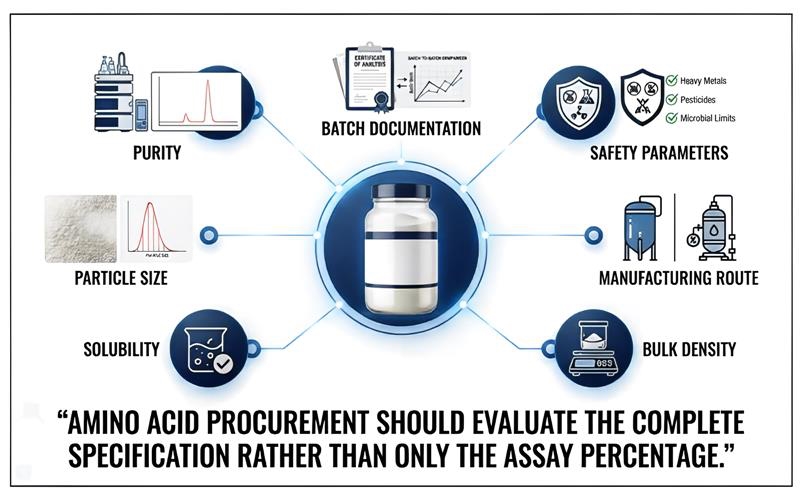
That is why Amino Acid Quality should be evaluated as a complete specification rather than a single purity number.
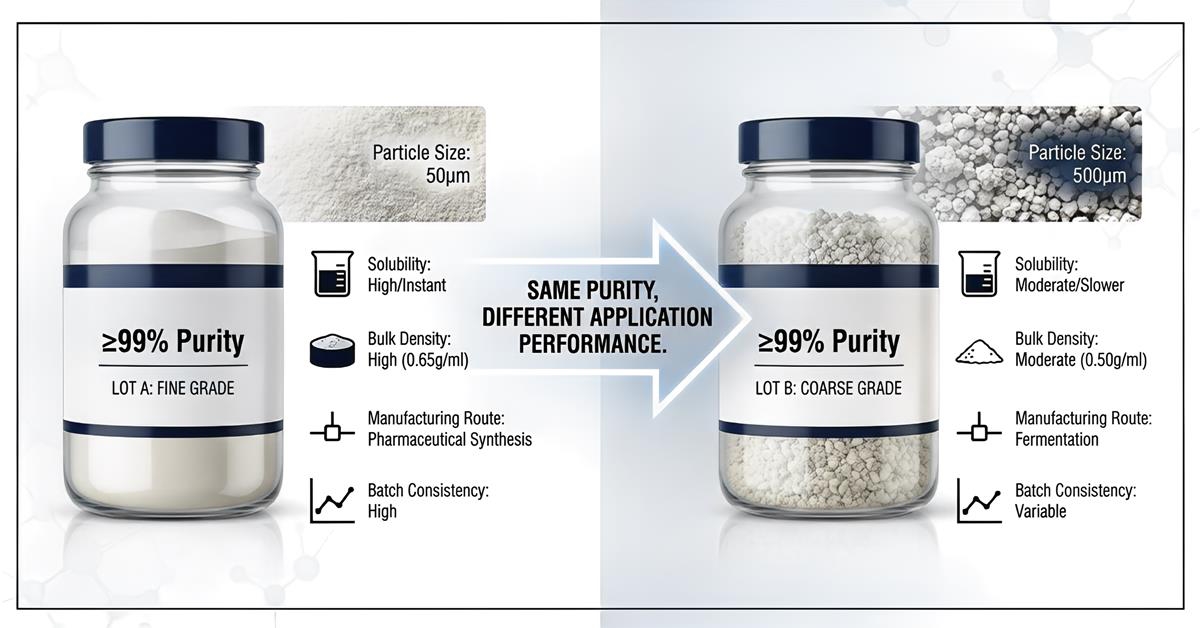
Why 99% Purity Does Not Tell the Whole Story
Purity answers an important question:
How much of the intended material is present?
But formulators often need answers to other questions:
Can the powder dissolve at the required concentration?
Will it flow consistently through the production process?
Will it behave properly during blending?
Does its particle size match the process?
Will bulk density affect filling or blending?
Is the manufacturing process appropriate for the intended application?
Can the supplier reproduce the same characteristics from batch to batch?
These are different questions.
For example, published technical data for L-arginine can include not only chemical identity and composition, but also water solubility, bulk density, and particle-size distribution. One EFSA assessment of fermented L-arginine reported these physical characteristics across batches, illustrating why physical properties can be relevant to evaluating an ingredient beyond its chemical assay. (efsa.europa.eu)
The practical lesson is simple:
High purity does not automatically mean high application suitability.
1. Start With Purity, But Don’t Stop There
Purity should still be one of the first checks when evaluating an amino acid.
A specification may include assay, related substances, moisture, residue on ignition, or other quality parameters depending on the ingredient and applicable standard.
But the right question is not:
“Is it 99%?”
It is:
“What does the complete specification tell me about this 99% material?”
A high assay with incomplete physical or application-related information may leave important questions unanswered.
For a formulation team, a material that meets chemical purity requirements but performs poorly during processing may create more cost than a slightly higher-priced material with better process compatibility.
This is why procurement and R&D should evaluate purity together with the characteristics that actually matter for the finished application.
2. Check Particle Size or Mesh Size
Particle size is one of the most practical parameters to consider for amino acid powders.
A specification such as 60 mesh, 80 mesh, or a defined particle-size distribution can provide information about the physical form of the material.
However, “mesh” and particle size are not always interchangeable in a simple way.
Mesh describes whether particles pass through a particular sieve, while particle-size distribution can provide a more detailed picture of the powder population.
Depending on the application, buyers may therefore need either a mesh specification, a particle-size distribution, or both.
Why does this matter?
Because particle size can affect powder handling, dissolution behavior, blending, dust generation, and other processing characteristics.
A powder that works well in a laboratory beaker may behave differently when hundreds of kilograms are blended or processed.
For this reason, particle size should be discussed in relation to the actual manufacturing process rather than treated as an isolated number.
3. Evaluate Solubility for the Actual Application
Solubility can be critical when an amino acid is intended for beverages, liquid formulations, or other applications where the ingredient must dissolve efficiently.
But “soluble in water” is not always enough information.
The practical result can depend on concentration, temperature, pH, formulation composition, and the physical characteristics of the ingredient.
For example, an ingredient may dissolve easily at a low concentration in laboratory water but behave differently when used at a higher dosage or in a more complex beverage system.
This is why the procurement specification should reflect the actual application whenever possible.
Instead of simply asking:
“Is it soluble?”
ask:
“At what concentration, temperature, and formulation conditions does it need to dissolve?”
That gives the supplier a much more useful technical target.
4. Look at Bulk Density and Powder Handling
Bulk density is another parameter that can be overlooked when buyers focus heavily on purity.
It describes the mass of powder occupying a given bulk volume and can affect how a powder behaves during handling, storage, filling, blending, and transportation.
Two powders with the same chemical assay can occupy different volumes and behave differently in a production environment.
This can matter particularly for:
- Tablet and capsule manufacturing
- Powder blends
- Sachets
- Dry beverage mixes
- Premixes
- Large-scale blending
Research on powder processing also shows that bulk properties such as bulk density and particle-size characteristics can be relevant to powder flow and segregation behavior. (usp.org)
Not every amino acid needs a strict bulk-density specification.
But when powder handling is important to the application, it is worth discussing.
5. Understand the Manufacturing Route
The same amino acid can potentially be produced through different manufacturing routes depending on the specific substance and supplier.
Fermentation is commonly used for the production of certain amino acids, while other materials may be manufactured through chemical synthesis or other processes.
FDA’s Q7 GMP guidance specifically recognizes amino acids among low-molecular-weight products that can be produced through fermentation and describes the importance of process controls, purification, contamination control, and defined specifications for materials produced through such processes. (fda.gov)
This does not mean one manufacturing route is automatically better.
The relevant question is whether the manufacturing route, purification process, and resulting quality characteristics are appropriate for the intended use.
For procurement teams, understanding the manufacturing route can also help clarify questions about documentation, traceability, impurities, and supplier qualification.
6. Check Whether the Specification Matches the Application
This is where procurement can move beyond commodity purchasing.
Imagine two amino acid suppliers.
Both offer:
Assay: ≥99%
At first glance, they appear equivalent.
But Supplier A provides a particle-size range, solubility information, manufacturing-route information, complete CoA, and consistent batch documentation.
Supplier B provides only assay, appearance, and a basic identification test.
The price difference may be small.
But the amount of technical uncertainty is not.
For a simple application, Supplier B may still be perfectly suitable.
For a demanding formulation, however, the additional information from Supplier A may be much more valuable.
The point is not to request every possible specification for every amino acid.
It is to identify which parameters actually influence your formulation and production process.
A good specification is application-driven.
7. Compare the Approved Sample With the Commercial Batch
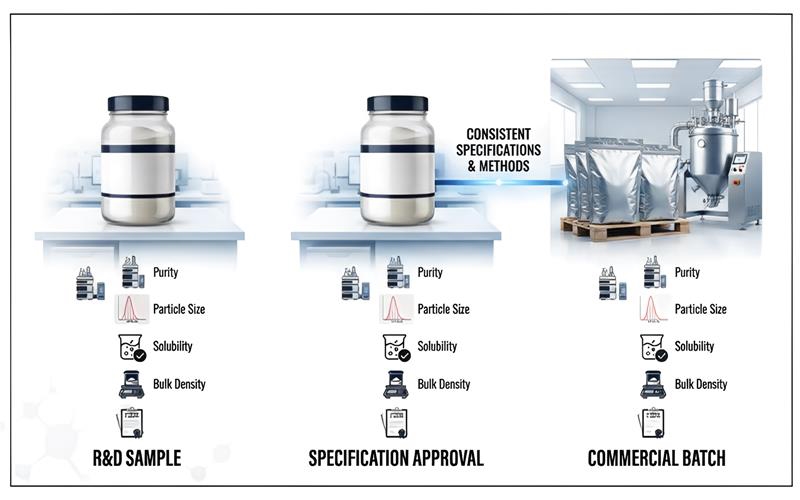
A sample can pass laboratory testing and still leave questions about commercial consistency.
This happens when the sample is evaluated against one set of expectations while the commercial purchase is controlled against another.
For example, R&D may approve a sample because it dissolves quickly and has a suitable powder appearance.
But the purchase specification may only state:
Assay ≥99%.
If the next commercial batch also meets ≥99% but has a different particle-size profile or bulk density, the material may behave differently during production.
This is why sample approval and commercial specifications should be connected.
Where physical characteristics are important, the agreed specification should define the relevant parameters and acceptance criteria before commercial supply begins.
The goal is not to guarantee that every batch will look exactly identical.
The goal is to establish measurable characteristics that help control meaningful variation.
A Better Amino Acid Specification
A useful amino acid specification should answer the questions that matter to the application.
Depending on the ingredient and intended use, it may include:
Identity and Assay
What is the material and what is the required assay?
Physical Characteristics
What are the appearance, particle size or mesh, and other relevant physical properties?
Solubility
What level of solubility is required under the intended application conditions?
Bulk Density
Is bulk density relevant to blending, filling, or processing?
Manufacturing Route
Is the material fermented, chemically synthesized, or produced through another route?
Safety and Purity Parameters
Which impurities, microbiological parameters, elemental impurities, or other safety-related characteristics need to be controlled?
Batch Documentation
Can the supplier provide a CoA and supporting specification for each commercial batch?
The exact specification should be based on the amino acid and its intended use.
More parameters do not automatically mean a better specification.
The right parameters do.
From “99% Pure” to Application-Ready Sourcing
For procurement, a high-purity amino acid can be an excellent starting point.
But purity is only one part of the purchasing decision.
If the ingredient will be used in a tablet, capsule, powder blend, sports nutrition product, or beverage, its physical properties can become just as relevant as its chemical assay.
This is why Amino Acid Quality should be evaluated through the complete specification:
Purity → Particle Size → Solubility → Bulk Density → Manufacturing Route → Safety Parameters → Batch Consistency
At Esubio, our Amino Acids sourcing focuses on functional ingredient applications including sports nutrition and recovery-oriented formulations.
Depending on the product and supplier, documentation may include CoA, SDS/MSDS, product specifications, and other available supporting information.
For application-specific requirements, we can discuss parameters such as particle size, mesh, solubility, and other relevant physical characteristics with the supplier before commercial sourcing.
The objective is not simply to find an amino acid that passes a purity test.
It is to find a material that fits the formulation, manufacturing process, documentation requirements, and commercial supply expectations.
The Bottom Line
When comparing amino acid suppliers, “≥99%” is useful information.
It just should not be the only information.
A complete sourcing decision may need to consider:
What is the purity?
What is the particle size?
How does it dissolve under the intended conditions?
What is the bulk density?
How is it manufactured?
Which safety and impurity parameters are controlled?
Can the supplier maintain these characteristics across commercial batches?
The more closely the specification reflects the actual formulation and production process, the fewer surprises are likely to appear during scale-up.
For amino acid procurement, the goal is not simply to buy a high-purity powder.
It is to buy the right specification for the way that powder will actually be used.
References
https://www.fda.gov/regulatory-information/search-fda-guidance-documents/q7a-good-manufacturing-practice-guidance-active-pharmaceutical-ingredientsFDA — Q7A Good Manufacturing Practice Guidance for Active Pharmaceutical Ingredients
https://pmc.ncbi.nlm.nih.gov/articles/PMC7009432/https://cmkc.usp.org/a/cmkc-resources/RE1221/novel-methodology-to-assess-segregation-risk-in-a-continuous-direct-compression-via-mini-batch-blending-process