
NMN Ingredient Sourcing: 7 Smart Checks Before You Compare Prices
NMN ingredient sourcing is often approached as a price comparison exercise. A buyer requests several quotations, compares the price per kilogram, checks the stated purity, and then moves to the next step.
For established commodities, this approach may sometimes be practical. For newer ingredients such as NMN and NAD+, however, price alone gives very little information about whether two materials are actually comparable.
The more important questions are: What exactly is being supplied? How is the stated purity measured? Which impurities are controlled? What stability data are available? Can the batch be traced back to its source? And does the supplier have the documentation needed for quality review?
These questions matter because analytical methods, specifications, production processes, storage conditions and documentation can differ between suppliers. Published analytical research on NMN, for example, has used HPLC-based methods to separate NMN from related substances and degradation products, while other recent work has highlighted the importance of distinguishing NMN isomers during analysis.
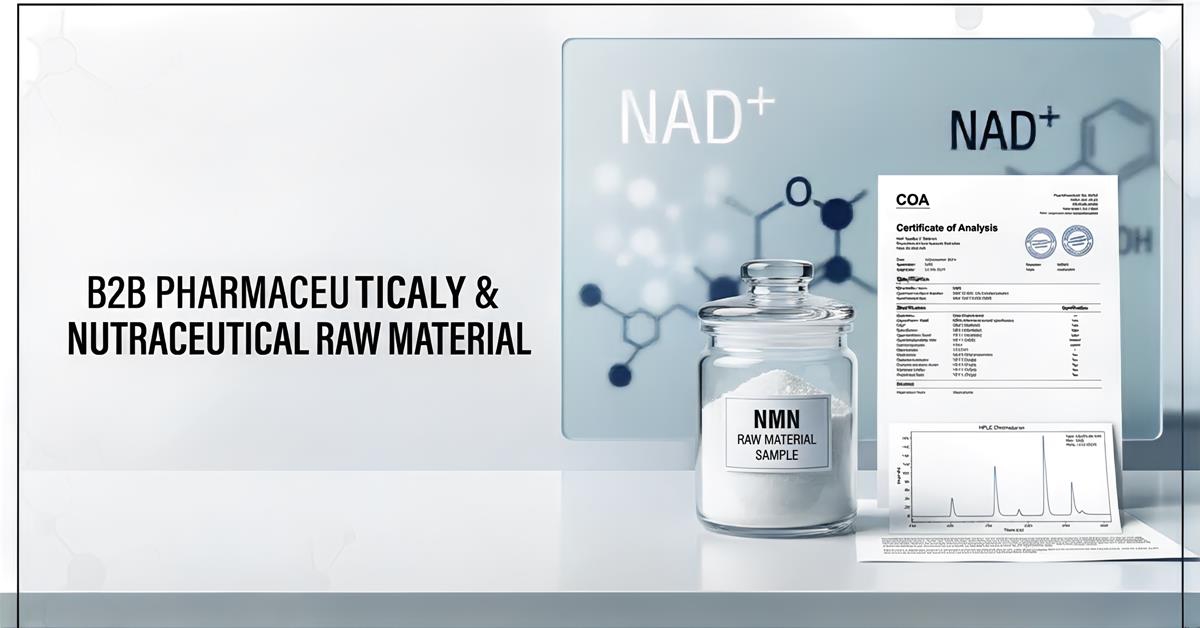
For procurement teams evaluating NMN or NAD+ raw materials, the following seven checks can make supplier comparisons much more meaningful.
1. Start with the exact material, not just the product name
“NMN” is a product name, not a complete purchasing specification.
Before requesting a price, define the material as precisely as possible. This may include the chemical name, CAS number, molecular form, physical form, assay requirement, intended application and applicable market requirements.
For NMN, the distinction between different forms or isomers may also be relevant to analytical control. A recent LC-MS/MS study reported substantial variation in isomer composition among commercial NMN supplements, illustrating why identity and analytical specificity should not be treated as secondary details.
For NAD+, the same principle applies. The buyer should confirm exactly which form is being quoted, including whether the material is supplied as a particular salt, hydrate or other defined form.
A quotation that simply says “NMN 99%” or “NAD+ 98%” is therefore not enough to establish that two suppliers are offering equivalent materials.
2. Ask how purity is measured
The number itself is only part of the specification. The analytical method behind the number is equally important.
When a supplier states “99% purity,” ask:
- Which analytical method is used?
- Is the result based on HPLC, HPLC-UV, LC-MS or another method?
- Is the method validated or otherwise demonstrated to be suitable for the material?
- Does the assay distinguish the target compound from related substances?
- Is the reported value calculated on an as-is basis or another basis?
This is particularly important for newer ingredients where analytical methods may vary between laboratories.
Research on NMN has demonstrated HPLC methods capable of separating NMN from potential impurities and degradation products. Another study developed an analytical method specifically for assessing NMN-related substances generated during production and storage.
The practical procurement lesson is simple: do not compare “99% vs. 98%” until you know how both numbers were obtained.
3. Look beyond the headline purity
A high assay result does not automatically describe the complete quality profile of a raw material.
For NMN and NAD+ materials, the specification may also need to address relevant related substances, residual solvents, water content, elemental impurities, microbiological parameters and other product-specific quality attributes.
The exact testing panel should depend on the material, manufacturing process and intended application rather than being copied from another ingredient.
This is where the supplier’s specification becomes particularly useful. A proper specification should show what is controlled, the acceptance criteria, and where appropriate, the analytical method used.
For example, a supplier may offer a material with a high stated assay but provide little information about related substances or manufacturing-process residues. Another supplier may provide a more complete quality package at a higher price.
The second quotation may therefore represent a materially different level of information rather than simply a more expensive version of the same raw material.
4. Treat stability as part of the specification
Stability should be discussed before purchase rather than after the material arrives.
Temperature, humidity, light, packaging and handling can influence the quality of sensitive ingredients. ICH stability guidance describes stability studies as a way to understand how material quality changes over time under environmental factors such as temperature, humidity and light, and to support appropriate storage conditions and shelf-life or re-test periods.
NMN research has also investigated degradation under different conditions, with temperature and pH identified as important factors in aqueous systems.
For procurement, this means asking practical questions:
- What is the recommended storage temperature?
- Is moisture protection required?
- What packaging is used?
- What shelf life or re-test period is supported?
- Is real-time stability data available?
- Is accelerated stability data available?
- Are there known sensitivity issues during transportation?
A supplier that cannot clearly explain how the material should be stored may create additional risk even if the initial COA looks acceptable.
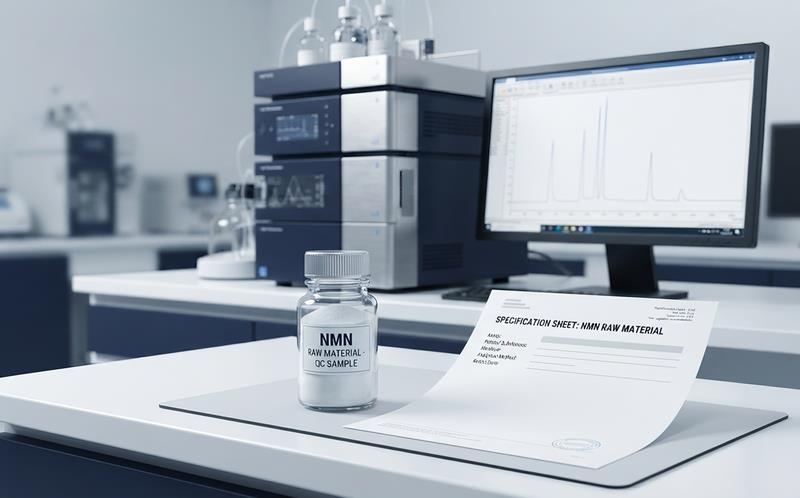
5. Review the COA, not just the specification
A specification tells you what the material is supposed to meet. A batch-specific Certificate of Analysis tells you what a particular lot was reported to meet.
That distinction is important.
Before approval, request a recent representative COA and check whether it includes:
- Product identification
- Batch or lot number
- Manufacturing or test date
- Assay result
- Relevant impurity or related-substance results
- Water or moisture, where applicable
- Microbiological testing, where applicable
- Residual solvents, where relevant
- Elemental impurities, where relevant
- Analytical methods or references to the applicable methods
- Manufacturer or testing laboratory information
The COA should also be traceable to the actual batch being supplied.
For regulated or quality-sensitive applications, supply-chain transparency and valid certificates of analysis are important elements of supplier qualification. The U.S. FDA, for example, has emphasized the importance of valid COAs, supply-chain transparency and identification of the original manufacturer in its guidance for bulk ingredients and excipients. [5]
6. Verify the source and batch traceability
A supplier’s name and a manufacturer’s name are not necessarily the same thing.
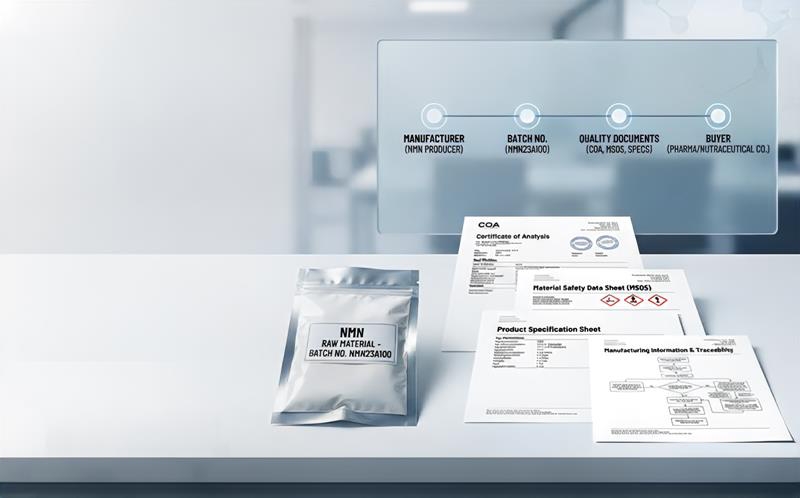
For trading and distribution channels, buyers should understand who actually manufactures the material, where it is produced, and how the supplied batch can be traced.
Useful questions include:
- Who is the original manufacturer?
- Where is the material manufactured?
- Is the quoted material manufactured by the same site shown on the documentation?
- Can the batch number be traced through the supply chain?
- Are manufacturing and packaging locations different?
- Can supporting quality documents be provided for the actual production batch?
This becomes particularly important when comparing multiple quotations. Two suppliers may appear to offer the same NMN at different prices while actually sourcing from different manufacturers or using different quality-control systems.
Traceability therefore helps turn a quotation into a verifiable supply proposition.
7. Compare the complete supply package, not only USD/kg
Once the technical information has been confirmed, price becomes much more useful.
Instead of asking only:
“Who offers the lowest price?”
compare:
material + specification + analytical method + documentation + stability support + traceability + lead time + MOQ + logistics.
For example, Supplier A may quote a lower price but provide only a basic COA. Supplier B may quote a higher price but provide a detailed specification, batch-specific COA, MSDS, manufacturing information and supporting stability data.
That does not automatically make Supplier B the right choice. The point is that the two offers should not be treated as equivalent until the underlying specifications and documentation have been compared.
This approach also helps avoid a common procurement problem: approving a low-priced sample and discovering later that the documentation or quality profile does not meet the requirements of the finished-product project.
What should buyers request before approving an NMN or NAD+ supplier?
A practical first-round document request can be kept relatively simple:
1. Product specification
2. Recent batch-specific COA
3. MSDS/SDS
4. Analytical method or method reference for assay and relevant impurities
5. Recommended storage conditions and shelf-life information
6. Manufacturing source and batch traceability information
7. Regulatory or market-specific documentation where applicable
Not every project requires every document at the same stage. The appropriate documentation depends on the intended use, target market and regulatory framework.
The key is to establish the technical baseline before comparing commercial offers.
Price is only meaningful after the material is defined
NMN and NAD+ are examples of why ingredient procurement should start with specification rather than price.
A lower quotation is not necessarily a problem, and a higher quotation is not necessarily better. What matters is whether the quoted materials are genuinely comparable in identity, assay, analytical methodology, impurity control, stability, documentation and traceability.
For newer ingredients, information quality is part of supply quality.
At Esubio, our Longevity & Cellular Health sourcing work focuses on ingredients such as NMN, NAD+ and related cellular-health actives. We work with supplier documentation including COA, MSDS and product specifications to help buyers establish the technical baseline before moving into commercial evaluation.
For emerging ingredients, the first question should not always be:
“What is your price?”
A better starting point is:
“What exactly are you supplying, how is it tested, and what documentation supports it?”
Once those questions are answered, the price comparison becomes much more meaningful.
References
PubMed — Degradation kinetics of β-nicotinamide mononucleotide based on reliable HPLC quantitative method
https://pubmed.ncbi.nlm.nih.gov/38212023/[2] PubMed — A Novel HPLC Method for Quality Inspection of NRK Biosynthesized β-Nicotinamide Mononucleotide
https://pubmed.ncbi.nlm.nih.gov/36617938/[3] PubMed — Aqueous LC-MS/MS quantification of α-/β-nicotinamide mononucleotide in dietary supplements
https://pubmed.ncbi.nlm.nih.gov/41545110/[4] ICH — Stability Testing of New Drug Substances and Products Q1A(R2)
https://database.ich.org/sites/default/files/Q1A%28R2%29%20Guideline.pdf[5] U.S. FDA — Know Your Bulk Drug Substances and Excipients Suppliers
https://www.fda.gov/drugs/human-drug-compounding/fda-compounders-know-your-bulks-and-excipients-suppliersAdditional reference — PubChem: β-Nicotinamide mononucleotide
https://pubchem.ncbi.nlm.nih.gov/compound/16219737