
Botanical Extract Quality: 7 Powerful Checks Beyond a 10:1 Ratio
Botanical Extract Quality cannot be judged by one number alone.
Yet “10:1,” “20:1,” or “50:1” is often one of the first things buyers see when comparing botanical extracts.
The number looks precise.
But what does it actually tell you?
A plant-to-extract ratio describes the relationship between the amount of starting botanical material and the amount of extract obtained. It can be useful for understanding how an extract was produced and, in some cases, for dosage calculations.
But it does not fully describe what is inside the finished extract.
Two botanical extracts can both be labeled 10:1 and still have meaningfully different chemical profiles.
That is why Botanical Extract Quality requires more information than an extract ratio.
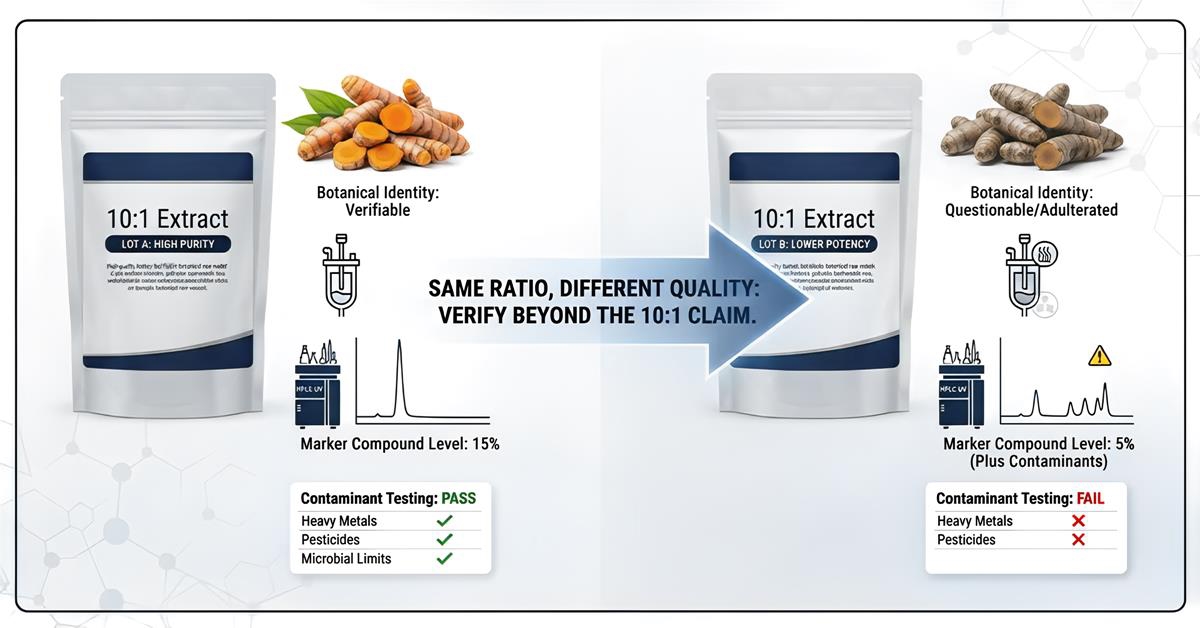
Why a 10:1 Extract Ratio Is Not Enough
A 10:1 ratio generally indicates that approximately 10 parts of starting botanical material were used to produce one part of extract, subject to how the ratio is defined and calculated.
It does not automatically tell you:
- Which plant species was used
- Which plant part was extracted
- Where the botanical material came from
- Which extraction solvent was used
- Which compounds are present
- How much of a relevant marker compound is present
- Which analytical method was used
- Whether excipients were added
- Whether the material meets the required contaminant limits
A technical review of plant-to-extract ratios published in Frontiers in Pharmacology notes that the ratio does not completely describe a botanical extract because starting material quality, extraction solvents, extraction temperature and duration, drying processes, and excipients can all influence the final composition.
So the important question is not:
“Is this extract 10:1?”
It is:
“What does the 10:1 extract actually contain, and how is that quality controlled?”
1. Check the Botanical Identity
The first step in assessing Botanical Extract Quality is confirming exactly what plant material you are buying.
The botanical name should be clear and, where relevant, should include the plant part used.
For example, “Ginseng Extract” provides much less information than a specification identifying the botanical species and plant part.
This matters because different species, subspecies, varieties, and plant parts can have different chemical profiles.
Identity can also require more than a name on a specification sheet.
Depending on the material and quality requirements, identification may involve macroscopic or microscopic examination, chemical testing, chromatographic methods, or other suitable analytical approaches.
WHO quality-control guidance for herbal materials includes identity testing and emphasizes that appropriate analytical methods should be selected for the material being evaluated.
For procurement teams, the practical question is simple:
Can the supplier clearly demonstrate what botanical material was actually used?
2. Look Beyond the Extract Ratio to Marker Compounds
An extract ratio tells you about the starting material-to-extract relationship.
A marker specification tells you more about the chemical characteristics of the finished ingredient.
For standardized botanical extracts, a specification may define one or more marker or characteristic constituents and establish a quantitative range.
This can be much more useful for comparing batches than an extract ratio alone.
For example, two suppliers may both offer a botanical extract described as 10:1.
Supplier A may specify a relevant marker compound at a defined percentage using a stated analytical method.
Supplier B may provide only “10:1” without any quantitative marker specification.
Those are not equivalent specifications.
USP-related guidance on botanical extracts also distinguishes between situations where active principles or marker compounds are known and situations where they are not. Where relevant, the content of identified active principles or marker compounds can be part of the extract description; the starting-material-to-final-product ratio is used when active principles are unknown.
This is one reason buyers should ask:
What exactly is standardized, and how is it measured?
3. Ask Which Analytical Method Is Used
A number without a method is difficult to evaluate.
Suppose a supplier states:
“Marker compound: 20%.”
The next question should be:
Measured by which method?
HPLC?
UV?
TLC?
Another validated analytical procedure?
The analytical method can affect how a result is generated and interpreted.
For botanical materials, chemical profiles can also be important because botanicals are complex mixtures rather than single purified compounds.
WHO guidance describes chemical profiling, including TLC/HPLC fingerprinting where appropriate, as part of botanical quality control and also recommends quantitative testing of chemical markers where applicable.
Therefore, a stronger botanical specification does not simply state a target number.
It connects:
Constituent → Specification → Analytical Method → Result
That connection makes the specification much more useful for quality evaluation.
4. Confirm the Plant Part, Origin, and Processing Information
Botanical variability can begin before extraction.
The plant species, plant part, geographic origin, agricultural conditions, harvesting, storage, and processing can all influence the starting material.
This is why “same plant + same ratio” does not necessarily mean “same extract.”
For higher-risk or more technically sensitive botanical ingredients, buyers may need more information about where the raw material comes from and how it is processed.
FDA’s botanical drug guidance, although written for botanical drug development rather than dietary supplement ingredients generally, illustrates this broader quality-control principle. It identifies botanical raw material information such as authenticity, agricultural practices, geographic location, collection, and processing methods as relevant to understanding botanical consistency.
For ingredient procurement, the lesson is not that every commercial botanical extract requires a pharmaceutical-level dossier.
The lesson is that raw-material information can matter when evaluating consistency and risk.
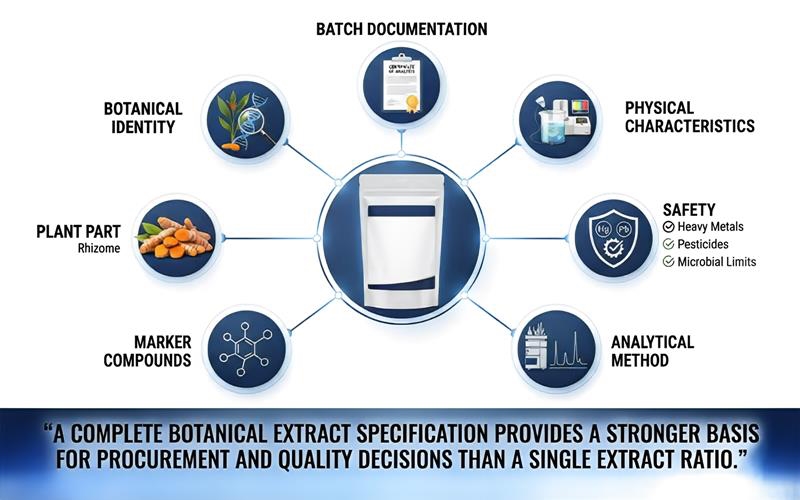
5. Review Safety and Contaminant Specifications
A botanical extract may meet its marker specification and still require additional quality checks.
Botanical materials can carry risks associated with agricultural production, environmental exposure, processing, storage, or contamination.
Depending on the ingredient and destination market, relevant specifications may include:
- Heavy metals
- Pesticide residues
- Microbiological limits
- Mycotoxins
- Residual solvents
- Foreign matter
- Other product-specific contaminants
WHO guidance on herbal material quality control specifically addresses testing for pesticide residues, arsenic and toxic heavy metals, microorganisms, aflatoxins, and other quality parameters.
The exact testing requirements should be determined according to the product, intended use, market, and applicable customer or regulatory requirements.
The important point is that Botanical Extract Quality is not only about potency or marker content.
It also includes purity and safety.
6. Check Whether the Specification Can Control Batch Consistency
This is where procurement and R&D often discover the limitations of an extract ratio.
Imagine that R&D approves a 10:1 botanical extract based on a successful sample.
Several months later, the next batch is also labeled 10:1.
But the color is different.
The aroma is different.
The marker level is lower.
The formulation behaves differently.
The buyer now has a problem.
The original specification may never have defined the parameters needed to control the differences.
A stronger specification should identify the characteristics that matter for the intended application.
Depending on the ingredient, that may include:
Identity → Marker/active constituents → Analytical method → Physical characteristics → Contaminant limits → Microbiological requirements → Packaging → Storage conditions
Not every botanical needs every parameter.
The right specification depends on the ingredient.
But the principle remains:
If a characteristic matters to product performance or quality, it should be defined and measurable whenever practical.
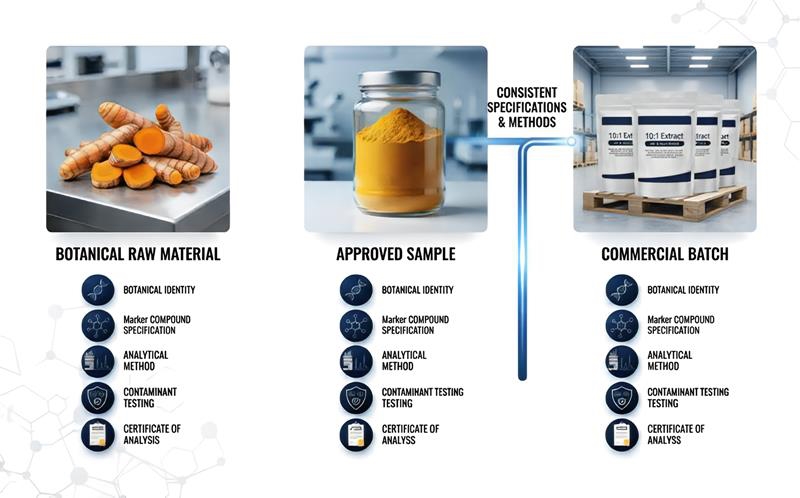
7. Compare the Sample and Commercial Batch Using the Same Specification
A successful sample does not automatically guarantee a successful commercial batch.
One reason is that the sample may have been evaluated using parameters that were never incorporated into the formal purchasing specification.
This creates a gap between:
What R&D approved
and
What procurement actually purchased.
To reduce this gap, the sample approval criteria and commercial specification should be aligned as closely as practical.
The same key identity requirements, marker specifications, analytical methods, physical characteristics, and safety parameters should be carried into the commercial supply process where appropriate.
The CoA for each commercial batch can then be reviewed against the agreed specification.
This makes the sample more than a one-time R&D exercise.
It becomes part of a controlled raw-material qualification process.
A Better Botanical Extract Specification
A useful botanical extract specification does not need to be unnecessarily complicated.
It needs to contain the information that actually controls the ingredient.
A practical framework is:
Botanical Identity
Scientific name, plant part, and relevant identification requirements.
Extract Description
Extract ratio or DER where applicable, extraction method or solvent information where relevant, and excipient information if applicable.
Standardization
Marker or active constituent and its specified range, where applicable.
Analytical Method
The method used to determine the specified constituent or quality parameter.
Safety Parameters
Relevant microbiological and contaminant limits.
Physical Parameters
Appearance, color, odor, particle size, moisture, or other application-specific characteristics where relevant.
Batch Documentation
CoA, specification, traceability information, and other agreed supporting documents.
The exact structure will vary from one botanical ingredient to another.
But this framework is far more informative than a single “10:1” statement.
From Extract Ratio to Transparent Botanical Sourcing
For buyers, the extract ratio is not useless.
It simply should not be treated as the complete definition of an extract.
A 10:1 ratio can provide useful information about the relationship between starting botanical material and finished extract.
But Botanical Extract Quality depends on a broader set of factors.
The plant identity matters.
The plant part matters.
The starting material matters.
The extraction process matters.
The marker compounds may matter.
The analytical method matters.
The contaminant limits matter.
And the batch documentation matters.
At Esubio, our Botanical Extracts sourcing approach focuses on complete specifications and transparent documentation rather than presenting an extract ratio as the whole quality story.
Depending on the product and supplier, documentation may include specifications, CoA, SDS/MSDS, testing reports, traceability information, and other available supporting documents.
Where market-specific documentation is relevant, requirements are confirmed according to the actual product, destination market, and available supplier documentation.
The objective is simple:
Give buyers enough information to evaluate a botanical extract before they commit to commercial supply.
Because when the only number you have is “10:1,” you may know how concentrated the starting material was.
You may still not know what you are buying.
The Bottom Line
A botanical extract specification should answer more than one question.
Not just:
“What is the extract ratio?”
But also:
“What plant is it?”
“Which part was used?”
“What does the extract contain?”
“How is it measured?”
“What contaminants are controlled?”
“Can the same specification be applied batch after batch?”
The more clearly these questions are answered, the easier it becomes for procurement, quality, and R&D teams to make informed sourcing decisions.
A 10:1 extract may be a starting point.
It should not be the finish line for evaluating Botanical Extract Quality.