
Ingredient Compatibility: 7 Powerful Checks to Prevent Costly Formulation Problems
Ingredient Compatibility is often overlooked when every individual raw material already meets its own specification.
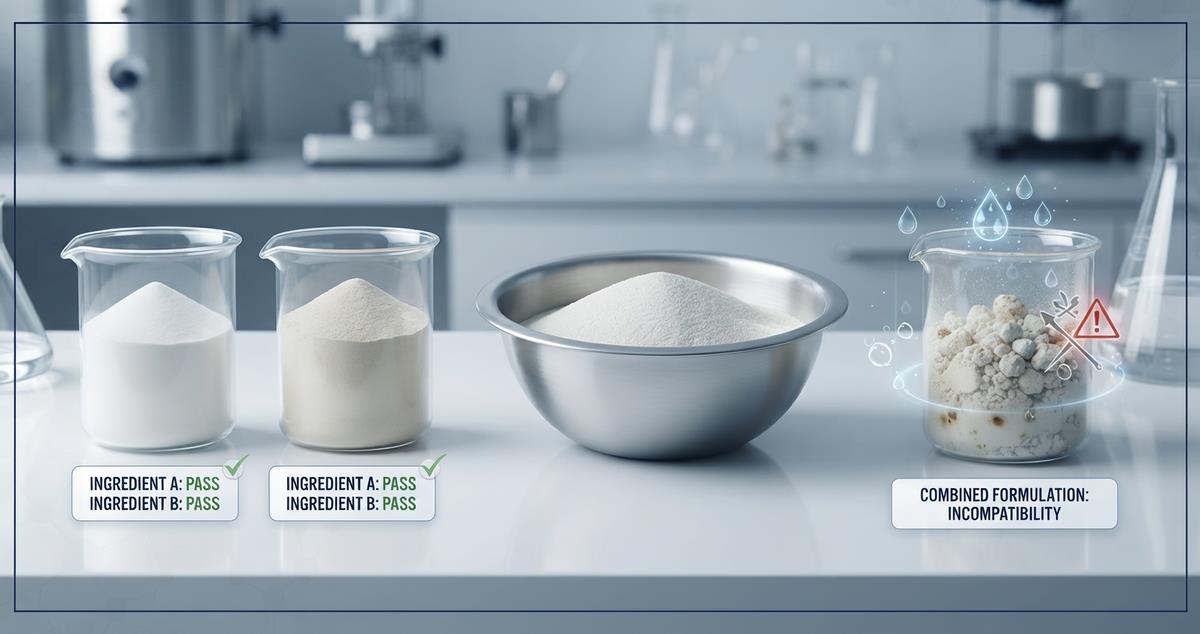
A botanical extract passes testing. An amino acid meets its purity requirement. A probiotic ingredient shows the expected viable count. A functional powder has acceptable moisture and particle size.
Then the ingredients are combined into one formulation—and something changes.
The powder starts absorbing moisture and forming lumps. The color gradually changes. The blend separates during handling. Solubility becomes inconsistent. An active ingredient loses stability during storage. A formulation that looked perfectly acceptable on paper becomes difficult to manufacture.
This is one of the less obvious challenges in multi-ingredient product development: individual raw-material quality does not automatically mean formulation compatibility.
Why Ingredient Compatibility Is Different From Raw Material Quality
A raw material is normally evaluated against its own specification.
That specification may include identity, assay, moisture, microbiological limits, particle size, heavy metals, residual solvents, or other parameters relevant to the material.
But a formulation creates a new environment.
Once several ingredients are combined, their physical and chemical properties can influence each other. Moisture can move between components. Different particle sizes can affect blend uniformity. Differences in density or flowability can cause segregation. A change in pH may affect another ingredient’s stability. Temperature, humidity, oxygen exposure, processing conditions, and packaging can further change the behavior of the finished blend.
This means a COA can confirm what an ingredient is and whether it meets its specification, but it cannot by itself prove that the ingredient will perform well inside every formulation.
That distinction is critical for developers working with probiotics, botanical extracts, amino acids, vitamins, minerals, functional powders, and multi-ingredient blends.
1. Check Moisture Sensitivity Before Combining Ingredients
Moisture is one of the most common sources of formulation problems.
Two powders may each meet their individual moisture specifications but behave differently when stored together.
For example, one ingredient may be relatively hygroscopic while another is sensitive to moisture. If the first ingredient absorbs water from the surrounding environment, it can change the local moisture conditions of the blend. The result may be caking, reduced flowability, changes in powder structure, or accelerated degradation of a moisture-sensitive component.
Water activity can also become relevant when the formulation contains ingredients with different moisture-management requirements.
This is why simply comparing the moisture values on individual COAs is not always enough.
For moisture-sensitive formulations, procurement and R&D teams should consider:
- Moisture content
- Water activity where relevant
- Hygroscopicity
- Recommended storage conditions
- Packaging requirements
- Expected exposure during manufacturing and transport
The question is not simply, “Does this ingredient have acceptable moisture?”
It is, “What happens when this ingredient shares the same formulation environment with the other components?”
2. Compare Particle Size, Density, and Powder Behavior
A blend can be chemically acceptable and still fail physically.
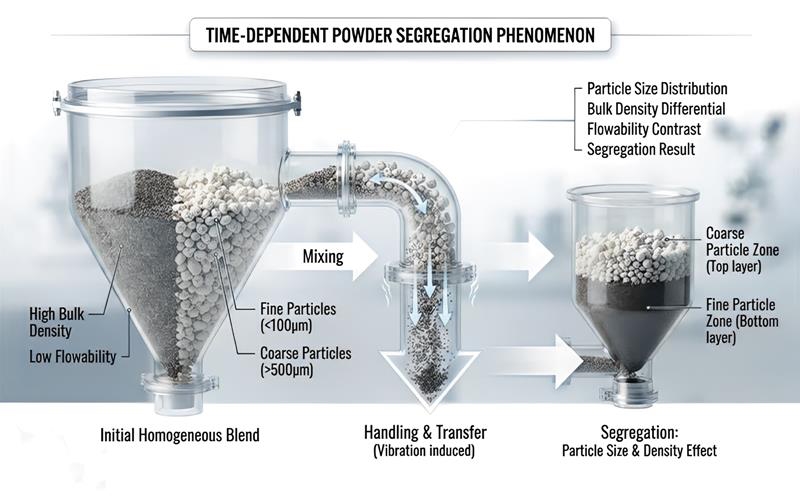
Particle size is particularly important for powders. When ingredients have substantially different particle-size distributions, shapes, densities, or flow properties, they may not remain uniformly distributed during mixing, transfer, filling, or transportation.
Powder segregation can occur through mechanisms such as sifting, rolling, or air entrainment. Research in pharmaceutical powder systems has shown that particle-size differences, density differences, powder flow properties, and equipment conditions can all contribute to segregation.
This matters well beyond tablets.
The same principle can affect:
- Powder sachets
- Capsules
- Stick packs
- Premixes
- Functional food powders
- Supplement blends
- Granulated products
A specification that says “powder” is therefore incomplete for many applications.
Depending on the formulation, it may be useful to compare particle-size distribution, mesh range, bulk density, tapped density, flow characteristics, and morphology across the major ingredients.
The objective is not necessarily to make every ingredient identical.
The objective is to understand whether their physical differences create a practical risk to blend uniformity.
3. Look for pH and Chemical Interaction Risks
Some compatibility problems are physical. Others are chemical.
An ingredient may be stable within a particular pH range but less stable outside it. Another component may change the local environment of the formulation after dissolution or during processing.
This can become important in liquid formulations, effervescent products, beverages, gummies, powders intended for reconstitution, and other systems where ingredients interact with water.
Potential questions include:
- Does one ingredient significantly change the pH?
- Could an acidic component affect another active?
- Are oxidation-sensitive ingredients present?
- Could minerals interact with other components?
- Does the formulation contain reducing or oxidizing substances?
- Are heat or water introduced during processing?
Not every combination will create a meaningful reaction, but the risk should be considered when the chemistry of the ingredients suggests a potential interaction.
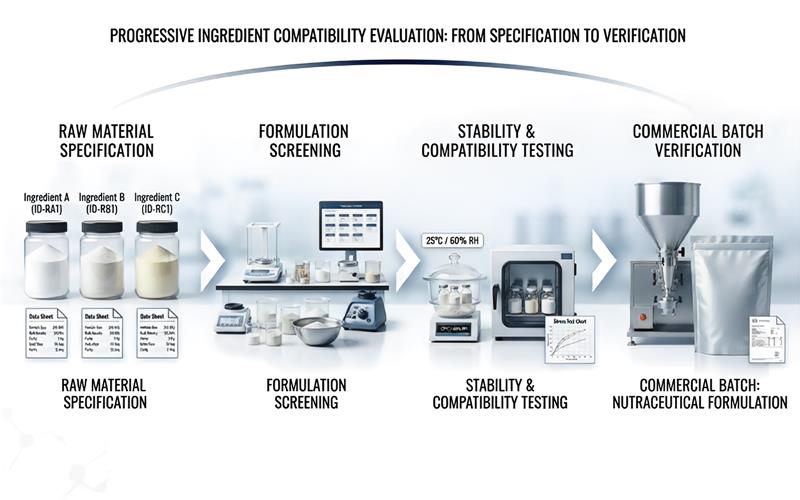
4. Evaluate Stability Under the Actual Formulation Conditions
An ingredient can be stable by itself but less stable after formulation.
For example, an active may remain acceptable under its recommended storage condition when packaged alone. Once combined with other ingredients, however, the formulation may have a different moisture environment, oxygen exposure, pH, physical structure, or microenvironment.
Stability therefore needs to be considered in context.
For products where stability is critical, development teams should evaluate relevant conditions such as:
- Temperature
- Relative humidity
- Light exposure
- Oxygen exposure
- Packaging configuration
- Storage duration
- Transportation conditions
Stability guidance commonly emphasizes evaluating the product under defined environmental conditions and considering the packaging system rather than treating stability as a single fixed property.
The exact study design depends on the product and market. The important point is that formulation stability should be evaluated on the actual formulation—not assumed from the individual ingredients.
5. Check Solubility and Dispersion Together
Solubility is another area where individual specifications can be misleading.
Two ingredients may each have acceptable solubility characteristics but behave differently when placed into the same system.
One component may dissolve quickly while another disperses slowly. A high concentration of one ingredient may alter the solution environment. Certain powders may form aggregates or sediment during reconstitution.
This is particularly important for:
- Powdered beverages
- Instant drinks
- Liquid supplements
- Water-soluble blends
- Effervescent formulations
- Functional drink mixes
Instead of asking only whether an ingredient is “water soluble,” it is often more useful to ask how it behaves under the actual formulation conditions.
Temperature, concentration, pH, mixing sequence, particle size, and the presence of other ingredients can all affect the final result.
6. Review the Manufacturing Process, Not Just the Formula
Ingredient compatibility does not stop at the formulation sheet.
The manufacturing process can introduce additional stress.
High-speed mixing, milling, granulation, compression, heat, moisture addition, long residence times, and repeated powder transfer can change how ingredients behave.
A blend that looks uniform immediately after mixing may segregate during transfer or filling. Conversely, a formulation that appears difficult to blend initially may become more stable after granulation or another processing step.
This is why formulation development should connect three elements:
Ingredient properties → processing conditions → finished-product performance.
Changing any one of these can change the overall behavior.
For procurement teams, this also means that “standard grade” is not always enough information. A particular particle size, density, solubility profile, or physical form may be more suitable for one manufacturing process than another.
7. Compare the Approved Sample With the Commercial Batch
One of the most practical Ingredient Compatibility checks happens before scale-up.
A development sample may perform well because its physical properties happen to fit the formulation.
But if the commercial batch has noticeably different particle size, bulk density, moisture, color, flowability, or other relevant characteristics, the formulation may behave differently.
This is why sample approval should not automatically mean the sourcing process is finished.
Before commercial production, it is useful to confirm:
- The commercial specification
- Key physical parameters
- Manufacturing or processing characteristics where relevant
- Packaging
- Storage conditions
- COA requirements
- Batch-to-batch consistency
- Any critical attributes identified during formulation testing
The goal is not to freeze every parameter unnecessarily.
The goal is to identify the parameters that actually matter to the formulation and control them consistently.
A Better Way to Think About Ingredient Compatibility
Ingredient Compatibility should not be treated as a simple pass-or-fail property attached to a raw material.
It is better understood as a relationship between:
Ingredient properties + formulation composition + processing + packaging + storage conditions.
This explains why the same ingredient can work extremely well in one product and create problems in another.
A botanical extract may be suitable for a capsule but require different specifications for a powdered beverage.
An amino acid with excellent purity may still need a particular particle-size range for a specific powder blend.
A probiotic ingredient may require tighter attention to moisture exposure and packaging than another functional ingredient.
The raw material itself has not necessarily changed.
The application has.
What Procurement Should Ask Before Buying
For a multi-ingredient formulation, procurement does not need to become the formulation scientist.
But procurement can ask better questions before placing the order.
Instead of asking only:
“What is the price per kilogram?”
consider asking:
“What specification is appropriate for this application?”
Useful information may include:
- Intended dosage form
- Target particle size
- Solubility requirement
- Moisture or water activity sensitivity
- Bulk density requirements
- Storage conditions
- Packaging format
- Required certifications or documentation
- Expected annual volume
- Sample-to-commercial batch consistency
This creates a much stronger connection between R&D requirements and sourcing decisions.
From Raw Material Sourcing to Application-Fit Sourcing
The purpose of sourcing is not simply to find an ingredient that passes a COA.
The more useful objective is to find an ingredient that fits the intended application and can remain consistent as the project moves from laboratory testing to commercial production.
At Esubio, we approach ingredient sourcing from the application side first.
For botanical extracts, amino acids, probiotics, postbiotics, fruit and vegetable powders, and functional blends, we discuss relevant requirements such as specification, particle size, solubility, storage conditions, documentation, and intended use before matching a suitable supply option.
We provide COA, MSDS, and product specifications with shipments as applicable.
This does not replace formulation compatibility testing. Final compatibility still needs to be verified within the customer’s own formulation, process, packaging, and storage conditions.
But understanding the application before sourcing can help identify obvious risks earlier—before they become expensive formulation problems.
The Bottom Line
A formulation can fail even when every individual raw material passes its own quality test.
That is because Ingredient Compatibility is not the same as individual ingredient quality.
Moisture sensitivity, particle size, density, solubility, pH, processing conditions, packaging, and batch consistency can all influence how multiple ingredients behave together.
For R&D teams, the lesson is to test the actual formulation environment.
For procurement teams, the lesson is to communicate the application before selecting the specification.
And for both, the goal is the same:
Do not buy a raw material only because it is qualified on paper. Make sure its critical properties make sense for the formulation in which it will actually be used.